Key Highlights
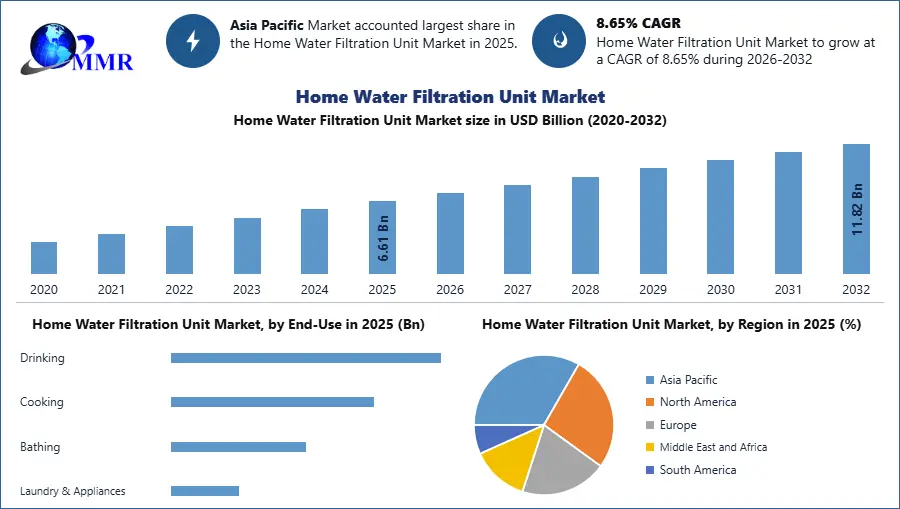
- Home Water Filtration Unit Market was valued at USD 6.61 billion in 2025 and is expected to reach USD 11.82 billion by 2032.
- The market is forecast to grow at a CAGR of 8.65% during 2026–2032.
- Whole-house water filtration units held 29.11% market share in 2025, making them the dominant segment.
- Asia Pacific is projected to grow at a CAGR of 9.06%, outpacing global expansion.
- Faucet filters are expected to achieve 64.44% absolute growth during the forecast period.
- Under-penetrated markets across Asia Pacific, South America, and the Middle East & Africa are creating new expansion opportunities.
Why This Matters Now
Water quality has become a strategic consumer issue rather than a household convenience. Rising concerns about contamination, aging water infrastructure, and increasing awareness of health risks are transforming residential filtration systems into essential home infrastructure investments.
At the same time, digital technologies are entering the category. Connected filtration systems, sensor-driven monitoring, predictive maintenance, and smart-home integration are changing how manufacturers compete. The result is a market that increasingly resembles the broader smart-appliance ecosystem rather than a traditional consumer goods category.
Market Overview
The Home Water Filtration Unit Market is entering a new phase of expansion as households prioritize water security alongside energy efficiency, air quality, and connected-home technologies. According to Maximize Market Research, the market was valued at USD 6.61 billion in 2025 and is projected to reach USD 11.82 billion by 2032, growing at a CAGR of 8.65%.
What changed is the perception of water filtration. Consumers increasingly view filtration systems as preventive health investments rather than optional appliances. That shift is expanding adoption across both developed and emerging markets.
Why now? Urbanization, declining potable water quality, and heightened consumer awareness have accelerated purchasing decisions. Manufacturers are responding with broader product portfolios that range from compact countertop systems to whole-house installations.
Who benefits? Equipment manufacturers, component suppliers, smart-home technology providers, retailers, and service providers all gain from a growing installed base that requires ongoing maintenance, filter replacement, and digital monitoring services.
Key Trends Driving Growth
The strongest trend shaping the market is the migration toward multi-stage filtration technologies. Consumers increasingly seek systems capable of addressing multiple contaminants simultaneously, creating demand for advanced purification platforms.
Another major shift is the growth of smart filtration. Connected systems capable of monitoring filter performance, water quality, and maintenance schedules are creating recurring engagement opportunities for manufacturers. These technologies align with broader smart-home adoption trends and create opportunities for subscription-based service models.
Product accessibility is also improving. Affordability, portability, and easier installation are expanding adoption beyond premium households. Faucet-mounted and under-sink systems are attracting consumers seeking effective purification without major home modifications.
Sustainability is emerging as a competitive differentiator. Manufacturers are increasingly focusing on efficient filtration designs, longer-lasting components, and reduced maintenance requirements to lower environmental impact and ownership costs.
Get a sample of the report: https://www.maximizemarketresearch.com/request-sample/165242/
Segment Insights
- Dominant Segment: Whole House Water Filtration Units
- Accounted for 29.11% of market share in 2025.
- Growth reflects increasing consumer preference for comprehensive water treatment across entire residential properties.
- Signals a shift toward infrastructure-style investments rather than point-of-use solutions alone.
- Fastest-Growing Segment: Faucet Filters
- Expected absolute growth of 64.44% during the forecast period.
- Adoption is supported by affordability, portability, and ease of installation.
- Particularly attractive for urban households and rental properties.
- Under-Sink Filtration Systems
- Adoption is accelerating through products offered by Aquasana, iSpring, and APEC.
- Compact designs align with space constraints in modern residential developments.
- Inline Filters
- Valued at USD 226.77 million in 2022.
- Increasing demand in emerging markets highlights opportunities for localized manufacturing and distribution strategies.
Regional Growth Story
Asia Pacific has become the market’s growth engine. The region is expected to expand at a CAGR of 9.06% through the forecast period.
Several structural factors explain this leadership. Rapid urbanization, growing middle-class populations, and increasing concerns about water quality are creating sustained demand across residential markets. The region also benefits from large under-penetrated consumer segments, providing manufacturers with substantial room for expansion.
South America is emerging as a secondary growth opportunity. Rising awareness of household water treatment and improving distribution networks are supporting adoption. Brazil and Mexico remain key markets for future expansion.
The Middle East and Africa also represent significant long-term opportunities. Water scarcity concerns and infrastructure challenges are increasing the relevance of residential purification technologies. As affordability improves, penetration rates are expected to rise across urban populations.
Competitive Landscape
Competition is increasingly shifting from hardware performance alone to ecosystem development.
Manufacturers are differentiating through product architecture, installation simplicity, maintenance economics, and service capabilities. The market’s evolution resembles broader smart-device industries, where long-term customer relationships often matter more than initial equipment sales.
The growing prominence of companies offering under-sink and whole-house solutions signals a move toward higher-value installations and recurring revenue streams. Brands investing in advanced filtration technologies, digital monitoring, and customer support infrastructures are strengthening competitive positioning.
Competitive leadership increasingly depends on three capabilities: technology innovation, channel reach, and service networks. Companies that successfully combine these elements gain pricing power while creating barriers to entry for lower-cost competitors.
Recent Developments
- Increased adoption of multi-stage countertop filtration systems is expanding household penetration.
- Under-sink technologies from Aquasana, iSpring, and APEC continue gaining traction in compact residential environments.
- Faucet-mounted filtration systems are benefiting from consumer demand for low-cost installation and portability.
- Manufacturers are targeting under-penetrated markets in Asia Pacific, South America, and the Middle East & Africa.
- Product innovation increasingly focuses on convenience, performance, and long-term maintenance efficiency.
Strategic Implications
For manufacturers, the opportunity extends beyond equipment sales. The growing installed base creates recurring revenue through filter replacements, maintenance programs, and digital monitoring services.
For investors, the market offers exposure to several long-term themes simultaneously: consumer health, smart-home adoption, sustainability, and infrastructure resilience.
For technology providers, connected filtration systems create opportunities to integrate sensors, data analytics, and predictive maintenance capabilities into residential environments.
For supply chains, localization strategies will become increasingly important. Companies capable of aligning product portfolios with regional water-quality requirements can capture greater market share while improving operational efficiency.
Future Outlook
The next phase of competition will be defined by intelligent filtration platforms rather than standalone purification hardware. As consumers increasingly demand connected, efficient, and comprehensive water treatment solutions, the companies that combine advanced filtration science with digital service ecosystems will define the industry’s future, while manufacturers that remain focused solely on commodity hardware risk losing relevance.
Analyst Perspective
“The Home Water Filtration Unit Market is transitioning from a product-driven industry to a technology-enabled service ecosystem. Growth opportunities are increasingly concentrated in under-penetrated regions, while innovation around smart monitoring, convenience, and comprehensive filtration will determine future competitive leadership,” — Rucha Deshpande
About Maximize Market Research:
Maximize Market Research is a multifaceted market research and consulting company with professionals from several industries. Some of the industries we cover include medical devices, pharmaceutical manufacturers, science and engineering, electronic components, industrial equipment, technology and communication, cars and automobiles, chemical products and substances, general merchandise, beverages, personal care, and automated systems. To mention a few, we provide market-verified industry estimations, technical trend analysis, crucial market research, strategic advice, competition analysis, production and demand analysis, and client impact studies.
Contact Maximize Market Research:
3rd Floor, Navale IT Park, Phase 2
Pune Banglore Highway, Narhe,
Pune, Maharashtra 411041, India
sales@maximizemarketresearch.com
+91 96071 95908, +91 9607365656
