Key Highlights
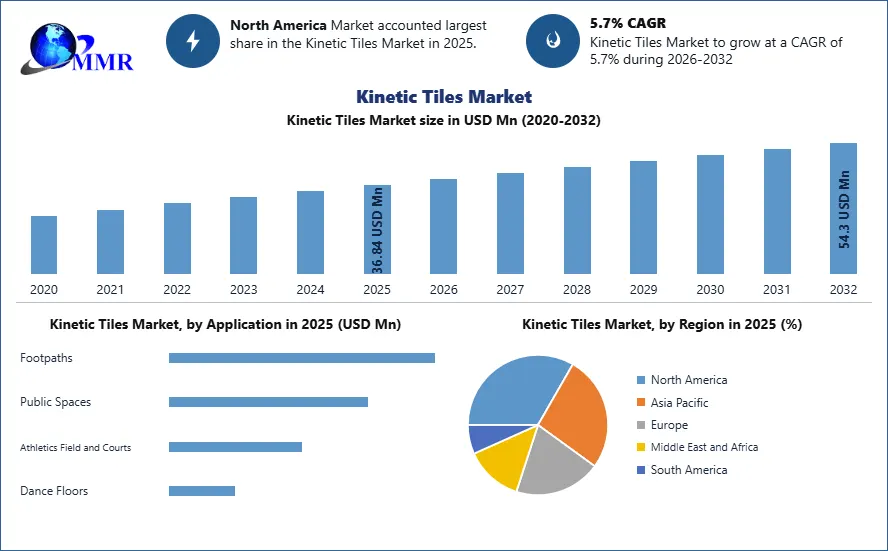
The Kinetic Tiles Market was valued at USD 36.84 million in 2025.
The market is projected to reach nearly USD 54.3 million by 2032.
The industry is expected to expand at a CAGR of 5.7% from 2026 to 2032.
Growth is being driven by demand for innovative flooring solutions.
Smart city initiatives are creating new deployment opportunities.
Infrastructure development projects are expanding the addressable market.
Public spaces, transportation hubs, and retail environments remain key application areas.
Competition is centered on product innovation and portfolio expansion.
Why This Matters Now
Every infrastructure operator is searching for ways to make assets work harder. Kinetic tiles are transforming a simple floor surface into an energy-generating and interactive platform.
That shift arrives at a critical moment. Governments, city planners, transit authorities, and commercial property owners face growing pressure to improve sustainability outcomes while enhancing user experience. The Kinetic Tiles Market sits at the intersection of both objectives.
According to Maximize Market Research, the market is expected to grow from USD 36.84 million in 2025 to nearly USD 54.3 million by 2032, reflecting a CAGR of 5.7%. The implication is clear: energy-harvesting flooring is moving beyond pilot projects and becoming part of broader infrastructure planning.
Market Overview
Kinetic tiles Market represent a relatively new category within the smart infrastructure ecosystem. These systems use motion-activated technology to generate responses when people walk across them. In many deployments, the flooring becomes both a functional surface and an engagement tool.
The technology has gained attention because it aligns with multiple investment priorities at once. Infrastructure owners want sustainable solutions. Cities want smarter public environments. Commercial operators want differentiated customer experiences.
The result is a market that is attracting increasing attention despite its relatively modest size. Growth is being supported by rising adoption of smart city concepts, expanding infrastructure investments, and demand for innovative flooring technologies.
Unlike traditional construction materials, kinetic tiles offer a technology layer that can contribute to broader digital infrastructure goals. That positioning is helping the category gain visibility among public and private sector stakeholders.
Key Trends Driving Growth
One major trend is the increasing integration of technology into physical infrastructure. Flooring is no longer viewed solely as a construction component. It is increasingly being considered part of a connected environment.
Another trend is the expansion of smart city programs. As cities invest in intelligent transportation systems, digital public spaces, and sustainable infrastructure, technologies capable of supporting these objectives gain relevance.
Infrastructure modernization is also creating momentum. New transit facilities, public gathering spaces, and commercial developments provide opportunities to incorporate emerging technologies during the design phase rather than as retrofits.
The growing demand for interactive experiences is another market catalyst. Public and commercial venues increasingly seek technologies that engage users while delivering operational value.
Importantly, the market benefits from alignment with sustainability goals. Energy-harvesting technologies fit naturally within broader conversations around resource efficiency and smarter urban environments.
Explore the latest market dynamics—grab your free sample and uncover key insights today
Segment Insights
By Floor Mechanism
Piezoelectric
Magnetic
Generators
Static
By Shape
Triangle
Square
By Application
Footpaths
Public Spaces
Athletics Field and Courts
Dance Floors
Dominant Segment
Not specified in the source report.
Fastest-Growing Segment
Not specified in the source report.
The segmentation structure itself provides important insight. The market is evolving across multiple technology pathways rather than converging around a single mechanism. This suggests that innovation remains active and the industry is still exploring optimal performance models.
Applications are also diversified. Deployment opportunities range from transportation and public infrastructure settings to recreational and entertainment environments. Such diversity reduces dependence on any single end-use market.
Regional Growth Story
The Kinetic Tiles Market spans North America, Europe, Asia Pacific, the Middle East and Africa, and South America.
North America remains an important market because of its focus on technology adoption and infrastructure modernization. Large-scale transportation networks and commercial facilities create potential deployment environments for kinetic flooring systems.
Europe continues to benefit from sustainability-focused urban development strategies. Public infrastructure projects and smart city initiatives support demand for technologies that combine functionality with environmental objectives.
Asia Pacific represents a significant long-term opportunity due to rapid urban development and ongoing investment in infrastructure. As cities expand and transportation networks evolve, demand for innovative construction technologies is expected to increase.
The Middle East and Africa, along with South America, offer emerging opportunities linked to infrastructure investment and modernization programs.
Regional competition will likely intensify as cities increasingly prioritize technologies capable of supporting both sustainability objectives and digital transformation goals.
Competitive Landscape
The report describes the global market as highly competitive. That characterization is significant because it indicates that companies are competing not only on product performance but also on innovation speed.
Two companies identified in the report are Swisstrax Corporation and Pavegen Systems Ltd.
The emphasis on continuous innovation signals an industry that remains in an expansion phase rather than a consolidation phase. Companies are actively broadening their product offerings to address changing customer requirements.
For competitors, this means standing still is not an option. Product differentiation, technology enhancements, and application-specific solutions are likely to become more important over the next 12 to 24 months.
The broader signal for the market is clear: competitive advantage will increasingly depend on demonstrating practical value within real-world infrastructure environments. Companies capable of translating technology into measurable outcomes are likely to capture greater attention from project developers and public-sector buyers.
Recent Developments
Companies continue to innovate to maintain competitiveness.
Market participants are expanding product portfolios.
Smart city adoption is creating new commercial opportunities.
Infrastructure development projects are increasing potential deployment locations.
Demand for innovative flooring solutions continues to support industry expansion.
Strategic Implications
For infrastructure developers, kinetic tiles represent an opportunity to introduce technology-enabled functionality into traditional construction projects.
For city planners, the technology aligns with broader smart city objectives. It creates a pathway to combine infrastructure investment with digital engagement and sustainability goals.
For commercial property operators, kinetic flooring can help differentiate environments while supporting innovation-focused brand positioning.
For investors, the market’s projected growth indicates increasing acceptance of energy-harvesting infrastructure concepts. While the market remains relatively specialized, its connection to major investment themes—including smart cities, sustainability, and infrastructure modernization—strengthens its strategic relevance.
Future Outlook
The next phase of market development will likely be shaped by infrastructure spending priorities, smart city deployment rates, and the industry’s ability to demonstrate practical returns from kinetic flooring installations.
Growth from USD 36.84 million in 2025 to nearly USD 54.3 million by 2032 signals steady momentum rather than speculative expansion. That distinction matters because sustainable growth often creates stronger long-term market foundations.
The companies that successfully connect energy harvesting, infrastructure modernization, and user engagement will define the next chapter of the industry, while those that fail to prove measurable value risk being left behind as smart infrastructure investment accelerates.
Analyst Perspective
“The Kinetic Tiles Market is entering a period where infrastructure innovation and smart city investment are increasingly aligned. Organizations that integrate interactive and energy-harvesting technologies into public and commercial environments will be better positioned to capitalize on emerging growth opportunities.” — Siddhi Dole, Analyst
About Maximize Market Research
Maximize Market Research Pvt. Ltd. (MMR) is a global market research and consulting company that provides reliable, data-focused, and practical business insights. The firm serves a wide range of industries, including healthcare, pharmaceuticals, technology, automotive, electronics, chemicals, personal care, and consumer goods. Through market forecasts, competitive analysis, strategic consulting, and industry impact assessments, MMR helps organizations understand changing market conditions, identify growth opportunities, and make informed business decisions for long-term success.
Contact Us
2nd Floor, Navale IT Park Phase 3
Pune Banglore Highway, Narhe
Pune, Maharashtra 411041, India
+91 9607365656
sales@maximizemarketresearch.com
