Key Highlights
- Growing adoption of contactless payment technologies is accelerating wearable payment device deployment.
- Smartwatches and fitness trackers continue to drive device innovation and consumer adoption.
- NFC-enabled payment functionality remains a key technology enabler.
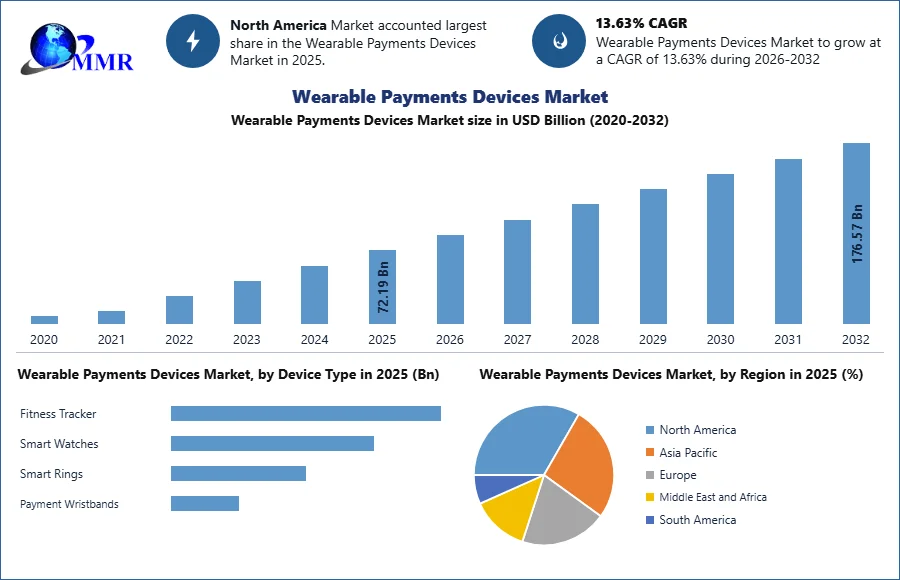
- North America maintains leadership due to strong technology adoption and established payment infrastructure.
- India is emerging as a major growth opportunity supported by expanding digital payment ecosystems and rising wearable shipments.
- Partnerships between payment providers, banks, and wearable manufacturers are reshaping competitive dynamics.
- Security technologies, tokenization platforms, and embedded payment capabilities are becoming critical product differentiators.
Why This Matters Now
The payments industry is undergoing a structural shift toward frictionless transactions. Consumers increasingly expect authentication, connectivity, and payment functionality to be integrated into everyday devices.
For semiconductor suppliers, this shift translates into rising demand for NFC chips, secure elements, wireless connectivity solutions, sensors, power-management ICs, and embedded security architectures. Every wearable payment device requires a combination of processing, connectivity, authentication, and energy-efficiency technologies, expanding opportunities throughout the semiconductor ecosystem.
At the same time, governments and financial institutions continue investing in digital payment infrastructure, creating favorable conditions for widespread adoption of payment-enabled wearables. The result is a market that extends beyond consumer electronics into banking, fintech, mobility, retail, and public transportation ecosystems.
Market Overview
Wearable payment devices allow users to conduct transactions directly through connected wearable products such as smartwatches, fitness trackers, and payment wristbands. The technology eliminates the need for physical cards or smartphones during transactions while delivering speed, convenience, and security.
Market momentum is being fueled by the rapid adoption of contactless payment technologies and the growing acceptance of cashless transactions worldwide. According to the MMR report, expanding consumer demand for seamless payment experiences continues to drive adoption across multiple regions and end-user segments.
The market’s evolution also aligns with broader technology trends, including IoT expansion, edge computing adoption, connected-device ecosystems, and increasing consumer reliance on smart devices for daily activities.
Key Trends Driving Growth
One of the most significant changes is the convergence of financial services and consumer electronics. Wearable manufacturers are no longer competing solely on health monitoring or lifestyle functionality. Payment capabilities are becoming a core value proposition.
NFC technology remains central to this transformation. The technology enables secure, low-latency transactions while maintaining the compact form factors consumers expect from wearables. This trend creates sustained demand for advanced semiconductor components that balance performance, security, and energy efficiency.
Another major development is the increasing integration of tokenization and digital security technologies. As payment transactions move onto wearable devices, cybersecurity becomes a competitive differentiator. Device makers that can combine convenience with robust security gain stronger consumer trust and greater ecosystem adoption.
The rapid growth of digital payments in emerging economies is also reshaping market dynamics. Countries investing heavily in digital payment infrastructure are creating favorable environments for wearable payment adoption, particularly where smartphone penetration and digital banking services are expanding simultaneously.
AI-enabled wearables represent another emerging opportunity. While payment functionality remains the primary feature, next-generation devices increasingly integrate health monitoring, contextual intelligence, personalization, and predictive services. This broadens the role of wearables within connected consumer ecosystems and creates additional semiconductor demand.
Segment Insights
- Dominant Segment: Smartwatches remain the leading commercial category due to their ability to combine communication, health monitoring, lifestyle functionality, and payment capabilities within a single device.
- Fastest-Growing Segment: Advanced payment-enabled wearable formats, including next-generation connected wearables, are gaining momentum as consumers seek frictionless and always-available transaction experiences.
- NFC-enabled devices continue to represent a critical technology category because of their widespread compatibility with contactless payment infrastructure.
- Fitness-focused wearables remain important growth contributors as payment functionality becomes increasingly integrated into health and wellness ecosystems.
The strategic significance of these segments extends beyond consumer convenience. Each new device category increases demand for sensors, wireless modules, secure processors, memory components, and low-power semiconductor architectures.
Regional Growth Story
North America continues to lead the market due to strong consumer acceptance of contactless payments, advanced payment infrastructure, and the presence of major technology and payment ecosystem participants.
Asia-Pacific is becoming increasingly important as wearable adoption and digital payment penetration accelerate simultaneously. Markets such as India are demonstrating particularly strong momentum as consumers embrace both wearable technology and cashless payment systems.
India’s wearable ecosystem is attracting attention because of rapid smartwatch adoption and collaboration among electronics manufacturers, banks, and payment providers. The combination of digital payment infrastructure development and expanding consumer electronics adoption creates favorable conditions for wearable payment deployment.
China, South Korea, Japan, and Taiwan also remain strategically important due to their positions within global electronics manufacturing and semiconductor supply chains. These regions influence component production, device innovation, manufacturing scalability, and technology commercialization.
Europe remains a key market because of mature digital payment ecosystems, regulatory frameworks supporting secure transactions, and high consumer acceptance of contactless technologies.
Competitive Landscape
Competition is increasingly centered on ecosystem control rather than hardware alone.
Technology leaders are building integrated platforms that connect wearable devices, payment networks, banking services, and consumer applications. This strategy strengthens customer retention while creating barriers to entry for competitors lacking ecosystem scale.
Partnerships between wearable manufacturers, financial institutions, and payment providers signal a broader industry shift toward platform-based competition. Companies capable of integrating payment services directly into consumer experiences gain advantages in adoption, transaction volume, and customer engagement.
For semiconductor suppliers, this competitive environment creates opportunities in secure payment chips, embedded authentication technologies, wireless connectivity solutions, and ultra-low-power processing platforms. As payment functionality becomes standard across wearable categories, component innovation becomes increasingly important.
The market also highlights the growing importance of software-defined capabilities. Future leadership will depend not only on device hardware but also on security frameworks, tokenization technologies, digital identity systems, and ecosystem interoperability.
Get a sample of the report: https://www.maximizemarketresearch.com/request-sample/94746/
Recent Developments
- Banks, payment networks, and wearable manufacturers continue expanding strategic partnerships.
- Payment functionality is increasingly integrated into smartwatches and fitness-oriented devices.
- NFC-based transaction capabilities are becoming standard across premium wearable categories.
- Digital payment infrastructure expansion is supporting adoption across emerging markets.
- Security-focused innovations and tokenization technologies are strengthening consumer confidence in wearable payments.
Strategic Implications
The Wearable Payment Device Market has become a proxy for broader shifts occurring across digital commerce and connected electronics.
For semiconductor companies, growth opportunities extend beyond payment functionality itself. Demand is increasing for secure processors, wireless communication chips, sensors, memory technologies, and integrated system-on-chip architectures.
For OEMs, differentiation will depend on balancing convenience, security, battery efficiency, and ecosystem integration. For investors, the market provides exposure to multiple growth themes simultaneously, including digital payments, IoT adoption, wearable computing, and connected consumer electronics.
Supply-chain resilience is also becoming more important. Manufacturers capable of securing critical semiconductor components and scaling production efficiently will be better positioned to capture market share as adoption accelerates.
Future Outlook
The next phase of growth will be defined by deeper integration between wearable devices, digital identity platforms, AI-enabled personalization, and real-time payment ecosystems. As payment functionality becomes a standard feature across connected devices, competitive advantage will increasingly depend on secure semiconductor innovation, ecosystem scale, and the ability to transform every wearable into an intelligent transaction endpoint—separating future technology leaders from companies that remain tied to traditional payment models.
Analyst Perspective
“The Wearable Payment Device Market is entering a phase where payments, connectivity, security, and consumer electronics innovation are converging. Companies that successfully integrate secure transaction capabilities into broader digital ecosystems will be best positioned to capture long-term value across both the electronics and financial technology sectors.” — Rucha Deshpande
About Maximize Market Research:
Maximize Market Research is a multifaceted market research and consulting company with professionals from several industries. Some of the industries we cover include medical devices, pharmaceutical manufacturers, science and engineering, electronic components, industrial equipment, technology and communication, cars and automobiles, chemical products and substances, general merchandise, beverages, personal care, and automated systems. To mention a few, we provide market-verified industry estimations, technical trend analysis, crucial market research, strategic advice, competition analysis, production and demand analysis, and client impact studies.
Contact Maximize Market Research:
3rd Floor, Navale IT Park, Phase 2
Pune Banglore Highway, Narhe,
Pune, Maharashtra 411041, India
sales@maximizemarketresearch.com
+91 96071 95908, +91 9607365656
