Key Highlights
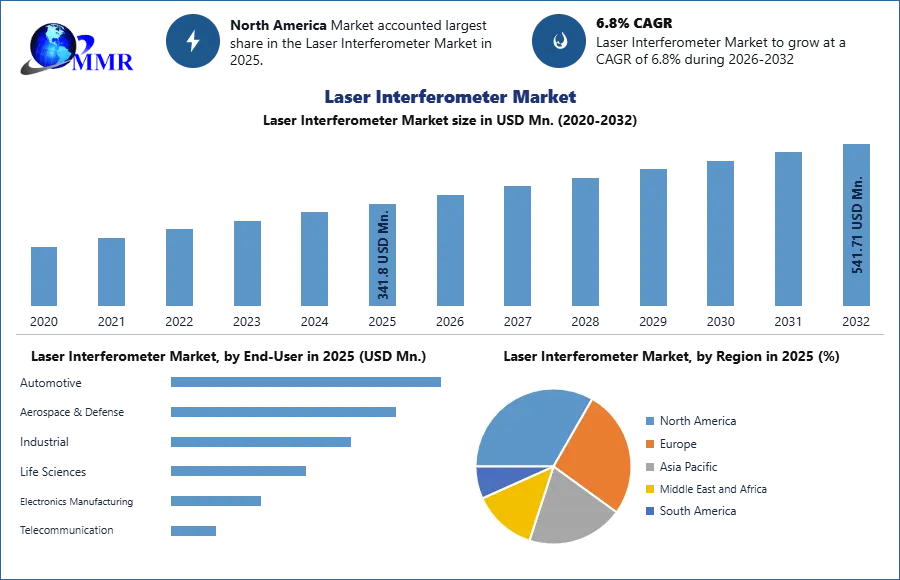
- Laser Interferometer Market reached USD 341.8 million in 2025 and is forecast to reach USD 541.71 million by 2032 at a CAGR of 6.8%. The expansion signals rising investment in precision manufacturing and advanced inspection systems.
- Growing demand from automotive, aerospace, electronics manufacturing, telecommunications, and industrial sectors is expanding deployment of laser-based metrology platforms.
- Semiconductor detection remains a core application area as chipmakers pursue tighter process tolerances and higher yields.
- Asia-Pacific continues to benefit from manufacturing expansion, automation initiatives, and quality-control investments.
- Rising adoption of 3D metrology is increasing demand for high-accuracy, non-contact measurement technologies across advanced manufacturing environments.
Why This Matters Now
The semiconductor industry is entering a phase where measurement precision has become a competitive weapon. AI accelerators, advanced packaging architectures, high-bandwidth memory integration, and increasingly complex chip designs are pushing manufacturing tolerances to unprecedented levels.
Every additional nanometer of accuracy influences yield, performance, and production economics. As governments invest in semiconductor sovereignty, foundries expand capacity, and electronics manufacturers automate production lines, laser interferometers are becoming critical infrastructure rather than optional inspection tools. The companies that control precision metrology increasingly influence who can scale advanced manufacturing efficiently.
Market Overview
The Laser Interferometer Market is expanding as manufacturers seek higher precision, stronger quality assurance, and faster throughput across industrial production systems. The market reached USD 341.8 million in 2025 and is expected to climb to USD 541.71 million by 2032. This growth reflects increasing demand for advanced measurement technologies capable of supporting modern production requirements.
Laser interferometers are used to measure extremely small dimensions, calibrate equipment, verify alignment, inspect surface quality, and monitor manufacturing accuracy. Their role is becoming increasingly important as industries move toward automated production, digital quality control, and smart factory operations.
The shift toward precision-driven manufacturing is no longer limited to aerospace and scientific laboratories. Electronics manufacturing, semiconductor production, telecommunications infrastructure, and industrial automation are creating broader commercial demand for advanced optical metrology systems.
Get a sample of the report: https://www.maximizemarketresearch.com/request-sample/165246/
Key Trends Driving Growth
One of the strongest growth catalysts is the expansion of automated quality-control systems. Manufacturers increasingly require real-time verification and traceable measurement capabilities to reduce defects and improve consistency. Laser interferometry provides the measurement confidence required for automated production environments.
The rise of 3D metrology represents another major shift. Industries including aerospace, defense, automotive, electronics, medical devices, and heavy machinery are adopting three-dimensional measurement systems to improve inspection accuracy and accelerate production validation. Laser interferometers play a central role in generating precise measurement data for these workflows.
Semiconductor manufacturing is creating an additional layer of opportunity. Advanced chips require increasingly sophisticated process control, wafer inspection, positioning systems, and calibration technologies. Precision metrology is becoming essential for maintaining yields as device geometries shrink and packaging complexity increases.
Innovation within interferometry itself is also reshaping market dynamics. Developments such as phase-shifting Fizeau interferometry and spatiotemporal phase-shifting methods are improving measurement stability, reducing errors, and increasing confidence in precision inspection. These advances expand applicability across more industrial use cases.
Segment Insights
- Dominant Segment (Type): Heterodyne Laser Interferometers – The segment benefits from high sensitivity and suitability for demanding industrial, telecommunications, and manufacturing applications.
- Fastest-Growing Segment (Application): Semiconductor Detection – Semiconductor manufacturing increasingly requires ultra-precise measurement and process control, creating significant demand for advanced interferometric technologies.
- Surface topology applications continue to account for significant demand due to their role in precision inspection and manufacturing quality assurance.
- Electronics manufacturing is emerging as a strategic end-user category as manufacturers invest in automation, smart factories, and advanced quality-control infrastructure.
- Aerospace and defense remain important adopters because of stringent performance requirements and traceable measurement standards.
Regional Growth Story
Asia-Pacific is positioned at the center of industry expansion. The region benefits from manufacturing investments, growing electronics production, automotive demand, and increasing automation across industrial facilities. Companies are expanding manufacturing operations and strengthening global production networks throughout the region.
China, Japan, South Korea, Taiwan, and India continue to strengthen their roles within global electronics and semiconductor ecosystems. As semiconductor fabrication capacity expands and advanced electronics production scales, demand for high-precision metrology tools is expected to rise alongside manufacturing investments.
North America remains strategically important because of advanced semiconductor manufacturing, aerospace leadership, and strong R&D investment. Government-backed semiconductor initiatives and advanced manufacturing programs are likely to reinforce demand for precision inspection technologies.
Europe maintains relevance through industrial automation, automotive engineering, aerospace manufacturing, and precision engineering expertise. Germany, in particular, benefits from its strong advanced-manufacturing base and emphasis on quality-driven production systems.
Competitive Landscape
Competition is increasingly centered on measurement accuracy, software integration, automation compatibility, and application-specific innovation rather than hardware alone.
In 2022, 4D Technology Corporation introduced a new member of its PhaseCam dynamic interferometer family along with enhanced analysis software. The move signals a broader market transition toward intelligent metrology systems capable of operating in environments involving vibration, motion, turbulence, and complex production conditions.
Leading vendors are investing heavily in R&D to improve accuracy, reduce uncertainty, and expand application flexibility. This reflects customer demand for systems that can integrate directly into automated manufacturing workflows and digital quality-control architectures.
The competitive battleground increasingly overlaps with semiconductor readiness. Vendors that deliver higher throughput, AI-compatible analytics, real-time measurement capabilities, and integration with smart-factory platforms are likely to strengthen pricing power and ecosystem influence. Companies unable to support advanced manufacturing requirements risk being displaced as industrial customers modernize production environments.
Recent Developments
- 4D Technology Corporation launched a new PhaseCam dynamic interferometer and 4Sight Focus Acquisition and Analysis Software.
- Industry investment continues to focus on advanced 3D metrology capabilities for precision inspection and manufacturing validation.
- Development of spatiotemporal phase-shifting methods is improving measurement stability and reducing periodic errors.
- Manufacturers are expanding R&D efforts to create more accurate and cost-effective interferometric measurement solutions.
Strategic Implications
The market is becoming strategically linked to semiconductor competitiveness, industrial automation, and advanced manufacturing resilience. Precision metrology increasingly determines production efficiency, yield optimization, and product quality.
For semiconductor manufacturers, laser interferometry supports tighter process control and improved fabrication accuracy. For electronics OEMs, it enables more reliable quality assurance and accelerated product development cycles. For investors, the sector represents exposure to a foundational technology layer supporting broader AI, automation, and digital manufacturing growth trends.
The biggest opportunity lies at the intersection of optical metrology, AI-enabled manufacturing analytics, and smart-factory deployment. Vendors that combine measurement accuracy with software intelligence may capture disproportionate value as manufacturing ecosystems digitize.
Future Outlook
Laser interferometers are evolving from standalone measurement instruments into connected production assets embedded across semiconductor fabs, electronics manufacturing facilities, and automated industrial environments. As advanced packaging, AI computing infrastructure, and next-generation electronics demand tighter tolerances, precision metrology will move closer to the center of manufacturing strategy.
The next industry divide will not be between companies that manufacture chips and those that do not—it will be between manufacturers that can measure, control, and optimize at nanometer-scale precision and those that cannot.
Analyst Perspective
“Laser interferometry is becoming a strategic enabler for advanced manufacturing, semiconductor quality control, and industrial automation. As manufacturers pursue higher precision and digitalized production environments, demand for accurate, real-time metrology solutions will continue to strengthen across global industries.” — Rucha Deshpande
About Maximize Market Research:
Maximize Market Research is a multifaceted market research and consulting company with professionals from several industries. Some of the industries we cover include medical devices, pharmaceutical manufacturers, science and engineering, electronic components, industrial equipment, technology and communication, cars and automobiles, chemical products and substances, general merchandise, beverages, personal care, and automated systems. To mention a few, we provide market-verified industry estimations, technical trend analysis, crucial market research, strategic advice, competition analysis, production and demand analysis, and client impact studies.
Contact Maximize Market Research:
3rd Floor, Navale IT Park, Phase 2
Pune Banglore Highway, Narhe,
Pune, Maharashtra 411041, India
sales@maximizemarketresearch.com
+91 96071 95908, +91 9607365656
