Key Highlights
- Rising health and fitness awareness is accelerating demand for sports equipment and apparel.
- Equipment remains the dominant product segment.
- Apparel is emerging as the fastest-growing product category.
- Offline retail continues to lead distribution despite growing digital engagement.
- Outdoor sports activities are gaining momentum faster than several traditional categories.
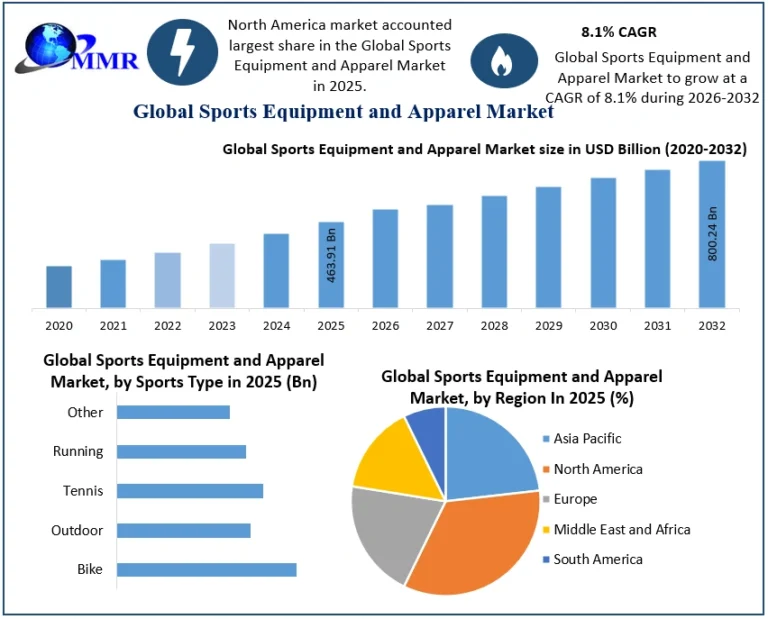
- North America remains the leading regional market.
- Product launches, acquisitions, and collaborations are intensifying competitive pressure.
- Global brands are investing aggressively in performance innovation and consumer engagement.
Why This Matters Now
Consumer demand is shifting faster than many sports brands expected. Fitness is no longer a niche activity. It has become a lifestyle decision influencing purchasing behavior across equipment, apparel, and athletic accessories.
For executives, the challenge is no longer whether demand exists. The challenge is capturing growth before competitors lock in consumer loyalty through innovation, distribution strength, and brand relevance. The Sports Equipment and Apparel Market is increasingly becoming a contest of speed, digital reach, and product differentiation.
Market Overview
The Sports Equipment and Apparel Market is benefiting from a powerful combination of rising health awareness, expanding sports participation, and increasing consumer interest in active lifestyles. According to the Maximize Market Research report, growing engagement in sports and recreational activities continues to drive demand across product categories.
The market is also benefiting from the global popularity of major sporting events. Large-scale competitions and professional leagues create recurring demand cycles for both equipment and athletic apparel. This translates into stronger brand visibility, higher consumer engagement, and expanded retail opportunities.
Manufacturers are responding with continuous product innovation. Advances in materials, design technologies, and performance-focused features are helping companies improve functionality while attracting new consumer segments. The business implication is clear: innovation is becoming a competitive requirement rather than a premium differentiator.
Key Trends Driving Growth
Health and wellness have become primary purchase drivers. Consumers increasingly associate sports participation with physical fitness, mental well-being, and lifestyle enhancement. This is expanding the addressable market beyond professional athletes and dedicated enthusiasts.
Performance-driven product development is gaining importance. Improvements in manufacturing materials and equipment design are encouraging product upgrades and repeat purchases. For brands, this creates opportunities to increase customer lifetime value rather than relying solely on new customer acquisition.
Consumer engagement is also shifting toward lifestyle-oriented purchasing behavior. Athletic products are no longer limited to sports participation. Many consumers now integrate sports-inspired products into everyday routines, expanding demand across broader demographic groups.
Digital influence continues to shape buying decisions even though offline retail remains dominant. Consumers increasingly research products online before making purchases, forcing brands to strengthen both digital marketing and omnichannel retail strategies.
Sustainability, clean-label demand, and formal environmental initiatives were not specifically detailed in the supplied report and therefore are not included.
Get a Complimentary Sample Copy of the Report with Detailed TOC
Segment Insights
- Dominant Segment: Equipment
- Equipment holds the largest share of the Sports Equipment and Apparel Market.
- Demand is supported by growing participation in organized sports, fitness activities, and recreational pursuits.
- The segment’s leadership indicates that consumers continue to prioritize performance and functionality investments.
- Fastest-Growing Segment: Apparel
- Apparel is projected to record notable growth during the forecast period.
- Growth reflects increasing consumer interest in athletic clothing, performance wear, and active lifestyle products.
- The trend signals expanding opportunities for brands focused on design, comfort, and brand-driven differentiation.
- Dominant Sports Category
- Other Team Sports represent the leading sports segment.
- Strong participation rates and widespread popularity continue to support demand across equipment and apparel categories.
- Fastest-Growing Sports Category
- Outdoor sports are expected to grow at a higher rate than other sports categories.
- This signals increasing consumer interest in recreational and adventure-oriented activities.
- Dominant Distribution Channel
- Offline retail remains the leading distribution channel.
- Consumer preference for physical product evaluation, immediate availability, and broad assortment continues to support store-based purchasing.
Regional Growth Story
North America remains the largest regional market in the Sports Equipment and Apparel industry. Its leadership reflects strong consumer spending, established sports culture, and widespread adoption of fitness-related activities.
The region’s dominance also demonstrates the importance of mature retail networks and brand ecosystems. For global manufacturers, North America remains a critical testing ground for product launches, premium positioning strategies, and innovation-led growth initiatives.
Other regions continue to offer expansion opportunities as sports participation rises and consumer awareness of fitness increases. However, North America’s position highlights the value of brand equity and established consumer engagement models.
Competitive Landscape
Competition is intensifying among global brands including Nike, Adidas, Puma, Under Armour, Amer Sports, ASICS, Reebok, New Balance, Gap, and VF Corporation.
The report highlights product launches, acquisitions, and collaborations as the primary strategic tools being used by market participants. This signals a market moving beyond organic growth alone. Companies are increasingly using external partnerships and portfolio expansion to accelerate market share gains.
For rivals, this means standing still is becoming riskier. Product innovation cycles are shortening. Consumer expectations are rising. Brands that fail to refresh product portfolios or strengthen distribution networks may find themselves losing relevance faster than in previous market cycles.
Over the next 12–24 months, competitive advantage is likely to depend on three factors: innovation speed, brand engagement, and the ability to integrate physical and digital consumer experiences.
Recent Developments
- Product launches continue to serve as a key strategy for market expansion.
- Acquisitions are being used to strengthen competitive positioning and broaden product portfolios.
- Strategic collaborations are helping companies enhance profitability and market reach.
- Major global brands are increasing investments in innovation and consumer-focused product development.
Strategic Implications
The Sports Equipment and Apparel Market is increasingly shaped by consumer lifestyle choices rather than purely athletic requirements. Companies that understand this shift can unlock growth opportunities beyond traditional sports segments.
Investment priorities are moving toward innovation, consumer engagement, and distribution efficiency. Businesses that combine performance-focused products with strong brand experiences are likely to outperform competitors.
Executives should also recognize that market leadership is becoming harder to defend. Competitive barriers are increasingly determined by brand relevance and innovation execution rather than scale alone.
Future Outlook
The next phase of growth will be driven by health-conscious consumers, expanding participation in sports and fitness activities, and ongoing product innovation. Demand for both equipment and apparel is expected to remain strong as active lifestyles become more deeply embedded in consumer behavior.
Companies that invest aggressively in innovation, brand engagement, and omnichannel distribution will capture the largest share of future demand. Those that rely on legacy positioning and slow product cycles risk losing ground in an increasingly competitive marketplace.
The winners will be the brands that convert lifestyle trends into scalable growth platforms; the losers will be those that mistake market growth for guaranteed market share.
Analyst Perspective
“The Sports Equipment and Apparel Market is entering a phase where innovation, consumer engagement, and fitness-driven demand are becoming the primary growth engines. Companies that align product development with changing lifestyle behaviors will be best positioned to strengthen their competitive advantage in the years ahead.”
— Siddhi Dole, Analyst
About Maximize Market Research
Maximize Market Research Pvt. Ltd. (MMR) is a global market research and consulting company that provides reliable, data-focused, and practical business insights. The firm serves a wide range of industries, including healthcare, pharmaceuticals, technology, automotive, electronics, chemicals, personal care, and consumer goods. Through market forecasts, competitive analysis, strategic consulting, and industry impact assessments, MMR helps organizations understand changing market conditions, identify growth opportunities, and make informed business decisions for long-term success.
Contact Us
2nd Floor, Navale IT Park Phase 3
Pune Banglore Highway, Narhe
Pune, Maharashtra 411041, India
+91 9607365656
sales@maximizemarketresearch.com
