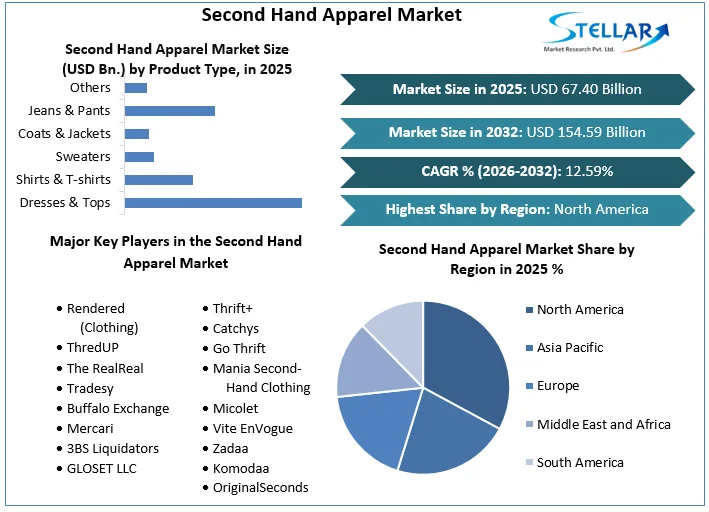
PUNE, India, June 18, 2026 – The Second Hand Apparel Market is entering a new phase of growth as sustainability priorities, digital commerce innovation, and changing consumer attitudes toward ownership accelerate the adoption of circular fashion models worldwide. According to the latest study by Stellar Market Research, the market was valued at USD 67.40 billion in 2025 and is projected to reach USD 154.59 billion by 2032, expanding at a CAGR of 12.59% during the forecast period 2026-2032. The report highlights how resale platforms, authenticated luxury recommerce, and consumer demand for affordable fashion are transforming the global apparel ecosystem.
Market Opportunity Overview
The second hand apparel industry is no longer a niche segment serving budget-conscious shoppers. It has evolved into a strategic component of the global fashion value chain. Rising concerns about textile waste, carbon emissions, and overproduction are encouraging consumers and brands to embrace resale, rental, and reuse models.
Digital marketplaces are creating efficient channels for peer-to-peer transactions, while artificial intelligence, authentication technologies, and data-driven merchandising are improving customer trust and inventory management. As consumers increasingly prioritize value and sustainability simultaneously, retailers and investors are recognizing resale commerce as a long-term growth opportunity rather than a secondary retail channel.
The convergence of ESG goals, affordability pressures, and digital commerce innovation is expected to unlock significant investment opportunities across online resale platforms, logistics providers, apparel authentication services, and circular fashion ecosystems.
𝐃𝐨𝐰𝐧𝐥𝐨𝐚𝐝 𝐅𝐫𝐞𝐞 𝐏𝐃𝐅 𝐁𝐫𝐨𝐜𝐡𝐮𝐫𝐞: https://www.stellarmr.com/report/req_sample/Second-Hand-Apparel-Market/1885
Key Findings from the Report
The global Second Hand Apparel Market was valued at USD 67.40 billion in 2025 and is forecast to reach USD 154.59 billion by 2032.
The market is expected to grow at a 12.59% CAGR during the forecast period.
More than 52% of consumers purchased second-hand apparel in 2023, indicating mainstream adoption.
Approximately 60% of consumers believe second-hand shopping offers better value for money than traditional retail purchases.
Online channels continue gaining traction, with 51% of consumers preferring to shop second-hand online rather than through physical stores.
Europe remains the leading regional market due to strong sustainability awareness, mature resale networks, and established vintage fashion culture.
Asia-Pacific is emerging as the fastest-growing region, supported by digital marketplace adoption, urbanization, and expanding middle-class demand for affordable fashion.
Market Drivers and Restraints
Key Drivers
Growing Sustainability Awareness
Consumers increasingly seek environmentally responsible alternatives to fast fashion. The extension of apparel life cycles reduces textile waste and supports circular economy objectives.
Rapid Expansion of Online Resale Platforms
Digital marketplaces and social commerce channels have significantly simplified the buying and selling of pre-owned apparel, expanding market accessibility across geographies.
Economic Value and Affordability
Inflationary pressures and rising apparel prices are driving consumers toward second-hand purchases that offer branded products at lower price points.
Key Restraints
Product Authentication and Quality Concerns
Counterfeit products and inconsistent quality standards remain challenges, particularly in premium and luxury resale categories.
Fragmented Supply Chains
The collection, sorting, grading, and distribution of used apparel require operational efficiency that many market participants continue to develop.
𝐃𝐨𝐰𝐧𝐥𝐨𝐚𝐝 𝐅𝐫𝐞𝐞 𝐏𝐃𝐅 𝐁𝐫𝐨𝐜𝐡𝐮𝐫𝐞: https://www.stellarmr.com/report/req_sample/Second-Hand-Apparel-Market/1885
Technology, Regulation, and Sustainability Trends
Artificial intelligence is increasingly being used for personalized recommendations, dynamic pricing, inventory optimization, and fraud detection within resale platforms. Advanced image recognition and authentication technologies are enhancing consumer confidence, particularly in luxury apparel resale.
From a regulatory perspective, governments are promoting sustainable consumption and circular economy initiatives. Consumer sentiment is also aligning with policy objectives, as a growing share of shoppers support legislative measures encouraging sustainable fashion practices.
ESG commitments from global fashion brands are driving partnerships with resale platforms and encouraging the launch of branded recommerce programs. These initiatives help reduce waste, improve resource utilization, and strengthen sustainability credentials.
Regional Insights
Europe: Market Leader
Europe continues to dominate the second hand apparel market due to widespread environmental awareness, established thrift culture, and growing consumer acceptance of circular fashion. Countries such as the United Kingdom, Germany, and France are witnessing strong participation from both consumers and retailers.
Asia-Pacific: Emerging Growth Hub
Asia-Pacific is expected to record the fastest growth through 2032. Markets including India, China, Japan, and South Korea are benefiting from expanding digital commerce infrastructure and increasing consumer demand for affordable, sustainable fashion. India’s position as one of the world’s largest importers of used clothing further highlights regional market potential.
North America
The United States remains a major contributor to market revenues due to strong adoption of online resale platforms, luxury recommerce services, and sustainability-driven consumer behavior.
Recent Industry Developments
ThredUp (2025): Expanded AI-driven resale technology capabilities, enhancing inventory management efficiency and customer personalization across its platform.
Vestiaire Collective (2025): Strengthened luxury authentication programs and expanded premium resale services, increasing consumer trust in luxury recommerce.
eBay (2025): Enhanced authentication guarantees for luxury fashion categories, supporting growth in premium second-hand apparel transactions.
Depop (2024): Introduced new seller tools and creator-focused commerce features, improving engagement among Gen Z consumers and independent resellers.
The RealReal (2024): Expanded authenticated luxury consignment operations and digital verification capabilities, supporting broader adoption of circular luxury fashion.
Competitive Landscape
The market remains highly competitive, featuring global resale platforms, specialized luxury recommerce companies, thrift retailers, and marketplace operators. Key participants include ThredUp, Poshmark, Depop, Vestiaire Collective, The RealReal, eBay, ASOS Marketplace, Mercari, Goodwill Industries International, and Buffalo Exchange. Companies are focusing on technology investments, authentication capabilities, strategic partnerships, and geographic expansion to strengthen market positioning.
Analyst Commentary
“The next growth phase of the second hand apparel industry will be driven by digital trust, platform scalability, and circular economy integration. As brands increasingly participate in resale ecosystems and consumers prioritize sustainable purchasing decisions, recommerce is expected to become a core component of the global fashion industry rather than an alternative retail channel,” said a Senior Research Analyst at Stellar Market Research.
Future Outlook
Through 2032, the Second Hand Apparel Market is expected to benefit from sustained consumer demand for affordable fashion, continued investment in digital resale infrastructure, and expanding sustainability regulations. The integration of AI-powered personalization, authentication technologies, and omnichannel resale models is likely to improve operational efficiency and customer engagement. As fashion brands increasingly adopt circular business models, competition is expected to intensify while creating new opportunities across resale platforms, logistics networks, and sustainability-focused retail ecosystems.
About Stellar Market Research
Stellar Market Research is a global market research and business consulting firm providing actionable intelligence across diverse industries, including consumer goods, healthcare, technology, manufacturing, energy, and automotive sectors. The company delivers comprehensive market forecasts, competitive benchmarking, strategic consulting, and industry insights that support informed business decision-making. Through rigorous primary and secondary research methodologies, Stellar Market Research helps organizations identify growth opportunities, assess market risks, evaluate investment prospects, and develop data-driven strategies. Its research solutions serve multinational corporations, investors, government agencies, and emerging enterprises seeking a deeper understanding of evolving market dynamics and competitive landscapes.
Media Contact
Stellar Market Research
Website: http://stellarmr.com/
Email: sales@stellarmr.com
