Key Highlights
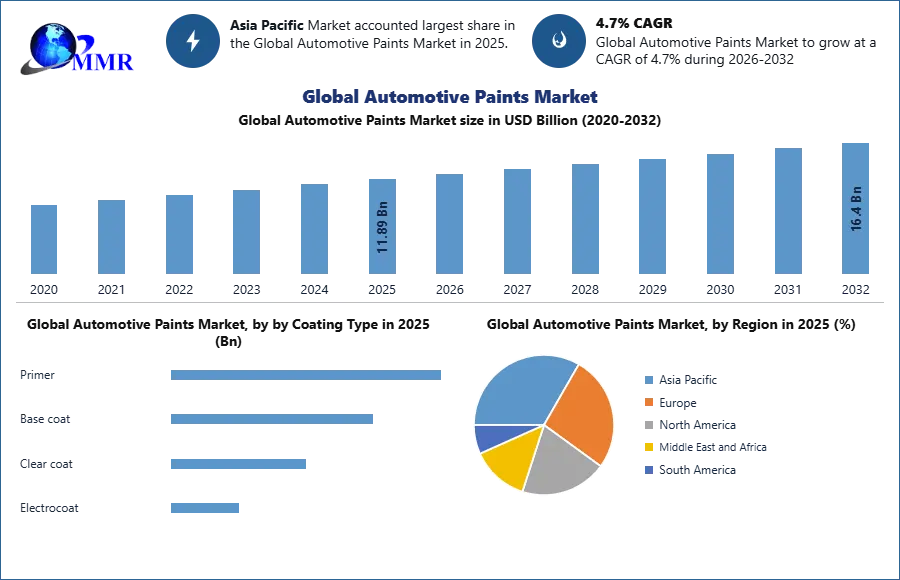
- Global automotive paints market valued at USD 11.89 billion in 2025.
- Market projected to reach nearly USD 16.48 billion by 2032.
- CAGR forecast of 4.7% from 2026 to 2032.
- Asia Pacific remains the leading regional market.
- Clear coat segment dominates by coating type.
- Polyurethane leads among resin categories.
- Waterborne coatings hold the leading technology position.
- EV adoption is creating demand for specialized coating solutions.
- Sustainability regulations continue to accelerate low-VOC and waterborne paint adoption.
- Major suppliers are expanding capacity and launching energy-efficient coating technologies.
Why This Matters Now
The automotive sector is navigating simultaneous transitions in electrification, emissions compliance, manufacturing efficiency, and consumer expectations. Paint systems sit at the intersection of all four.
For OEMs, coatings have become more than an appearance feature. They influence vehicle durability, corrosion resistance, energy consumption during manufacturing, and environmental compliance. For suppliers, coatings increasingly determine long-term platform wins because vehicle manufacturers are seeking differentiated solutions tailored to electric and advanced mobility platforms.
The result is a market where innovation, rather than commodity supply, increasingly determines competitive advantage.
Market Overview
Automotive paints Market serve both protective and decorative functions across vehicle production. Demand continues to rise alongside global automotive manufacturing growth, urbanization, rising vehicle ownership, and increasing consumer demand for customization.
What changed is the technology requirement. Environmental regulations are pushing the industry toward water-based and low-VOC coatings. At the same time, vehicle manufacturers are demanding coatings that deliver greater durability, improved scratch resistance, enhanced aesthetics, and lower lifecycle environmental impact.
This combination is transforming coatings from a procurement category into a strategic technology layer within vehicle manufacturing.
Key Trends Driving Growth
The strongest trend is the transition toward eco-friendly coating systems. Water-based automotive paints are gaining momentum as manufacturers seek to reduce emissions, waste generation, and energy consumption across production facilities. Regulatory pressure is accelerating this shift across major automotive manufacturing regions.
Advanced coating technologies are also gaining commercial traction. Self-healing coatings and anti-scratch solutions are moving from niche innovations toward broader adoption as automakers seek to improve vehicle longevity and customer satisfaction.
Electrification is creating a second growth engine. Electric vehicles increasingly use lightweight composites and aluminum structures that require specialized coating systems. EV manufacturers are also exploring paint technologies that contribute to aerodynamic efficiency and thermal management around batteries and electric motors. These requirements create opportunities for suppliers capable of delivering application-specific innovation.
Consumer demand for personalization is another market catalyst. Buyers increasingly expect wider color options, premium finishes, and differentiated vehicle aesthetics, driving additional value creation across paint portfolios.
𝐃𝐨𝐰𝐧𝐥𝐨𝐚𝐝 𝐏𝐃𝐅 𝐁𝐫𝐨𝐜𝐡𝐮𝐫𝐞 @ https://www.maximizemarketresearch.com/request-sample/14750/
Segment Insights
- Dominant Segment – Clear Coat: Clear coats lead the market because they provide critical protection against UV exposure, chemicals, weather conditions, road debris, oxidation, and corrosion while preserving color quality and vehicle appearance. Their role in extending vehicle lifespan makes them strategically important for OEMs and consumers alike.
- Dominant Resin Segment – Polyurethane: Polyurethane coatings maintain leadership due to strong resistance to weather, UV radiation, chemicals, abrasion, and scratches. Demand is strengthened by premium and luxury vehicle production where appearance quality and durability remain essential purchasing criteria.
- Leading Technology Segment – Waterborne Coatings: Waterborne technology leads due to lower-temperature processing requirements, chemical resistance, solvent-free characteristics, and alignment with sustainability objectives. The technology also supports regulatory compliance without sacrificing performance.
- Fastest-Growing Segment: The report does not specify a fastest-growing segment. No estimate is provided.
Regional Growth Story
Asia Pacific remains the center of gravity for the global automotive paints market. The region benefits from high vehicle production volumes, expanding automotive manufacturing capacity, growing middle-class consumption, and supportive government policies. China and India continue to play particularly influential roles in shaping regional demand.
For paint manufacturers, this leadership has direct implications. Capacity investments, product localization strategies, and technology partnerships are increasingly concentrated around Asia-Pacific production hubs.
India’s position is especially notable. The country produced 22.93 million vehicles in FY22 and maintains a strong position in domestic demand and exports. For coating suppliers, that scale creates both volume opportunities and a testing ground for next-generation sustainable coating technologies.
Competitive Landscape
Competition is increasingly centered on technology leadership, sustainability credentials, and manufacturing footprint expansion.
Major participants include PPG Industries, BASF, Axalta Coating Systems, AkzoNobel, Sherwin-Williams, Nippon Paint Holdings, Kansai Paint, Jotun, Asian Paints, and other global and regional suppliers. These companies continue to invest in research, portfolio expansion, strategic partnerships, mergers, and acquisitions to strengthen market positioning.
The strategic message is clear. Suppliers are competing to become embedded within OEM development cycles rather than simply supplying coatings after platform decisions are made. Winning early specification decisions can create long-duration revenue streams and stronger pricing power.
Recent Developments
- March 2025: PPG Industries opened a new waterborne automotive coatings manufacturing facility in Thailand, expanding production capacity for sustainable coatings and strengthening its Southeast Asian position.
- February 2025: AkzoNobel launched Sikkens Autowave Optima, a next-generation waterborne basecoat designed to improve productivity while reducing energy consumption and environmental impact.
- April 2025: Axalta introduced its Fast Cure Low Energy System for the refinish market, targeting faster repairs and lower energy usage in body shops.
- April 2024: BASF launched eco-efficient undercoats and clearcoats intended to reduce carbon dioxide emissions while maintaining finish quality.
Strategic Implications
The market’s direction signals several priorities for industry stakeholders.
OEMs must integrate coating strategies into broader EV and sustainability roadmaps. Suppliers that can reduce emissions, energy consumption, and manufacturing complexity are becoming more valuable partners.
Tier-1 suppliers and coating manufacturers face increasing pressure to balance environmental compliance with cost competitiveness. Waterborne technologies and advanced protective coatings are emerging as differentiators rather than optional features.
Investors should watch capacity expansion, sustainable coating portfolios, and EV-focused innovation pipelines. These areas increasingly indicate future market share gains.
The report does not provide evidence regarding semiconductor dependencies, fleet electrification metrics, autonomous-driving coating requirements, charging infrastructure investments, pricing trends, trade-flow volumes, or fastest-growing segments. These areas remain outside the published findings.
Future Outlook
The next growth cycle in automotive paints will be defined by the convergence of electrification, sustainability regulation, advanced materials, and manufacturing efficiency. Companies that deliver specialized, low-emission, EV-compatible coating technologies will capture the greatest strategic value, while those tied to legacy formulations risk losing relevance as automotive production continues to evolve.
Analyst Perspective
“Automotive coatings are moving from a protective layer to a strategic enabler of vehicle performance, sustainability, and customer differentiation. The strongest opportunities will emerge where advanced coating technologies align with EV production growth, regulatory compliance, and evolving consumer expectations.”
— Tejaswini Kakade, Research Analyst
About Maximize Market Research
Maximize Market Research Pvt. Ltd. (MMR) is a global market research and consulting company that provides reliable, data-focused, and practical business insights. The firm serves a wide range of industries, including healthcare, pharmaceuticals, technology, automotive, electronics, chemicals, personal care, and consumer goods. Through market forecasts, competitive analysis, strategic consulting, and industry impact assessments, MMR helps organizations understand changing market conditions, identify growth opportunities, and make informed business decisions for long-term success.
2nd Floor, Navale IT Park Phase 3
Pune Banglore Highway, Narhe
Pune, Maharashtra 411041, India
+91 9607365656
sales@maximizemarketresearch.com
