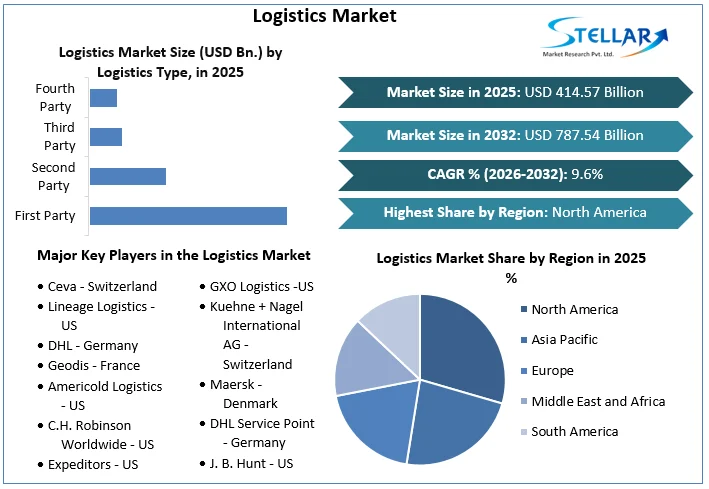
PUNE, June 18, 2026 – The Logistics Market is entering a new phase of transformation as companies accelerate investments in digital supply chains, warehouse automation, AI-powered route optimization, and sustainable transportation networks. According to the latest Logistics Market Report published by Stellar Market Research, the market was valued at USD 414.57 billion in 2025 and is projected to reach nearly USD 787.54 billion by 2032, expanding at a CAGR of 9.6% during the forecast period (2026–2032). The report highlights how technological innovation, cross-border trade growth, and evolving consumer expectations are reshaping logistics ecosystems worldwide.
Market Opportunity Overview
Download Free PDF Brochure: https://www.stellarmr.com/report/req_sample/Logistics-Market/1811
The logistics industry is no longer viewed solely as a transportation and warehousing function. It has become a strategic enabler of global commerce, supporting manufacturing resilience, omnichannel retail, and international trade flows. The rapid rise of e-commerce, increasing demand for same-day delivery, and growing complexity of supply chains are driving organizations to modernize logistics operations.
Companies are increasingly adopting cloud-based logistics platforms, AI-driven demand forecasting, real-time visibility tools, robotics, and Internet of Things (IoT) technologies to improve efficiency and reduce operational costs. At the same time, governments worldwide are investing heavily in transport infrastructure, multimodal connectivity, and trade corridors, creating new growth opportunities for logistics service providers.
Key Findings from the Report
- The Logistics Market was valued at USD 414.57 billion in 2025 and is expected to approach USD 787.54 billion by 2032.
- The market is forecast to grow at a 9.6% CAGR from 2026 to 2032.
- Transportation and freight forwarding continue to represent dominant revenue-generating activities across the logistics value chain.
- E-commerce logistics remains among the fastest-growing segments, supported by rising online retail penetration and last-mile delivery demand.
- Asia-Pacific maintains leadership due to strong manufacturing output, export activity, and infrastructure investments.
- Middle East and Southeast Asian economies are emerging as high-growth logistics hubs driven by trade diversification and strategic infrastructure development.
- Increasing adoption of AI, automation, blockchain, and IoT is improving supply chain visibility and operational efficiency.
Market Drivers and Restraints
Key Drivers
E-commerce Expansion and Last-Mile Delivery Demand
The rapid growth of online retail continues to create demand for advanced fulfillment centers, express delivery services, and urban logistics infrastructure.
Digital Transformation Across Supply Chains
AI-powered route optimization, predictive analytics, warehouse automation, and real-time tracking solutions are enhancing logistics performance while reducing costs and delays.
Global Trade and Infrastructure Investments
Large-scale investments in ports, rail networks, highways, logistics parks, and multimodal transport systems are improving supply chain efficiency and supporting international trade growth.
Key Restraints
Rising Transportation and Fuel Costs
Volatility in fuel prices and operating expenses continues to impact profitability across logistics networks.
Supply Chain Disruptions and Regulatory Complexity
Geopolitical tensions, customs regulations, labor shortages, and trade restrictions create operational challenges for logistics providers operating globally.
Technology, Regulation, and Sustainability Trends
The logistics industry is undergoing rapid digitalization. Companies are deploying AI-enabled transportation management systems, autonomous mobile robots, digital freight platforms, blockchain-based documentation systems, and predictive maintenance technologies to improve productivity and transparency.
Regulatory frameworks aimed at reducing carbon emissions are encouraging logistics operators to transition toward electric vehicles, alternative fuels, and energy-efficient warehouse facilities. Governments across Europe, North America, and Asia are also implementing policies to strengthen supply chain resilience and accelerate digital trade initiatives.
Sustainability has become a critical competitive differentiator. Organizations are increasingly investing in green logistics programs, carbon tracking tools, eco-friendly packaging, and low-emission transportation fleets to meet ESG commitments and customer expectations.
Download Free PDF Brochure: https://www.stellarmr.com/report/req_sample/Logistics-Market/1811
Recent Industry Developments
DHL Group (2025): Expanded investments in automated warehouses and AI-powered logistics solutions, improving fulfillment efficiency and supply chain visibility.
United Parcel Service (UPS) (2025): Increased deployment of electric delivery vehicles across major markets, supporting carbon reduction targets and sustainable last-mile delivery.
Maersk (2025): Strengthened integrated logistics offerings through digital supply chain platforms and end-to-end freight management services.
FedEx (2024): Enhanced network optimization initiatives utilizing advanced analytics and automation to improve delivery speed and operational efficiency.
Amazon Logistics (2025): Continued expansion of robotics-enabled fulfillment centers and regional distribution infrastructure to support growing e-commerce demand.
Regional Insights
Leading Region: Asia-Pacific
Asia-Pacific remains the largest logistics market, supported by robust manufacturing activity, expanding export industries, and significant infrastructure development. China, India, Japan, South Korea, and Southeast Asian economies continue to attract substantial logistics investments due to growing trade volumes and digital commerce adoption.
Emerging Region: Middle East and Southeast Asia
The Middle East is emerging as a strategic logistics hub, driven by investments in ports, free trade zones, and multimodal transportation networks. Countries such as Saudi Arabia and the UAE are strengthening their positions as global trade gateways.
Southeast Asia is witnessing strong growth as manufacturers diversify supply chains and establish regional production centers, creating significant demand for logistics services.
Competitive Landscape
The Logistics Market remains highly competitive, with global players focusing on network expansion, digital transformation, sustainability initiatives, and strategic partnerships. Leading companies are investing in AI-driven logistics platforms, automated warehouses, electric vehicle fleets, and integrated supply chain solutions to strengthen their market positions.
Major participants include DHL Group, UPS, FedEx, Kuehne+Nagel, DB Schenker, DSV, Maersk, Nippon Express, XPO Logistics, and C.H. Robinson. Competitive strategies increasingly center on technology innovation, customer-centric service models, and global logistics network optimization.
Analyst Commentary
“The next phase of growth in the logistics market will be defined by intelligent supply chains. Companies that successfully combine automation, real-time data visibility, sustainability initiatives, and resilient transportation networks will be best positioned to capture emerging opportunities across global trade and e-commerce ecosystems,” said a Senior Research Analyst at Stellar Market Research.
Future Outlook
Through 2032, the logistics industry is expected to experience sustained growth as digital commerce expands, supply chains become increasingly interconnected, and sustainability regulations intensify. Investments in AI, robotics, electric mobility, predictive analytics, and smart logistics infrastructure will continue to reshape competitive dynamics.
As businesses seek greater supply chain resilience and operational efficiency, demand for integrated logistics solutions, advanced warehousing capabilities, and technology-enabled transportation services is expected to remain strong throughout the forecast period.
About Stellar Market Research
Stellar Market Research is a global market research and business consulting firm delivering strategic intelligence across diverse industries. The company provides comprehensive market analysis, competitive benchmarking, industry forecasts, and advisory services that help organizations identify growth opportunities and make informed business decisions. Leveraging rigorous primary and secondary research methodologies, Stellar Market Research delivers actionable insights for manufacturers, investors, technology providers, and policymakers. The firm’s expertise spans sectors including healthcare, information technology, chemicals, manufacturing, consumer goods, automotive, energy, and logistics, enabling clients to navigate evolving market dynamics and achieve sustainable growth in increasingly competitive environments.
Media Contact
Stellar Market Research
Address: Phase 3, Navale IT Zone, S.No. 51/2A/2, Office No. 202, 2nd Floor, Near Navale Bridge, Narhe, Pune, Maharashtra 411041
Website: http://stellarmr.com/
Email: sales@stellarmr.com
Mobile: +91 9607365656
