Key Highlights
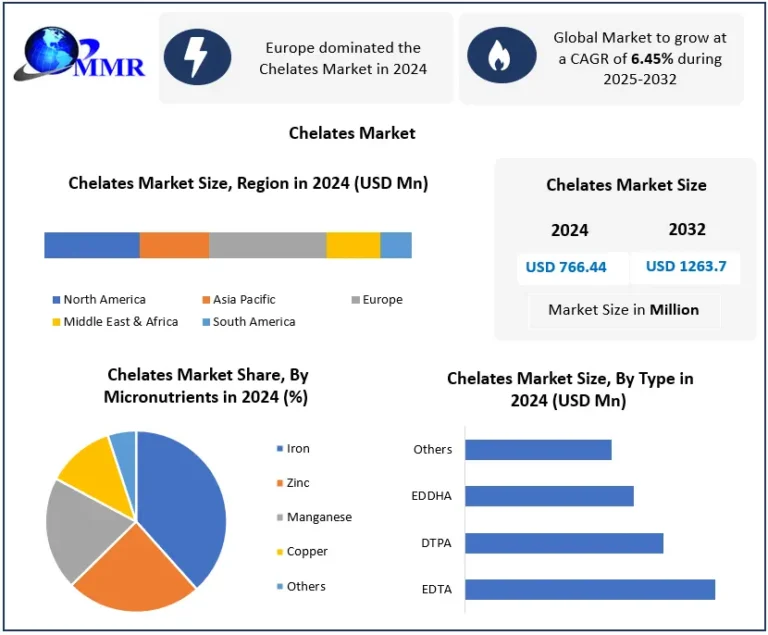
- Global Chelates Market was valued at USD 766.44 Mn in 2024.
- Market is projected to reach USD 1,263.7 Mn by 2032.
- Market is expected to grow at a CAGR of 6.45% during 2025–2032.
- Iron accounted for 41% of the market in 2024, making it the dominant micronutrient segment.
- EDTA agricultural chelates are expected to record the highest growth rate during the forecast period.
- Europe held the largest regional market share at 30%.
- Asia-Pacific is projected to grow at a CAGR of 6% through the forecast period.
- Growing micronutrient deficiencies in agricultural soils continue to drive adoption.
Why This Matters Now
Crop productivity is becoming a strategic issue rather than a purely agronomic one. Food security pressures, declining soil nutrient availability, and rising expectations for sustainable farming are forcing growers to extract more value from every hectare.
Chelates are emerging as a critical tool in this transition. By improving micronutrient availability and uptake, they help farmers improve crop quality and yield while reducing nutrient losses. For agribusiness suppliers, the shift is creating new opportunities across fertilizers, precision agriculture systems, specialty crop production, and sustainable crop nutrition programs.
Market Overview
The global Chelates Market was valued at USD 766.44 Mn in 2024 and is forecast to reach USD 1,263.7 Mn by 2032, expanding at a CAGR of 6.45% during the forecast period. This growth signals increasing investment in micronutrient management as growers seek greater productivity from limited agricultural resources.
The market’s expansion reflects broader structural changes across agriculture. Farmers are moving beyond traditional macronutrient applications and focusing on nutrient efficiency. Micronutrients such as iron, zinc, copper, and manganese are becoming increasingly important as intensive cultivation practices expose deficiencies in agricultural soils. Chelates enable these nutrients to remain available for plant uptake, improving crop performance under varying soil conditions.
The business implication is clear. As crop economics become increasingly dependent on productivity gains, demand is shifting toward higher-value agricultural inputs capable of delivering measurable yield improvements.
Key Trends Driving Growth
Precision agriculture adoption is increasing the importance of nutrient-use efficiency. Growers are seeking input technologies that maximize returns from every nutrient application. Chelated micronutrients align closely with precision farming strategies because they improve nutrient stability and availability.
Climate variability is creating additional demand. Extreme weather conditions can intensify nutrient deficiencies and reduce nutrient availability in soils. Chelates help maintain micronutrient accessibility even under challenging agronomic conditions, supporting climate-resilient production systems.
Soil health management is becoming a major investment area. Across key agricultural regions, concerns about nutrient depletion are encouraging greater use of advanced crop nutrition products. The growing recognition of micronutrient deficiencies is expanding demand for chelated formulations across cereals, fruits, vegetables, pulses, and oilseeds.
Sustainability initiatives are also influencing purchasing decisions. Agricultural stakeholders increasingly prioritize technologies that improve nutrient efficiency while minimizing waste and environmental impact. Chelates support these objectives by enhancing nutrient absorption and reducing losses.
For full access to the data, request a sample report now
Segment Insights
- Dominant Segment: Iron
Iron accounted for 41% of the Chelates Market in 2024. The segment’s leadership is linked to increasing demand for nutrient-rich crop production and widespread iron deficiency challenges across agricultural soils. For input suppliers, this concentration indicates strong commercial opportunities in iron-based crop nutrition solutions.
- Fastest-Growing Segment: EDTA Agricultural Chelates
The EDTA segment is expected to witness the highest CAGR during the forecast period. EDTA chelates provide strong binding capabilities with essential micronutrients including iron, zinc, copper, and manganese. Improved nutrient absorption translates directly into stronger crop development, making these products increasingly attractive for growers seeking productivity gains.
- Micronutrient management is moving from corrective application toward preventive crop nutrition strategies.
- Demand is expanding as growers seek greater consistency in crop quality and yield outcomes.
- Specialty crop producers are increasingly adopting advanced micronutrient programs to support premium-value production systems.
Regional Growth Story
Europe remains the largest market, accounting for 30% of global demand. Countries such as Spain and the Netherlands continue to expand cultivated acreage and support diverse crop production systems. The widespread occurrence of soil micronutrient deficiencies across European agricultural regions is strengthening long-term demand for chelated nutrient products. For suppliers, Europe remains a mature but innovation-driven market where nutrient efficiency and sustainability increasingly influence purchasing decisions.
Asia-Pacific is emerging as the industry’s most significant growth engine, with a projected CAGR of 6% during the forecast period. China and India play central roles due to their large agricultural sectors and substantial crop production volumes. The region’s strong demand for rice, cereals, grains, fruits, and vegetables is creating sustained opportunities for micronutrient management technologies. The increasing use of direct micronutrient applications to address plant deficiencies is further accelerating market growth.
For investors and agribusiness companies, Asia-Pacific represents one of the most important expansion opportunities as agricultural modernization continues across major farming economies.
Competitive Landscape
The market includes established agricultural input companies such as BASF SE, Syngenta AG, Haifa Chemicals, Nufarm Ltd., Yara International ASA, Nouryon, Aries Agro Ltd., Wilbur-Ellis Company Inc., The Andersons Inc., and BMS Micro-Nutrients.
Competition is increasingly focused on nutrient efficiency, formulation performance, and agronomic outcomes rather than commodity volume alone. This signals a broader shift toward value-added crop nutrition products.
Leading suppliers are positioning themselves around integrated nutrient management solutions. The competitive advantage is moving toward companies capable of combining micronutrient technologies with precision agriculture platforms, agronomic advisory services, and sustainability-focused farming programs.
The market’s direction suggests future competition will be defined by innovation, nutrient-use efficiency, and the ability to deliver measurable productivity improvements at the farm level.
Recent Developments
- Increased industry focus on advanced micronutrient delivery systems.
- Growing adoption of chelated formulations for iron, zinc, copper, and manganese applications.
- Expansion of precision farming practices supporting higher-value nutrient management products.
- Rising investments in sustainable crop nutrition solutions.
- Stronger emphasis on addressing soil micronutrient deficiencies across major agricultural regions.
Strategic Implications
Agricultural input manufacturers face a growing opportunity to differentiate through performance-based nutrient solutions. Farmers increasingly evaluate products based on productivity gains rather than input cost alone.
Food supply chains benefit from improved crop quality and production consistency. Policymakers focused on food security can leverage micronutrient technologies to support higher agricultural output without significant land expansion.
For investors, the market reflects a broader transition toward precision agriculture and climate-smart farming. Companies positioned around nutrient efficiency and sustainable crop nutrition are likely to capture a larger share of future agricultural spending.
Future Outlook
The next phase of growth will be driven by the convergence of precision agriculture, sustainability targets, and increasing pressure to improve crop productivity. As nutrient efficiency becomes a core performance metric across farming systems, chelates will move from specialty inputs to essential components of modern crop nutrition programs. Market leaders will be those that integrate micronutrient science with digital agriculture and sustainability strategies, while laggards risk competing solely on price in an increasingly performance-driven market.
Analyst Perspective
“The Chelates Market is entering a period where micronutrient efficiency is becoming central to agricultural productivity strategies. As growers face mounting pressure to improve yields, manage soil health, and adapt to changing environmental conditions, demand for advanced chelated nutrient solutions is expected to strengthen across both mature and emerging agricultural markets.” — Siddhi Dole, Analyst
About Maximize Market Research
Maximize Market Research Pvt. Ltd. (MMR) is a global market research and consulting company that provides reliable, data-focused, and practical business insights. The firm serves a wide range of industries, including healthcare, pharmaceuticals, technology, automotive, electronics, chemicals, personal care, and consumer goods. Through market forecasts, competitive analysis, strategic consulting, and industry impact assessments, MMR helps organizations understand changing market conditions, identify growth opportunities, and make informed business decisions for long-term success.
Contact Us :
2nd Floor, Navale IT Park Phase 3
Pune Banglore Highway, Narhe
Pune, Maharashtra 411041, India
+91 9607365656
sales@maximizemarketresearch.com
