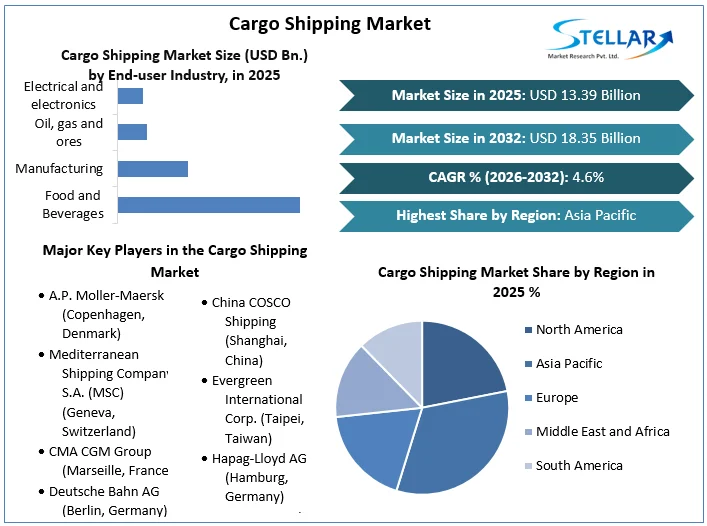
PUNE, June 18, 2026 — The Cargo Shipping Market is entering a new phase of transformation as shipping operators, port authorities, and logistics providers accelerate investments in digital fleet management, emissions reduction technologies, and supply chain resilience. According to the latest Cargo Shipping Market Report by Stellar Market Research, the market was valued at 13.39 billion tons in 2025 and is projected to reach 18.35 billion tons by 2032, growing at a CAGR of 4.6% during the forecast period of 2026–2032. The market’s evolution is being shaped by increasing international trade volumes, containerization, and regulatory pressure to reduce maritime emissions.
Market Opportunity Overview
Global cargo shipping remains the backbone of international commerce, carrying the majority of traded goods worldwide. However, the industry is undergoing a significant shift from traditional capacity-driven operations to data-driven and sustainability-focused logistics models. Shipping companies are increasingly leveraging predictive analytics, AI-enabled route optimization, blockchain-based documentation, and smart port infrastructure to improve vessel utilization and reduce operational costs.
At the same time, geopolitical trade realignments and manufacturing diversification across Asia, Southeast Asia, and Eastern Europe are creating new shipping corridors. As businesses seek resilient supply chains, demand for efficient maritime transportation is expected to remain strong, creating substantial opportunities for fleet modernization, digital transformation, and green shipping investments.
Download Free PDF Brochure:https://www.stellarmr.com/report/req_sample/Cargo-Shipping-Market/1146
Key Findings from the Report
- The Cargo Shipping Market was valued at 13.39 billion tons in 2025 and is expected to reach 18.35 billion tons by 2032.
- The market is forecast to expand at a CAGR of 4.6% between 2026 and 2032.
- Container Cargo dominated the cargo type segment with approximately 27% market share in 2025.
- Container Cargo is also projected to be the fastest-growing cargo type due to increasing intermodal transportation efficiency.
- Manufacturing accounted for the largest end-user segment with nearly 29% market share in 2025.
- Asia-Pacific led the market with a 39.55% share, supported by strong manufacturing exports and port infrastructure.
- Middle East & Africa is emerging as a high-growth region due to expanding port modernization projects and increasing trade volumes.
Market Drivers and Restraints
Key Drivers
Growth in Global Trade Activities
Expanding import-export operations and cross-border commerce continue to increase demand for maritime freight transportation, especially for containerized cargo.
Digital Fleet Optimization
Shipping operators are increasingly deploying predictive analytics and cargo visibility platforms to optimize vessel utilization, reduce empty backhaul trips, and improve profitability.
Cost and Environmental Advantages
Cargo shipping remains one of the most cost-effective and environmentally efficient transportation modes for long-distance freight movement, supporting sustained market growth.
Key Restraints
Geopolitical Trade Tensions
Ongoing trade disputes and tariff uncertainties can disrupt established shipping routes and reduce cargo volumes on major trade corridors.
Stringent Emission Compliance Requirements
International maritime regulations requiring lower sulfur emissions and cleaner fuels are increasing operating and compliance costs for fleet operators.
Technology, Regulation, and Sustainability Trends
The cargo shipping industry is rapidly embracing digitalization through AI-powered route planning, predictive maintenance, blockchain-based shipping documentation, and real-time cargo tracking systems. These technologies improve operational efficiency, reduce delays, and enhance supply chain transparency.
Regulatory developments led by the International Maritime Organization (IMO) continue to reshape fleet investment strategies. Compliance with carbon intensity regulations, sulfur emission standards, and decarbonization targets is driving adoption of LNG-powered vessels, methanol-fueled ships, and alternative marine fuels.
Sustainability has become a strategic priority as shipping companies pursue net-zero goals through fleet modernization, energy-efficient vessel designs, shore-power integration, and carbon reduction initiatives.
Download Free PDF Brochure:https://www.stellarmr.com/report/req_sample/Cargo-Shipping-Market/1146
Recent Industry Developments
A.P. Moller-Maersk (2025): Expanded its dual-fuel methanol vessel fleet deployment, strengthening industry-wide adoption of low-carbon maritime transportation solutions.
Mediterranean Shipping Company – MSC (2025): Continued investments in integrated logistics and digital cargo visibility platforms, improving supply chain efficiency and customer service capabilities.
CMA CGM Group (2025): Accelerated alternative fuel investments and sustainable shipping initiatives while expanding strategic port infrastructure partnerships.
Hapag-Lloyd AG (2024): Advanced fleet decarbonization programs and strengthened digital booking platforms to enhance operational efficiency and cargo transparency.
China COSCO Shipping (2025): Expanded smart shipping technologies and port digitization projects across major Asian trade routes, improving cargo handling productivity.
Regional Insights
Asia-Pacific: Market Leader
Asia-Pacific remains the dominant region, accounting for nearly 40% of global cargo shipping activity. China continues to serve as the world’s leading manufacturing and export hub, while India, Vietnam, Indonesia, and ASEAN economies are emerging as important contributors to regional trade growth. Strong port infrastructure development and industrial expansion support continued market leadership.
Middle East & Africa: Emerging Growth Region
The Middle East and Africa are witnessing rapid growth due to strategic investments in port modernization, logistics hubs, and maritime connectivity projects. Countries across the GCC region, along with Egypt and South Africa, are expanding port capacities to support rising international trade volumes.
Europe and North America
Europe continues to benefit from infrastructure modernization and port optimization initiatives in countries such as Germany, Spain, and the United Kingdom. North America remains a critical market supported by strong manufacturing, consumer demand, and integrated logistics networks.
Competitive Landscape
The Cargo Shipping Market is highly competitive, with major players focusing on fleet modernization, digital transformation, sustainability initiatives, strategic partnerships, and port infrastructure investments.
Key market participants include:
- A.P. Moller-Maersk
- Mediterranean Shipping Company (MSC)
- CMA CGM Group
- China COSCO Shipping
- Hapag-Lloyd AG
- Ocean Network Express (ONE)
- Evergreen International Corp.
- HMM Co., Ltd.
- Yang Ming Group
- Orient Overseas Container Line (OOCL)
These companies are increasingly differentiating themselves through green shipping technologies, digital logistics ecosystems, and end-to-end supply chain solutions.
Analyst Commentary
“The cargo shipping industry is transitioning from a scale-focused business model toward a technology-enabled and sustainability-driven ecosystem. Companies that successfully integrate digital intelligence, emissions reduction strategies, and supply chain resilience will be best positioned to capture long-term growth opportunities through 2032,” said a Senior Research Analyst at Stellar Market Research.
Future Outlook
Through 2032, the Cargo Shipping Market is expected to benefit from rising international trade activity, increasing containerization, growing investment in smart ports, and stronger demand for resilient supply chains. Digital transformation will continue to improve vessel utilization and operational efficiency, while stricter environmental regulations will accelerate adoption of low-carbon fuels and sustainable shipping technologies.
As global manufacturers diversify production locations and governments invest in trade infrastructure, cargo shipping providers are expected to expand capacity, modernize fleets, and strengthen logistics integration, creating a more efficient and environmentally responsible maritime transportation ecosystem.
About Stellar Market Research
Stellar Market Research is a global market research and business consulting firm delivering actionable intelligence across multiple industries. The company provides comprehensive market assessments, competitive benchmarking, strategic forecasting, technology trend analysis, and investment insights to help organizations make informed business decisions. Leveraging a combination of primary research, secondary research, and advanced analytical methodologies, Stellar Market Research supports enterprises, investors, policymakers, and industry stakeholders in identifying growth opportunities and navigating evolving market landscapes. The firm’s expertise spans manufacturing, transportation, healthcare, technology, energy, consumer goods, and industrial sectors worldwide.
Media Contact
Stellar Market Research
Address: Phase 3, Navale IT Zone, S.No. 51/2A/2, Office No. 202, 2nd Floor, Near Navale Bridge, Narhe, Pune, Maharashtra 411041
Website: http://stellarmr.com/
Email: sales@stellarmr.com
Mobile: +91 9607365656
