Key Highlights
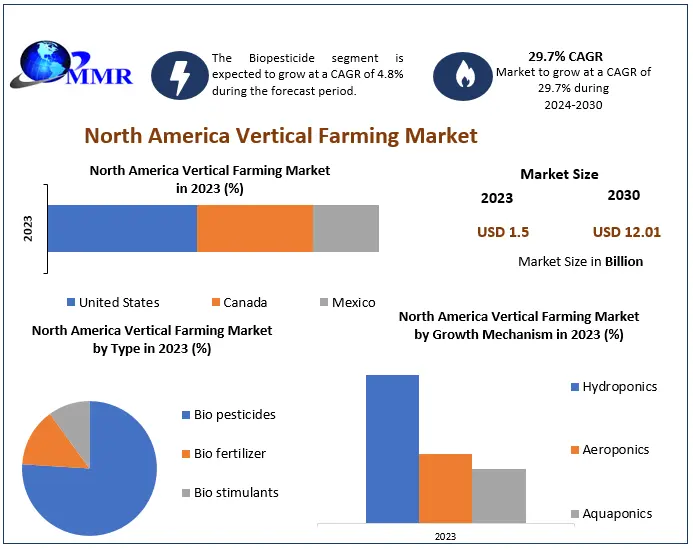
- North America Vertical Farming Market was valued at USD 1.5 billion in 2023 and is projected to reach USD 12.01 billion by 2030.
- The market is expected to expand at a CAGR of 29.7% during 2024–2030.
- Urbanization, climate volatility, and shrinking arable land are accelerating adoption.
- Controlled-environment agriculture is improving crop productivity while reducing water use.
- Technology investment is increasingly focused on automation, artificial intelligence, and data-driven cultivation.
- The United States remains the largest market within the region.
- Leading participants include AeroFarms, Plenty Unlimited, Bowery Farming, BrightFarms, Gotham Greens, and 80 Acres Farms.
Why This Matters Now
Food production is entering a new phase. Traditional farming systems face increasing pressure from climate disruptions, land constraints, labor shortages, and growing urban populations.
North America’s vertical farming industry is positioning itself as a strategic response. The market is expected to expand from USD 1.5 billion in 2023 to USD 12.01 billion by 2030 at a CAGR of 29.7%. For agribusiness investors, technology providers, food retailers, and policymakers, that growth signals a structural shift in how fresh produce may be cultivated, distributed, and consumed across major urban centers.
Market Overview
North America Vertical Farming Market has moved beyond experimental agriculture into a commercially significant segment of controlled-environment food production. The model uses vertically stacked growing systems supported by artificial lighting, climate control technologies, and advanced crop management platforms.
The market’s rapid expansion is being driven by several converging forces. Urban populations continue to grow while available agricultural land remains limited. Climate-related disruptions are increasing production risks in conventional farming systems. At the same time, consumers are demanding year-round access to fresh, locally produced vegetables and specialty crops.
The result is a new investment cycle focused on productivity, supply-chain resilience, and resource efficiency. Vertical farms are increasingly being viewed not only as food-production assets but also as infrastructure supporting food security and urban sustainability goals.
Key Trends Driving Growth
Technology is becoming the defining competitive advantage in vertical farming. Industry leaders are integrating machine learning, data analytics, environmental sensors, and automated cultivation systems to optimize growing conditions and maximize output. These technologies reduce variability while improving operational efficiency.
Water efficiency has emerged as another major driver. Companies are deploying hydroponic and aeroponic systems that significantly reduce water consumption compared with traditional field agriculture. As drought concerns intensify across key agricultural regions, water productivity is becoming a critical economic metric.
Food supply resilience is also reshaping investment priorities. Controlled-environment agriculture enables production closer to consumption centers, reducing transportation distances and lowering exposure to logistics disruptions. For retailers and food processors, this creates opportunities for fresher inventory and more predictable supply chains.
Sustainability objectives continue to attract both public and private capital. Investors increasingly view vertical farming as a pathway toward lower land use intensity, reduced pesticide dependence, and climate-adaptive food production systems.
Need more information? Inquire about a sample report now
Segment Insights
- Dominant Segment: Hydroponics (Growth Mechanism)
Hydroponic systems remain central to commercial vertical farming because they support efficient nutrient delivery, high productivity, scalability, and resource optimization. Their widespread deployment has made them the preferred growth mechanism across many commercial facilities. - Fastest-Growing Segment: Not specified in the report
The supplied report does not identify a fastest-growing segment. No unsupported estimates are included. - Leading Crop Category: Leafy Greens
Leafy greens continue to be a major focus for vertical farming operators due to rapid growth cycles, strong urban demand, and suitability for controlled-environment production. - Application Segments
The market is segmented into Indoor and Outdoor applications, reflecting diverse deployment strategies across commercial farming operations.
Regional Growth Story
The United States is expected to hold the largest share of the North America Vertical Farming Market. The country’s position is supported by strong investment activity, advanced agricultural technology ecosystems, established venture capital participation, and growing demand for locally produced food.
Urban centers are emerging as focal points for deployment. Companies are increasingly locating facilities closer to major consumer markets to reduce transportation costs, minimize spoilage, and improve inventory responsiveness. This model aligns with broader efforts to strengthen regional food systems while reducing dependence on long-distance produce supply chains.
Canada is also participating in the industry’s expansion through innovation initiatives and growing adoption of smart agriculture technologies. The broader regional trend points toward greater integration of digital agriculture, automation, and controlled-environment production systems.
Competitive Landscape
Competition is increasingly centered on operational efficiency rather than simply expanding capacity. Market leaders are investing in technologies that improve yield consistency, resource utilization, and production economics.
AeroFarms has focused on advanced aeroponic systems designed to increase crop yields while reducing water consumption. This signals growing industry emphasis on productivity per square foot and resource efficiency rather than land expansion.
Plenty Unlimited Inc. has incorporated machine learning and data analytics into cultivation processes. The strategy highlights the industry’s movement toward precision agriculture and software-driven farm management.
Other significant participants include Bowery Farming, BrightFarms, Gotham Greens, 80 Acres Farms, Lufa Farms, and Kalera. Their continued investments indicate a competitive race to lower production costs, improve unit economics, and secure retail partnerships.
The competitive landscape also suggests increasing industry consolidation. As investors prioritize profitability and operational performance, companies with scalable technology platforms and efficient production systems are likely to gain market share.
Recent Developments
- AeroFarms advanced aeroponic farming systems focused on improving yields while reducing water use.
- Plenty expanded technology deployment utilizing machine learning and data analytics to optimize crop growth conditions.
- Industry participants increased investment in vertical farming infrastructure, research initiatives, and automation technologies.
- Retail-oriented indoor farming networks expanded near major metropolitan markets to improve supply-chain efficiency and freshness.
Strategic Implications
The strongest opportunity lies at the intersection of agriculture and technology. Equipment manufacturers, lighting suppliers, sensor developers, automation providers, and agricultural software companies all stand to benefit from industry expansion.
Food retailers gain access to more localized supply networks. Investors gain exposure to a rapidly scaling agri-tech segment. Policymakers gain a tool for strengthening food security and climate resilience.
The next phase of growth will likely be determined by who can improve productivity while managing energy costs. As production scales, economic efficiency will become as important as technological innovation.
Future Outlook
North America’s vertical farming industry is evolving from a niche agricultural model into a strategic component of modern food systems. The combination of climate pressures, urban demand, technological advancement, and investment activity continues to strengthen the business case for controlled-environment agriculture.
Companies that achieve superior productivity, resource efficiency, and supply-chain integration will define the next generation of agricultural leaders, while operators that fail to reach sustainable economics risk being left behind as the industry matures.
Analyst Perspective
“Vertical farming is transitioning from innovation-led adoption to scale-driven commercialization. The companies that combine advanced cultivation technologies with strong operational execution will shape the future of resilient food production across North America.” — Siddhi Dole, Analyst
About Maximize Market Research
Maximize Market Research Pvt. Ltd. (MMR) is a global market research and consulting company that provides reliable, data-focused, and practical business insights. The firm serves a wide range of industries, including healthcare, pharmaceuticals, technology, automotive, electronics, chemicals, personal care, and consumer goods. Through market forecasts, competitive analysis, strategic consulting, and industry impact assessments, MMR helps organizations understand changing market conditions, identify growth opportunities, and make informed business decisions for long-term success.
Contact Us
2nd Floor, Navale IT Park Phase 3
Pune Banglore Highway, Narhe
Pune, Maharashtra 411041, India
+91 9607365656
sales@maximizemarketresearch.com
