Key Highlights
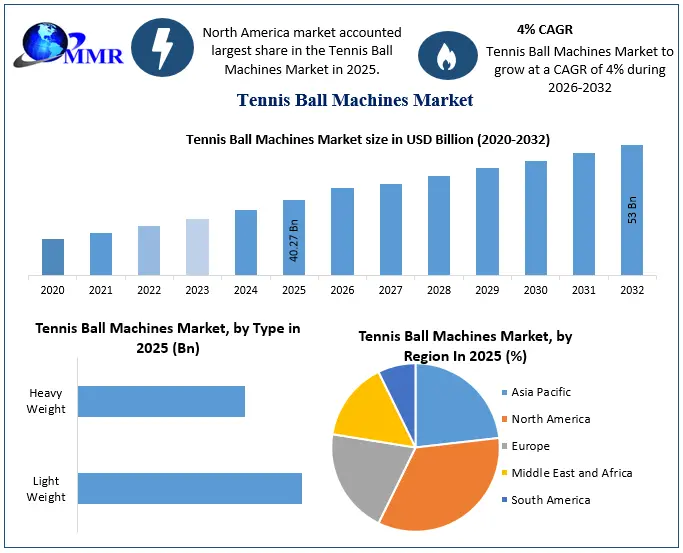
- Global Tennis Ball Machines Market valued at USD 40.27 Billion in 2025.
- Market projected to reach nearly USD 53 Billion by 2032.
- Expected CAGR of 4% during 2026–2032.
- Lightweight machines hold the dominant market position.
- Rising participation among young tennis players is accelerating demand.
- Mobile app integration is creating a new competitive battleground.
- North America remains the leading regional market.
- Schools, colleges, and sports development programs are expanding the addressable customer base.
Why This Matters Now
Tennis training is becoming more automated at the same time sports organizations face growing pressure to develop talent efficiently. That combination is changing purchasing decisions across clubs, academies, schools, and individual players.
The Tennis Ball Machines Market is no longer defined solely by equipment performance. Manufacturers are increasingly competing on portability, affordability, and digital functionality. For industry participants, that shift changes product design priorities, distribution strategies, and customer acquisition models.
Market Overview
The global Tennis Ball Machines Market was valued at USD 40.27 Billion in 2025 and is expected to reach nearly USD 53 Billion by 2032, expanding at a CAGR of 4%. This growth indicates sustained demand despite a relatively mature sports equipment category. For manufacturers, it signals an opportunity to generate recurring revenue through innovation rather than relying solely on replacement cycles.
The market is benefiting from broader participation in lawn tennis. As more players enter the sport, demand for independent training solutions increases. Tennis ball machines provide repetitive, consistent practice sessions without requiring a training partner, making them attractive across skill levels.
What once served primarily professional environments is increasingly moving into recreational and educational settings. This transition is expanding the customer base beyond traditional tennis academies.
Key Trends Driving Growth
A major growth catalyst is the increasing number of young tennis players worldwide. Rising participation creates demand for training tools that accelerate skill development and improve practice efficiency. For suppliers, youth engagement directly translates into a larger long-term customer pipeline.
Portability has emerged as a decisive purchasing factor. Lightweight and affordable machines are gaining traction because they reduce barriers to ownership. This trend suggests the market is moving away from heavy institutional equipment toward products designed for broader consumer adoption.
Another notable shift is the integration of Android and iOS applications. Mobile connectivity transforms a training machine into a digital coaching platform. The implication is significant: future competition may increasingly revolve around software capabilities rather than mechanical performance alone.
The growing acceptance of lightweight systems further indicates that convenience is becoming as important as functionality. Manufacturers that simplify transportation, setup, and operation are likely to capture greater market share.
Educational adoption is also emerging as a growth avenue. The inclusion of tennis within school curricula creates institutional demand and introduces younger athletes to automated training technologies early in their development journey.
Request Your Free Sample Copy for Detailed Market Data
Segment Insights
- Dominant Segment: Lightweight Tennis Ball Machines
- The lightweight segment holds the largest market share globally.
- Strong adoption among amateur and younger players is driving demand.
- Portability and ease of use are becoming core purchase criteria.
- Fastest-Growing Segment: Not specified in the MMR report.
- No fastest-growing segment data was provided in the source report.
- Power Categories
- Electric-powered machines.
- Battery-powered machines.
- End-Use Categories
- Sports clubs.
- Schools and colleges.
- Personal users.
- Distribution Channels
- Supermarkets and hypermarkets.
- E-commerce.
- Specialty stores.
Regional Growth Story
North America holds the largest share of the global Tennis Ball Machines Market, with Europe following closely behind. The dominance of these regions stems from a combination of infrastructure availability, institutional support, and active efforts to promote tennis among younger generations.
Government-backed funding initiatives for tennis training programs across schools and universities have strengthened the market foundation. For manufacturers, this means demand is increasingly supported by structured programs rather than discretionary consumer spending alone.
The regional leadership of North America also suggests that markets with established tennis ecosystems remain critical revenue centers. Companies seeking expansion will likely focus on replicating similar development models in emerging regions.
Competitive Landscape
The market includes players such as Ace Attack, Silent Partner Tennis, SIBOASI, Lobster Sports, Playmate, Spinfire, Sports Tutor, Match Mate Tennis, BABOLAT VS S.A., Penn Racquet Sports, Wilson, and others.
The competitive dynamic reveals a market in transition. Traditional manufacturers built their positions through hardware reliability and training performance. Today, however, app integration, portability, and affordability are becoming equally important differentiators.
This signals a broader shift in competitive strategy. Product development cycles are likely to increasingly focus on connected features and user experience. Rivals that continue competing solely on mechanical specifications may face pressure as customer expectations evolve.
Over the next 12–24 months, competition is expected to intensify around smart functionality, lightweight design, and user accessibility. Companies capable of combining performance with digital engagement are likely to gain strategic advantages.
Recent Developments
- Increasing integration of Android applications with tennis ball machines.
- Growing adoption of iOS-enabled training systems.
- Rising demand for lightweight and portable machine designs.
- Expansion of tennis programs within educational institutions.
- Greater focus on affordable machines targeting amateur players.
Strategic Implications
The industry is moving beyond equipment manufacturing into technology-enabled training ecosystems. Companies that combine hardware, software, and user engagement capabilities can build stronger customer retention and brand loyalty.
For distributors, e-commerce channels create opportunities to reach recreational players directly. For educational institutions and sports clubs, automated training systems offer scalable coaching solutions without proportionally increasing staffing requirements.
Investors should closely monitor companies developing integrated digital experiences. The next phase of competition may be determined by software functionality as much as machine performance.
Future Outlook
The Tennis Ball Machines Market is expected to maintain steady expansion through 2032, supported by rising tennis participation, lightweight product adoption, and increasing smartphone integration. Market opportunities will continue to emerge across schools, clubs, and personal training environments.
The companies that successfully combine portability, affordability, and digital intelligence will shape the next generation of tennis training, while those that remain focused solely on traditional equipment risk losing relevance in a rapidly evolving market.
Analyst Perspective
“The Tennis Ball Machines Market is entering a phase where accessibility and technology are becoming as important as performance. As participation in tennis expands and digital integration becomes standard, manufacturers that align innovation with user convenience will be best positioned to capture future growth opportunities.” — Siddhi Dole, Analyst
About Maximize Market Research
Maximize Market Research Pvt. Ltd. (MMR) is a global market research and consulting company that provides reliable, data-focused, and practical business insights. The firm serves a wide range of industries, including healthcare, pharmaceuticals, technology, automotive, electronics, chemicals, personal care, and consumer goods. Through market forecasts, competitive analysis, strategic consulting, and industry impact assessments, MMR helps organizations understand changing market conditions, identify growth opportunities, and make informed business decisions for long-term success.
Contact Us
2nd Floor, Navale IT Park Phase 3
Pune Banglore Highway, Narhe
Pune, Maharashtra 411041, India
+91 9607365656
sales@maximizemarketresearch.com
