Key Highlights
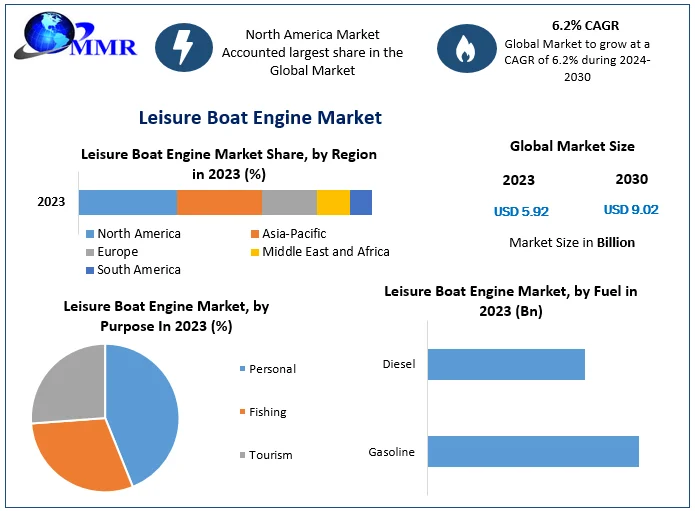
- Leisure Boat Engine Market projected to reach USD 9.54 billion by 2030.
- Market expected to grow at a CAGR of 5.8% during the forecast period.
- Recreational boating participation continues driving engine demand.
- Marine tourism expansion is creating sustained growth opportunities.
- North America remains one of the leading regional markets.
- Technological advancements in marine propulsion systems support product upgrades.
- Environmental regulations are influencing engine development strategies.
Why This Matters Now
Marine engine manufacturers face a strategic inflection point. Consumers increasingly demand performance, fuel efficiency, reliability, and environmental compliance from recreational vessels, forcing OEMs to rethink propulsion technologies.
At the same time, rising recreational boating activity and marine tourism are expanding the addressable market. Companies capable of balancing performance, efficiency, and regulatory compliance will gain competitive advantage as the leisure marine industry enters its next growth phase.
For suppliers, investors, and marine mobility strategists, propulsion systems have become one of the most critical value-creation areas within the recreational boating ecosystem.
Market Overview
Leisure Boat Engine Player Market form the core propulsion systems powering recreational vessels used for personal transportation, tourism, sport fishing, water sports, and leisure activities. Demand for these engines is closely tied to consumer participation in boating activities and investments in marine recreation infrastructure.
According to Maximize Market Research, the Leisure Boat Engine Market is projected to reach USD 9.54 billion by 2030 while expanding at a CAGR of 5.8% during the forecast period.
The market is benefiting from growing disposable incomes, increasing interest in outdoor recreation, and expanding marine tourism activities. Consumers are allocating greater spending toward lifestyle experiences, creating favorable conditions for boat sales and associated engine demand.
The business implication is significant. Every increase in recreational boating participation supports demand not only for new engines but also for upgrades, replacements, maintenance services, and associated marine technologies.
Key Trends Driving Growth
One of the strongest growth drivers is increasing recreational boating activity.
Consumers across multiple regions are showing growing interest in boating as a leisure activity. This trend supports demand for both new vessels and replacement propulsion systems.
Marine tourism continues creating additional opportunities.
Coastal tourism, recreational marinas, water sports facilities, and charter boating operations all contribute to increasing demand for reliable marine propulsion solutions. As tourism infrastructure expands, fleet operators require engines capable of delivering performance while maintaining operational efficiency.
Technological innovation remains a major competitive factor.
Manufacturers are focusing on improving engine performance, fuel efficiency, durability, and reliability. These improvements help boat owners reduce operating costs while enhancing the overall boating experience.
Environmental compliance is becoming increasingly important.
Regulatory pressure related to emissions and fuel consumption is encouraging manufacturers to develop cleaner and more efficient propulsion systems. This trend is influencing future product development strategies across the industry.
Consumer expectations are also changing.
Modern buyers increasingly prioritize advanced features, lower maintenance requirements, and improved fuel economy when selecting leisure boat engines.
𝐃𝐨𝐰𝐧𝐥𝐨𝐚𝐝 𝐏𝐃𝐅 𝐁𝐫𝐨𝐜𝐡𝐮𝐫𝐞 @ https://www.maximizemarketresearch.com/request-sample/72756/
Segment Insights
- Dominant Segment – Outboard Engines: Outboard engines continue to represent a major market segment due to their flexibility, ease of maintenance, and broad applicability across recreational boat categories.
- Fastest-Growing Segment – Not Explicitly Specified: The supplied MMR report does not explicitly identify the fastest-growing segment. No unsupported claim has been included.
- Application Opportunity – Recreational Boating: Recreational boating remains the primary demand generator within the market.
- Technology Focus: Fuel-efficient propulsion systems continue gaining attention as consumers and operators seek lower operating costs.
- Growth Opportunity: Marine tourism expansion is creating opportunities for engine suppliers across commercial leisure and recreational boating segments.
Regional Growth Story
North America remains one of the most important markets for leisure boat engines.
The region benefits from strong boating culture, established marina infrastructure, significant recreational boating participation, and a large installed base of leisure vessels. These factors continue supporting both new engine demand and replacement cycles.
The United States remains a key contributor due to widespread boating participation and substantial spending on recreational marine activities.
Europe also represents a significant market opportunity.
Countries with established marine tourism industries and recreational boating traditions continue generating demand for advanced marine propulsion systems. Regulatory focus on environmental performance is encouraging adoption of more efficient engine technologies.
Asia-Pacific is emerging as an attractive growth region.
Rising disposable incomes, expanding tourism sectors, and increasing participation in recreational water activities are creating favorable conditions for future market expansion. Coastal development projects and marina investments are further supporting long-term demand.
These regional dynamics suggest that future growth will be driven by a combination of mature-market replacement demand and emerging-market recreational boating adoption.
Competitive Landscape
Competition increasingly centers on technology, efficiency, and brand reputation.
Engine manufacturers are competing to deliver higher performance, improved fuel efficiency, greater durability, and compliance with environmental standards. These factors directly influence purchasing decisions within the leisure marine industry.
The competitive implications are substantial.
Manufacturers capable of delivering advanced propulsion systems gain stronger positions among boat builders, dealers, and end users. Product innovation also supports pricing power in premium market segments.
Environmental regulations are reshaping competitive priorities.
Companies investing in cleaner propulsion technologies are positioning themselves ahead of future compliance requirements while responding to evolving consumer preferences.
The market increasingly rewards suppliers that combine engineering excellence with strong distribution networks and aftermarket support capabilities.
Recent Developments
- Manufacturers continue investing in fuel-efficient propulsion technologies.
- Marine tourism growth is supporting demand for leisure boating equipment.
- Recreational boating participation continues expanding across key markets.
- Environmental compliance requirements are influencing engine development programs.
- Product innovation remains a central competitive strategy across leading manufacturers.
Strategic Implications
The Leisure Boat Engine Market illustrates how lifestyle spending trends can influence industrial supply chains.
For manufacturers, future success depends on balancing performance, efficiency, and regulatory compliance. Consumers increasingly expect premium experiences while maintaining manageable operating costs.
For suppliers, opportunities extend beyond engine sales into maintenance services, replacement parts, dealer networks, and customer support ecosystems.
For investors, the market offers exposure to a recreational industry supported by tourism growth, consumer spending, and product innovation.
The supplied MMR report does not provide specific information regarding EV adoption rates, battery-electric marine propulsion, hydrogen fuel systems, autonomous boating technologies, semiconductor dependencies, trade flows, manufacturing capacity expansion, pricing trends, or fleet electrification statistics. These topics have therefore been omitted in accordance with the source rule.
Future Outlook
The companies that successfully combine propulsion efficiency, regulatory readiness, product innovation, and strong marine distribution networks will emerge as the long-term leaders in the Leisure Boat Engine Market.
Analyst Perspective
“The Leisure Boat Engine Market continues to benefit from rising recreational boating participation, expanding marine tourism, and growing demand for efficient propulsion systems. Manufacturers that prioritize innovation, reliability, and environmental compliance will be best positioned to capture future growth opportunities.” — Tejaswini Kakade, Research Analyst
About Maximize Market Research
Maximize Market Research Pvt. Ltd. (MMR) is a global market research and consulting company that provides reliable, data-focused, and practical business insights. The firm serves a wide range of industries, including healthcare, pharmaceuticals, technology, automotive, electronics, chemicals, personal care, and consumer goods. Through market forecasts, competitive analysis, strategic consulting, and industry impact assessments, MMR helps organizations understand changing market conditions, identify growth opportunities, and make informed business decisions for long-term success.
2nd Floor, Navale IT Park Phase 3
Pune Banglore Highway, Narhe
Pune, Maharashtra 411041, India
+91 9607365656
sales@maximizemarketresearch.com
