Key Highlights
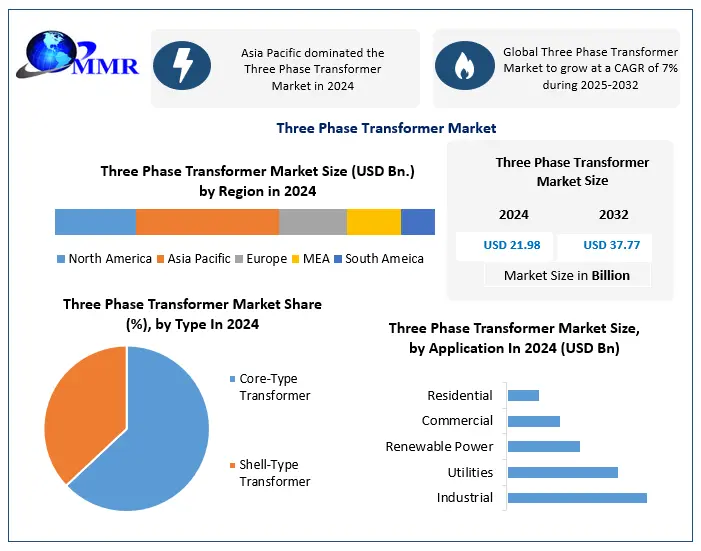
- Three Phase Transformer Market valued at USD 21.98 billion in 2024.
- Market projected to reach USD 37.77 billion by 2032.
- Forecast CAGR stands at 7% between 2025 and 2032.
- Asia-Pacific remains the largest regional market.
- Utilities emerged as the dominant application segment in 2024.
- 2,500–10,000 kVA capacity transformers led the market.
- Grid modernization and renewable energy integration continue to drive deployment.
Why This Matters Now
Automotive manufacturers, charging network operators, and fleet electrification planners face a growing challenge: vehicle electrification requires a power grid capable of handling significantly higher and more dynamic electricity demand. The transformer market has become a strategic infrastructure story rather than a traditional electrical equipment category.
As EV adoption accelerates and governments expand charging infrastructure, demand for reliable power distribution is rising across industrial zones, logistics hubs, manufacturing facilities, and utility networks. Three-phase transformers sit at the center of that transition, enabling efficient power transfer, grid stability, and large-scale electrification initiatives.
Market Overview
The global Three Phase Transformer Market was valued at USD 21.98 billion in 2024 and is expected to reach nearly USD 37.77 billion by 2032, growing at a CAGR of 7%. Rising electricity consumption across industrial and commercial sectors remains the primary growth engine.
The business case extends well beyond traditional utility applications. Electrified transportation systems, EV charging corridors, battery manufacturing facilities, renewable energy projects, and industrial automation all require higher levels of power reliability and efficiency.
Power quality has become increasingly important as industries deploy sensitive electronic systems, advanced automation equipment, and digitally connected operations. Voltage instability and power interruptions create operational risks that can damage critical infrastructure. Three-phase transformers help mitigate these risks while improving energy efficiency and power reliability.
For automotive manufacturers, this means transformer investments are becoming part of broader electrification strategies. Gigafactories, EV assembly plants, and charging infrastructure networks depend on resilient power distribution systems capable of supporting continuous high-load operations.
Key Trends Driving Growth
Grid modernization is emerging as the most significant market catalyst. Utilities worldwide are upgrading aging transmission and distribution infrastructure to improve efficiency and reduce energy losses. These investments directly increase transformer deployment across power networks.
Renewable energy integration is creating additional demand. Solar and wind projects require transformer systems capable of connecting decentralized generation assets to national grids. The market’s leading capacity range, 2,500–10,000 kVA, has benefited from this trend because it offers a balance between power delivery capability and installation economics.
The transportation sector adds another layer of growth. Fleet electrification programs, public charging infrastructure, and electric bus deployments require substantial upgrades to local distribution networks. Every fast-charging hub ultimately depends on transformer capacity.
Industrial expansion across emerging markets is also supporting demand. Growing manufacturing activity, especially in Asia-Pacific, continues to increase electricity requirements for production facilities and industrial parks.
Supply-side dynamics are becoming increasingly important. Transformer manufacturers are expanding production capacity globally to address equipment shortages and long lead times. Industry investment signals confidence that electricity demand growth will remain strong through the next decade.
Need more information? Inquire about a sample report now
Segment Insights
- Dominant Application Segment: Utilities. The segment led the market in 2024, supported by smart grid investments, transmission upgrades, and large-scale electrification programs. Government initiatives focused on reducing power losses and improving grid efficiency accelerated deployments.
- Dominant Capacity Segment: 2,500–10,000 kVA transformers. These units gained the largest market share due to widespread use in utility networks and renewable energy integration projects.
- Type Segments: Core-type and shell-type transformers continue to serve diverse industrial and utility applications.
- Application Coverage: Industrial, commercial, residential, utilities, and renewable power sectors contribute to market demand, creating diversified revenue streams for suppliers.
- Cooling Technologies: Dry-type and oil-immersed transformer systems remain key technology categories serving different operating environments.
Regional Growth Story
Asia-Pacific remains the leading market for three-phase transformers, supported by its extensive manufacturing base and expanding small- and medium-sized industrial sectors. The region continues to benefit from large-scale industrialization, urbanization, and infrastructure development.
China and India are particularly important growth engines. Grid upgrades, industrial expansion, renewable energy deployment, and transportation electrification programs are creating sustained demand for power distribution equipment.
North America is experiencing strong momentum driven by infrastructure modernization, industrial investment, and growing electricity demand from EV charging networks, data centers, and manufacturing facilities. Transformer suppliers are responding with significant manufacturing investments aimed at reducing supply shortages and improving equipment availability.
Europe continues to benefit from decarbonization initiatives, renewable energy integration, and industrial electrification efforts. Germany remains a critical market due to its manufacturing strength and energy transition programs.
Japan and South Korea continue investing in advanced industrial infrastructure and grid reliability improvements, supporting long-term transformer demand.
Competitive Landscape
Competition increasingly centers on manufacturing capacity, delivery timelines, and technology capabilities rather than price alone.
Recent industry investments indicate a strategic race to secure transformer supply amid rising demand. Manufacturers expanding production capacity are positioning themselves to capture opportunities linked to grid modernization, renewable energy integration, and transportation electrification.
The competitive environment also highlights growing importance of supply-chain resilience. Long lead times and equipment shortages have elevated the value of manufacturers with strong production networks and localized manufacturing capabilities. Companies capable of guaranteeing delivery schedules gain stronger negotiating leverage with utilities and infrastructure developers.
For suppliers, capacity expansion signals confidence in sustained infrastructure spending. For customers, it provides greater assurance that critical projects can proceed without equipment-related delays.
Recent Developments
- Utilities worldwide continue investing in smart-grid and transmission modernization projects.
- Countries including India and China are accelerating grid upgrade initiatives to improve efficiency and reliability.
- Transformer manufacturers are expanding production facilities to address supply shortages and growing infrastructure demand.
- Rising renewable energy deployment is increasing demand for grid-scale transformer installations.
- Electrification of transportation networks is creating new demand for power distribution infrastructure.
Strategic Implications
For automotive OEMs, transformer availability increasingly influences EV manufacturing expansion and charging infrastructure deployment. Electrification strategies cannot scale without parallel investment in power infrastructure.
For utilities, transformer procurement is becoming a long-term strategic planning exercise. Rising demand, supply constraints, and infrastructure modernization programs require earlier purchasing decisions and stronger supplier relationships.
For investors, transformer manufacturers represent direct beneficiaries of global electrification trends. Demand growth is supported by multiple structural drivers, including renewable energy, industrial expansion, data centers, and transportation electrification.
For policymakers, transformer deployment remains essential to achieving decarbonization and electrification targets. Grid readiness will determine the pace of EV adoption and industrial electrification.
Future Outlook
The Three Phase Transformer Market is moving from a conventional electrical equipment segment to a strategic enabler of energy transition and transportation electrification. Utilities, renewable developers, industrial operators, and mobility stakeholders are converging around the same infrastructure requirement: reliable, scalable power distribution.
As electricity demand rises and grid modernization accelerates, market growth will increasingly favor suppliers that combine manufacturing scale, delivery reliability, and technology expertise. The companies that secure capacity today will shape the electrified economy of tomorrow, while those that delay investment risk becoming bottlenecks in the energy transition.
Analyst Perspective
“The Three Phase Transformer Market is entering a phase where infrastructure investment, industrial expansion, and electrification initiatives are reinforcing each other. Utilities remain the primary growth engine, while renewable energy integration and transportation electrification are creating new long-term opportunities across global markets.” — Dharati Raut
About Maximize Market Research
Maximize Market Research Pvt. Ltd. (MMR) is a global market research and consulting company that provides reliable, data-focused, and practical business insights. The firm serves a wide range of industries, including healthcare, pharmaceuticals, technology, automotive, electronics, chemicals, personal care, and consumer goods. Through market forecasts, competitive analysis, strategic consulting, and industry impact assessments, MMR helps organizations understand changing market conditions, identify growth opportunities, and make informed business decisions for long-term success.
Contact Us
2nd Floor, Navale IT Park Phase 3
Pune Banglore Highway, Narhe
Pune, Maharashtra 411041, India
+91 9607365656
sales@maximizemarketresearch.com
