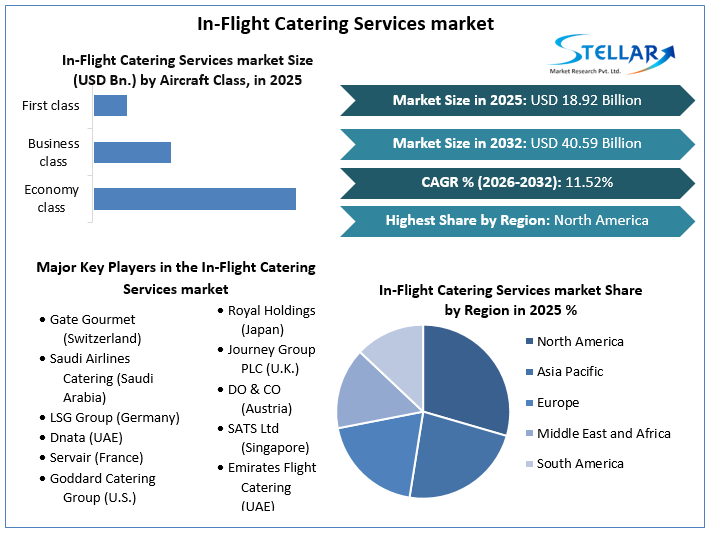
PUNE, June 18, 2026 The In-Flight Catering Services Market is entering a new growth phase as airlines increasingly compete through premium passenger experiences, customized onboard dining, and sustainability-focused catering operations. According to the latest Stellar Market Research analysis, the market is expected to grow from USD 18.92 billion in 2025 to USD 40.59 billion by 2032, registering a CAGR of 11.52% during 2026–2032. The report highlights how airlines are transforming food service from a support function into a strategic differentiator that influences passenger satisfaction, ancillary revenues, and brand loyalty.
Market Opportunity Overview
The aviation industry is witnessing a structural shift in how onboard food and beverage services are designed, delivered, and monetized. Airlines are increasingly leveraging catering partnerships, digital meal pre-ordering systems, premium menu offerings, and sustainable packaging solutions to enhance customer experience and improve operational efficiency.
As global passenger traffic continues to recover and expand, particularly across Asia-Pacific and the Middle East, airlines are investing heavily in catering innovation. The emergence of health-conscious travelers, demand for regional cuisine options, and rising expectations among business and premium-class passengers are creating new opportunities for catering providers.
Simultaneously, airline operators are seeking greater flexibility through outsourced catering models, allowing specialized providers to improve scalability, food quality, and supply chain resilience.
Download Free PDF Brochure:https://www.stellarmr.com/report/req_sample/In-Flight-Catering-Services-Market/1169
Key Findings from the Report
- The market is projected to reach USD 40.59 billion by 2032, expanding at a CAGR of 11.52%.
- Economy Class remains the dominant aircraft-class segment due to its large passenger base and high meal volumes.
- Business Class catering is emerging as the fastest-growing segment as airlines compete through premium onboard experiences.
- By food type, Meals account for the largest revenue share owing to growing demand for nutritious and customized food offerings.
- Asia-Pacific leads the global market, supported by rising air passenger traffic, airline fleet expansion, and tourism growth.
- The Middle East and Africa region is emerging rapidly due to aviation infrastructure investments and international transit traffic growth.
- Outsourced catering models continue to gain momentum as airlines focus on operational efficiency and cost optimization.
Market Drivers and Restraints
Key Drivers
Rising Global Air Passenger Traffic
Increasing leisure travel, business travel recovery, and expansion of international flight routes are generating sustained demand for onboard catering services.
Premiumization of Airline Services
Airlines are differentiating themselves through gourmet menus, chef-designed meals, regional cuisine selections, and personalized dining experiences, particularly in business and first-class cabins.
Growth in Ancillary Revenue Strategies
Low-cost and full-service carriers alike are using onboard food sales and premium meal upgrades to generate additional revenue streams.
Key Restraints
Volatile Food and Logistics Costs
Fluctuations in raw material prices, transportation costs, and supply chain disruptions can impact catering profitability.
Stringent Aviation Safety and Food Compliance Requirements
Airline caterers must comply with rigorous food safety, hygiene, and operational regulations, increasing operational complexity and costs.
Technology, Regulation, and Sustainability Trends
The industry is increasingly adopting digital technologies to improve forecasting, meal planning, inventory management, and passenger personalization. AI-enabled demand forecasting helps reduce food waste while improving inventory utilization.
Airlines and catering providers are also implementing digital meal pre-order systems that allow passengers to select meals before departure, improving customer satisfaction and reducing excess food production.
From a regulatory perspective, stricter food safety protocols and aviation compliance standards are encouraging investment in traceability systems, cold-chain management, and quality assurance technologies.
Sustainability is becoming a critical competitive factor. Airlines and caterers are replacing single-use plastics with biodegradable packaging, reducing food waste, sourcing local ingredients, and implementing circular economy initiatives to meet ESG objectives.
Download Free PDF Brochure:https://www.stellarmr.com/report/req_sample/In-Flight-Catering-Services-Market/1169
Recent Industry Developments
gategroup (2025): Expanded digital meal personalization capabilities across multiple airline customers, improving passenger engagement and reducing catering waste.
Emirates Flight Catering (2025): Increased investments in sustainable food production and packaging initiatives to support airline decarbonization objectives and waste reduction programs.
dnata Catering & Retail (2025): Expanded airport catering infrastructure and operational capacity across major international aviation hubs to meet rising passenger demand.
SATS Ltd. (2024): Strengthened airline catering partnerships in Asia-Pacific while investing in automation technologies to improve operational efficiency and food consistency.
DO & CO (2024): Expanded premium culinary offerings through strategic airline collaborations, targeting growing demand for luxury onboard dining experiences.
Regional Insights
Asia-Pacific Leads Global Growth
Asia-Pacific remains the largest market due to strong passenger growth in China, India, Southeast Asia, and other emerging aviation markets. Rising disposable incomes, expanding airline fleets, and increasing international tourism continue to drive demand for sophisticated onboard catering services.
Middle East and Africa Emerging as Strategic Growth Hub
Countries such as the UAE and Saudi Arabia are investing heavily in aviation infrastructure and international connectivity. Expanding transit traffic and airline network growth are creating substantial opportunities for catering providers.
North America and Europe Focus on Premiumization
Mature aviation markets in the United States, Germany, France, and the United Kingdom are emphasizing premium dining experiences, sustainability initiatives, and digital transformation to maintain competitive differentiation.
Competitive Landscape
The market remains moderately consolidated, with leading companies pursuing strategic partnerships, capacity expansion, service innovation, and sustainability initiatives.
Key participants include Gate Gourmet, Saudi Airlines Catering, LSG Group, dnata, Servair, Newrest Catering, DO & CO, SATS Ltd., Emirates Flight Catering, and Royal Holdings. Market leaders are increasingly investing in automation, AI-enabled forecasting systems, premium culinary partnerships, and environmentally responsible packaging solutions.
Strategic collaborations with airlines remain a key competitive advantage, enabling catering providers to secure long-term contracts and expand service portfolios.
Analyst Commentary
“The next phase of growth in the in-flight catering industry will be defined by personalization, sustainability, and operational intelligence. Airlines increasingly recognize onboard dining as a strategic touchpoint that influences passenger loyalty and ancillary revenue generation. Providers that combine culinary innovation with digital capabilities and sustainable operations will be best positioned to capture future market opportunities,” said a Senior Research Analyst at Stellar Market Research.
Future Outlook
Through 2032, demand for in-flight catering services is expected to be driven by continued expansion of global aviation networks, rising passenger expectations, and increasing airline investments in premium experiences.
Technology adoption will accelerate across forecasting, inventory management, and passenger personalization functions. Sustainability regulations and ESG commitments will further encourage investments in waste reduction, sustainable sourcing, and eco-friendly packaging solutions.
As competition among airlines intensifies, catering providers capable of delivering scalable, customized, and environmentally responsible services are expected to gain significant market share.
About Stellar Market Research
Stellar Market Research is a global market research and business consulting firm delivering actionable intelligence across industries including aerospace, healthcare, technology, manufacturing, consumer goods, energy, and transportation. The company provides comprehensive market assessments, competitive benchmarking, strategic forecasting, and growth opportunity analysis to help organizations make informed business decisions. Leveraging robust research methodologies, data analytics, and industry expertise, Stellar Market Research supports enterprises, investors, and policymakers with reliable insights that drive innovation, investment planning, and sustainable growth strategies across global and regional markets.
Media Contact
Stellar Market Research
Address: Phase 3, Navale IT Zone, S.No. 51/2A/2, Office No. 202, 2nd Floor, Near Navale Bridge, Narhe, Pune, Maharashtra 411041
Website: http://stellarmr.com/
Email: sales@stellarmr.com
Mobile: +91 9607365656
