Key Highlights
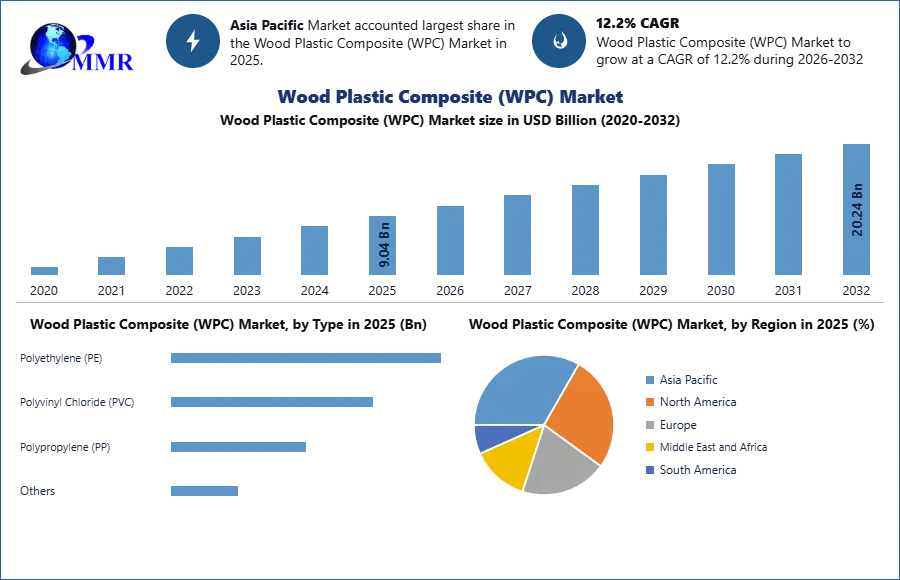
- Global Wood Plastic Composite (WPC) Market valued at USD 9.04 Billion in 2025 and projected to reach USD 20.24 Billion by 2032.
- Market expected to expand at a CAGR of 12.2% between 2026 and 2032.
- Building and construction products remain the largest application segment globally.
- Recycled material adoption is increasing in automotive manufacturing applications.
- Asia-Pacific is emerging as a major growth center driven by urbanization and infrastructure spending.
- Polyethylene-based WPC products dominate product demand due to durability and cost efficiency.
- Strategic investments are strengthening recycling capabilities and manufacturing capacity across the value chain.
Why This Matters Now
Material suppliers, automotive manufacturers, construction firms, and infrastructure investors are confronting the same challenge: delivering sustainability targets without sacrificing performance or profitability.
Wood Plastic Composite materials are increasingly positioned at the center of that transition. Governments are encouraging recycled content adoption, construction companies are seeking durable alternatives to traditional timber, and manufacturers are looking for lightweight materials that can support cost optimization and environmental compliance. The result is a market projected to more than double in value by 2032.
For executives across construction and industrial manufacturing, the shift is no longer about product substitution. It is becoming a competitive positioning strategy.
Market Overview
The global Wood Plastic Composite (WPC) Market is entering a period of accelerated commercialization. Valued at USD 9.04 Billion in 2025, the sector is forecast to reach nearly USD 20.24 Billion by 2032. Growth is being fueled by demand for durable, low-maintenance, and environmentally responsible materials across construction, automotive, and industrial applications.
WPC combines wood fibers with thermoplastics such as polyethylene (PE), polypropylene (PP), polyvinyl chloride (PVC), and polylactic acid (PLA). The resulting material offers high durability, low moisture absorption, improved strength, and extended lifecycle performance compared with traditional wood products.
The business case is becoming stronger as sustainability requirements tighten globally. Manufacturers can leverage recycled plastics and wood waste streams while delivering products with lower maintenance costs and longer operational life.
Key Trends Driving Growth
The first major trend is the rapid expansion of sustainable construction practices. Builders are increasingly adopting WPC for decking, fencing, flooring, railings, landscaping, and exterior applications because of its durability and lower maintenance requirements.
The second trend is growing automotive interest in recycled composite materials. Vehicle manufacturers are evaluating lightweight and sustainable materials to support environmental targets and material efficiency strategies. Increased use of recycled WPC materials in automotive manufacturing is becoming an important growth avenue for suppliers.
Technology is also reshaping the competitive landscape. Advanced extrusion and injection molding processes are improving moisture resistance, UV stability, and structural performance. These improvements are expanding WPC adoption beyond traditional applications into higher-value industrial uses.
A fourth trend is the shift toward modular and prefabricated construction. Lightweight and customizable composite materials fit well with faster construction methods, creating new demand channels across residential and commercial infrastructure projects.
𝐃𝐨𝐰𝐧𝐥𝐨𝐚𝐝 𝐏𝐃𝐅 𝐁𝐫𝐨𝐜𝐡𝐮𝐫𝐞 @ https://www.maximizemarketresearch.com/request-sample/76219/
Segment Insights
- Dominant Segment: Building and Construction Products
- Largest market share globally.
- Demand driven by windows, railings, fencing, flooring, landscaping materials, and exterior applications.
- Benefits include durability, moisture resistance, and reduced maintenance costs.
- Fastest-Growing Opportunity Segment: Automotive Components
- Increasing adoption of recycled WPC materials in vehicle manufacturing.
- Supports lightweighting initiatives and sustainability objectives.
- Creates new opportunities for composite suppliers serving automotive OEMs and Tier-1 manufacturers.
- Leading Material Segment
- Polyethylene-based WPC products dominate due to cost efficiency and performance advantages.
- Strong demand across residential and commercial applications.
- Leading End-Use Industry
- Residential applications account for the largest share of demand globally.
- Growth linked to renovation activity, outdoor living trends, and sustainable housing projects.
Regional Growth Story
Asia-Pacific is becoming the industry’s most important growth engine. China and India are benefiting from large-scale infrastructure investments, urban development programs, and industrial expansion. These factors are driving substantial demand for sustainable construction materials and advanced composite products.
Europe continues to benefit from sustainability regulations and policies supporting recycled materials. Regulatory emphasis on circular economy practices is encouraging broader adoption of WPC across construction and industrial sectors.
North America remains a significant market, supported by mature construction activity, outdoor living trends, and demand for low-maintenance building materials. Composite decking, fencing, and landscaping products continue to gain acceptance among residential and commercial users.
For suppliers, the regional story is increasingly about manufacturing proximity, feedstock availability, and access to recycled material streams.
Competitive Landscape
Competition is shifting from product differentiation toward ecosystem control.
Manufacturers that secure recycled polymer supply chains are strengthening cost positions while meeting sustainability requirements. This creates advantages in both pricing power and customer acquisition.
The acquisition of Northwest Polymers by The AZEK Company signals that access to recycled PVC is becoming a strategic asset rather than simply a sourcing consideration. The move enhances vertical integration and strengthens long-term supply security.
Capacity expansion initiatives are also intensifying. Companies investing in new manufacturing facilities are positioning themselves to capture future demand while improving scale economics. As adoption expands globally, production capacity could become a key competitive differentiator.
Major players include Trex Company, The AZEK Company, Fiberon, UFP Industries, Advanced Environmental Recycling Technologies, TAMKO Building Products, and CertainTeed.
Recent Developments
- Trex Company (2026): Launched Trex Refuge ignition-resistant decking, expanding its portfolio for fire-sensitive markets and strengthening premium product positioning.
- The AZEK Company (2025): Acquired Northwest Polymers to expand recycled PVC capabilities and strengthen circular economy leadership.
- Fiberon (2026): Introduced Novus fused composite decking with enhanced aesthetics and a 50-year performance proposition, targeting premium construction projects.
- UFP Industries (2025): Expanded production capacity through a new facility investment designed to significantly increase composite decking output.
Strategic Implications
The market’s next phase will be defined by three factors: recycled feedstock access, manufacturing scale, and product innovation.
Companies controlling recycled material inputs can better manage cost volatility while meeting customer sustainability requirements. Firms investing in advanced polymer formulations and production technologies will likely capture premium margins.
For investors, the strongest opportunities may emerge where sustainability regulation, construction growth, and recycling infrastructure converge.
For manufacturers, delaying investment in circular supply chains could create long-term competitive disadvantages.
Future Outlook
The companies that combine recycled material leadership, manufacturing scale, and advanced composite innovation will define the next decade of growth in the global Wood Plastic Composite market.
Analyst Perspective
“Wood Plastic Composite materials are moving beyond traditional construction applications and becoming a strategic sustainability solution across multiple industries. Companies investing in recycling capabilities, advanced materials technology, and scalable production infrastructure are expected to capture the greatest value as global demand accelerates.” — Tejaswini Kakade, Research Analyst
About Maximize Market Research
Maximize Market Research Pvt. Ltd. (MMR) is a global market research and consulting company that provides reliable, data-focused, and practical business insights. The firm serves a wide range of industries, including healthcare, pharmaceuticals, technology, automotive, electronics, chemicals, personal care, and consumer goods. Through market forecasts, competitive analysis, strategic consulting, and industry impact assessments, MMR helps organizations understand changing market conditions, identify growth opportunities, and make informed business decisions for long-term success.
2nd Floor, Navale IT Park Phase 3
Pune Banglore Highway, Narhe
Pune, Maharashtra 411041, India
+91 9607365656
sales@maximizemarketresearch.com
