Market Overview
The DC Contactor Market is gaining momentum as industrial operators seek higher reliability, improved safety, and greater control over direct current power systems. DC contactors are critical switching devices used across electric vehicles, battery energy storage systems, renewable power installations, industrial machinery, transportation infrastructure, and automation environments.
What changed is the scale of electrification. Electric mobility, renewable generation, and distributed energy systems have significantly increased the number of applications requiring sophisticated DC switching capabilities. This shift is creating demand for products capable of handling higher voltages, greater switching frequencies, and increasingly connected operating environments.
For manufacturers and automation suppliers, DC contactors are becoming an enabling technology for next-generation industrial systems.
Key Trends Driving Growth
The strongest growth catalyst comes from electric vehicle expansion. DC contactors are essential for battery disconnect functions, charging systems, and high-voltage power management. As EV production increases, suppliers of switching technologies are seeing greater demand from automotive OEMs and charging infrastructure developers. This creates opportunities for manufacturers capable of delivering higher reliability and safety performance.
Renewable energy and energy storage deployment represent another major growth driver. Solar installations, battery storage facilities, and smart grid projects require robust DC switching solutions to manage power flows safely and efficiently. The transition toward decentralized energy architectures is expanding the addressable market for advanced contactor technologies.
Industrial automation is creating a parallel growth path. Modern manufacturing facilities increasingly depend on automated equipment, intelligent motor controls, and digitally managed power systems. As factories pursue operational efficiency and uptime improvements, DC contactors are becoming integral to broader automation architectures.
Industry 4.0 initiatives are also influencing product design. End users are demanding equipment that supports predictive maintenance strategies, remote monitoring capabilities, and integration with factory management platforms. This trend aligns with broader adoption of industrial IoT, edge computing, and connected operational technology environments.
Artificial intelligence is indirectly influencing demand as well. AI-driven manufacturing systems require stable power management infrastructure capable of supporting automated operations, robotics integration, machine vision systems, and increasingly digital production environments.
Request a Free Sample Copy or View Report Summary::https://www.maximizemarketresearch.com/request-sample/146784/
Segment Insights
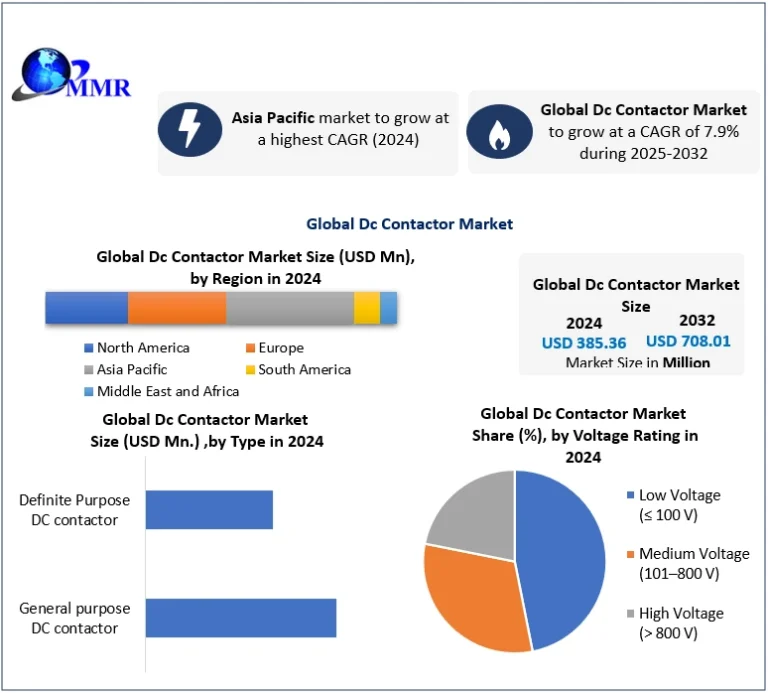
- Dominant Segment: General-purpose DC contactors lead market adoption due to broad utilization across industrial automation, power switching, motor control, and protection applications. Their versatility makes them attractive for both legacy and modern electrified systems.
- Dominant End-Use Segment: Electric vehicles represent the leading application segment as automakers expand electrified vehicle production and charging infrastructure deployment.
- Fastest-Growing Opportunity Segment: Renewable energy and energy storage applications are emerging as one of the most attractive growth areas due to accelerating investments in grid modernization and clean energy infrastructure.
- Industrial Automation Opportunity: Manufacturing modernization initiatives are increasing deployment across industrial machinery, factory automation systems, and intelligent power management environments.
- Technology Trend: Advanced arc suppression technologies, compact high-current designs, remote monitoring capabilities, and predictive maintenance features are becoming key differentiators.
Regional Growth Story
Asia-Pacific remains the most influential region in the DC Contactor Market. The region benefits from strong manufacturing ecosystems, rapid EV adoption, renewable energy investments, and large-scale industrial modernization programs. China, India, Japan, and South Korea continue to invest aggressively in electrification and industrial digitization initiatives.
China’s manufacturing scale and leadership in electric mobility are creating substantial demand for DC switching technologies. Investments in renewable power generation, charging infrastructure, and advanced manufacturing continue to strengthen the market environment.
India is emerging as a significant growth opportunity due to expanding industrial automation programs, infrastructure development, and increasing electrification efforts. Industrial modernization and domestic manufacturing initiatives are expected to support sustained demand.
Germany remains a critical European market because of its advanced industrial automation ecosystem and strong Industry 4.0 adoption. Demand is closely linked to smart factory deployment, industrial control systems, and manufacturing productivity initiatives.
The United States continues to benefit from investments in grid modernization, industrial automation, defense applications, and energy infrastructure upgrades. These investments support long-term opportunities for intelligent switching and control technologies.
Competitive Landscape
Competition is increasingly centered on technology leadership rather than component supply alone. Leading manufacturers including ABB, Schneider Electric, Siemens, Eaton, Mitsubishi Electric, Rockwell Automation, and TE Connectivity are focusing on performance, reliability, and integration capabilities.
The strategic signal is clear. Customers increasingly want switching devices that integrate into broader automation ecosystems. This pushes suppliers toward intelligent diagnostics, predictive maintenance functionality, and compatibility with digital manufacturing environments.
Product innovation around arc suppression, thermal management, compact form factors, and higher voltage capabilities reflects a market preparing for more demanding electrification applications. Companies that align product portfolios with smart factory and energy transition requirements are positioning themselves for long-term competitive advantage.
Recent Developments
- Manufacturers are advancing arc suppression technologies to improve safety and operational reliability.
- Product development is increasingly focused on compact, high-current DC contactors for EV and industrial applications.
- Remote monitoring and predictive maintenance capabilities are being integrated into next-generation solutions.
- Renewable energy and battery storage projects are expanding deployment opportunities globally.
- Industrial automation investments continue to increase demand across manufacturing and process industries.
Strategic Implications
For automation providers, the DC Contactor Market represents a gateway into broader electrification and digital transformation programs. The value proposition is shifting from switching performance to operational intelligence.
For manufacturers, integrating intelligent power control into automation architectures can improve uptime, support predictive maintenance strategies, and enhance operational efficiency.
For investors, the market offers exposure to multiple structural growth themes simultaneously: EV expansion, renewable energy deployment, industrial automation, smart manufacturing, and grid modernization.
Future Outlook
The next phase of market evolution will be defined by intelligent electrification. DC contactors will increasingly function as connected assets within industrial IoT ecosystems, supporting predictive maintenance, autonomous operations, and digitally optimized power management.
As factories become more automated and energy systems become more decentralized, demand will favor suppliers capable of combining switching performance with data intelligence, cybersecurity readiness, and integration into Industry 4.0 architectures.
The competitive divide will not be between companies that sell contactors and those that do not—it will be between manufacturers that enable autonomous, digitally connected industrial operations and those still supplying standalone hardware.
Analyst Perspective
“The DC Contactor Market is increasingly tied to the global shift toward electrification, industrial automation, and smart energy infrastructure. Organizations that align product innovation with digital manufacturing, renewable energy integration, and intelligent power management will be best positioned to capture long-term value creation opportunities.” — Neha Nalawade, Research Analyst
About Maximize Market Research
Maximize Market Research Pvt. Ltd. (MMR) is a global market research and consulting company that provides reliable, data-focused, and practical business insights. The firm serves a wide range of industries, including healthcare, pharmaceuticals, technology, automotive, electronics, chemicals, personal care, and consumer goods. Through market forecasts, competitive analysis, strategic consulting, and industry impact assessments, MMR helps organizations understand changing market conditions, identify growth opportunities, and make informed business decisions for long-term success.
2nd Floor, Navale IT Park Phase 3
Pune Banglore Highway, Narhe
Pune, Maharashtra 411041, India
+91 9607365656
sales@maximizemarketresearch.com
