Key Highlights
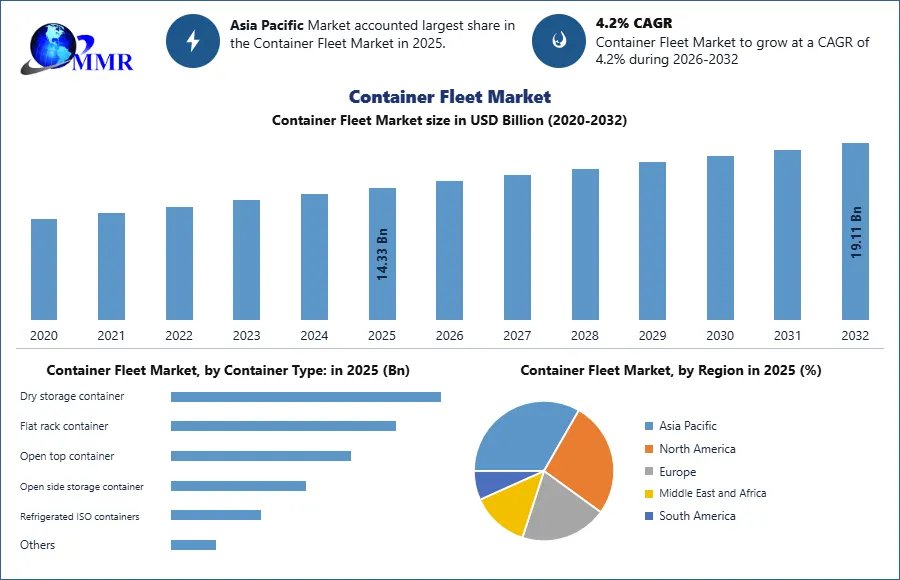
- Container Fleet Market was valued at USD 14.33 billion in 2025.
- Market revenue is expected to reach nearly USD 20.59 billion by 2032.
- Forecast CAGR stands at 4.2% during 2025–2032.
- Asia Pacific remains the largest regional market supported by manufacturing and export activity.
- Digitalization, smart containers, and logistics automation are emerging competitive differentiators.
- Major operators continue expanding fleet capacity, terminal networks, and integrated logistics services.
- Sustainability initiatives and emissions reduction programs are influencing fleet investment decisions.
Why This Matters Now
Container fleet operators are entering a new phase where scale alone is no longer enough. Fleet visibility, digital intelligence, operational efficiency, and integrated logistics capabilities are becoming decisive factors in winning cargo volumes and protecting margins.
For investors, fleet owners, logistics providers, and transportation strategists, the market’s next growth cycle will be shaped by technology adoption, trade route shifts, infrastructure investment, and competitive capacity expansion. Companies that modernize fleets and strengthen logistics ecosystems are positioned to capture disproportionate market share as global trade volumes continue to recover and expand.
Market Overview
The global Container Fleet Market was valued at USD 14.33 billion in 2025 and is projected to grow at a CAGR of 4.2%, reaching nearly USD 20.59 billion by 2032. The industry remains a critical component of global commerce, enabling standardized transportation across maritime, rail, and road networks. Containerization continues to reduce logistics costs, improve cargo handling efficiency, and support international trade growth.
The market’s growth trajectory is closely linked to globalization, rising cross-border commerce, and expanding e-commerce activity. Businesses increasingly depend on reliable containerized transportation to maintain supply chain resilience and meet delivery expectations across global markets. As a result, fleet operators are investing in technology, network optimization, and service integration to strengthen competitive positioning.
Unlike traditional transportation assets, container fleets are increasingly becoming data-driven infrastructure. Smart tracking systems, real-time monitoring capabilities, and automated logistics platforms are changing how fleets are managed, maintained, and utilized. This shift is creating new opportunities for operational efficiency and customer service differentiation.
Key Trends Driving Growth
Digital transformation has become one of the most influential forces shaping the container fleet industry. Smart containers equipped with sensors and tracking technologies provide real-time visibility into cargo conditions, location, and operational status. These capabilities help operators improve asset utilization while reducing delays and inefficiencies.
Sustainability has moved from a compliance issue to a strategic business priority. Shipping companies are increasingly focused on reducing emissions and improving environmental performance. Fleet modernization programs, route optimization technologies, and operational efficiency initiatives are becoming important investment areas across the industry.
The rapid expansion of e-commerce continues to create demand for reliable, scalable transportation networks. Online retailers require consistent international shipping capacity, driving demand for containerized freight solutions and encouraging fleet operators to expand service offerings.
Infrastructure investment is also reshaping market dynamics. Port modernization projects, terminal expansions, and logistics network upgrades are improving throughput capacity and supporting long-term demand growth. Strategic investments by major operators signal confidence in future trade volumes despite near-term market volatility.
Need more information? Inquire about a sample report now
Segment Insights
- Dominant Segment: Dry Storage Containers
Dry storage containers account for the leading share of the market due to their widespread use across consumer goods, industrial products, retail merchandise, and general cargo transportation. Their versatility and standardized design make them essential assets in global shipping networks. - Container Types Covered
Dry storage containers, flat rack containers, open-top containers, open-side storage containers, refrigerated ISO containers, and other specialized formats serve diverse cargo requirements across industries. - Size Segmentation
Small containers (20 feet), large containers (40 feet), and high-cube containers form the core fleet categories used across international logistics operations. - End-Use Industries
Food & beverages, consumer goods, healthcare, industrial products, and vehicle transport continue to generate significant demand for containerized transportation services. - Fastest-Growing Segment
The report identifies multiple container categories but does not specify a fastest-growing segment. Therefore, no further conclusion is provided.
Regional Growth Story
Asia Pacific remains the center of gravity for the Container Fleet Market. The region’s manufacturing dominance, export-oriented economies, and extensive port infrastructure support strong demand for containerized freight transportation. China, India, Japan, South Korea, and Southeast Asian economies continue to play central roles in global trade flows.
China’s position as a manufacturing powerhouse and export hub continues to drive fleet utilization rates. India is attracting increasing attention from global shipping operators, with major companies expanding capacity and logistics investments to capture growing trade opportunities.
Europe and North America remain critical markets due to their consumption-driven import demand and sophisticated logistics infrastructure. These regions continue investing in digital supply chain solutions and port modernization to improve operational efficiency.
Emerging markets across South America, the Middle East, and Africa are also contributing to growth as trade corridors expand and infrastructure investments improve connectivity.
Competitive Landscape
Competition remains concentrated among global shipping leaders including Maersk Line, Mediterranean Shipping Company, CMA CGM Group, COSCO Shipping Lines, Hapag-Lloyd, and other major operators. These companies compete through fleet scale, route coverage, logistics integration, technology investments, and terminal ownership.
Recent strategic moves indicate a shift toward vertically integrated logistics models. Capacity expansion, terminal investments, and broader supply chain services signal that future competition will increasingly center on end-to-end logistics capabilities rather than vessel capacity alone.
Technology leadership is becoming another source of competitive advantage. Operators investing in digital visibility, predictive analytics, and smart container technologies are likely to gain stronger customer retention and operational efficiency.
Recent Developments
- Smart container deployment continues to expand across major global shipping networks to improve cargo visibility and fleet utilization.
- Major shipping companies are investing in sustainability initiatives aimed at reducing emissions and improving environmental performance.
- CMA CGM announced plans to expand operational capacity and increase investments in India through terminals and logistics infrastructure.
- Leading operators continue fleet renewal and vessel investment programs to improve operational efficiency and competitiveness.
Strategic Implications
The industry is moving toward a model where operational intelligence matters as much as physical assets. Fleet operators capable of combining container capacity, digital visibility, terminal infrastructure, and logistics services will have stronger pricing power and customer retention.
For transportation companies, the challenge is balancing capacity expansion with market demand fluctuations. Recent investment announcements demonstrate confidence in long-term trade growth, but they also raise questions about future supply-demand balance and freight rate stability.
Investors should monitor digital adoption rates, sustainability investments, and infrastructure expansion projects, as these factors are likely to determine future market leadership.
Future Outlook
The Container Fleet Market is entering a phase where technology-enabled logistics, sustainable operations, and integrated supply chain capabilities will define competitive success; companies that modernize fleets and expand logistics ecosystems will lead, while operators relying solely on capacity growth risk losing relevance.
Analyst Perspective
“The Container Fleet Market is transitioning from a capacity-driven industry to a technology-enabled logistics ecosystem. Operators that combine fleet scale with digital intelligence, sustainability initiatives, and integrated supply chain services will be best positioned to capture future growth opportunities across global trade networks.” — Dharati Raut
About Maximize Market Research
Maximize Market Research Pvt. Ltd. (MMR) is a global market research and consulting company that provides reliable, data-focused, and practical business insights. The firm serves a wide range of industries, including healthcare, pharmaceuticals, technology, automotive, electronics, chemicals, personal care, and consumer goods. Through market forecasts, competitive analysis, strategic consulting, and industry impact assessments, MMR helps organizations understand changing market conditions, identify growth opportunities, and make informed business decisions for long-term success.
Contact us
2nd Floor, Navale IT Park Phase 3
Pune Banglore Highway, Narhe
Pune, Maharashtra 411041, India
+91 9607365656
sales@maximizemarketresearch.com
