Market Overview
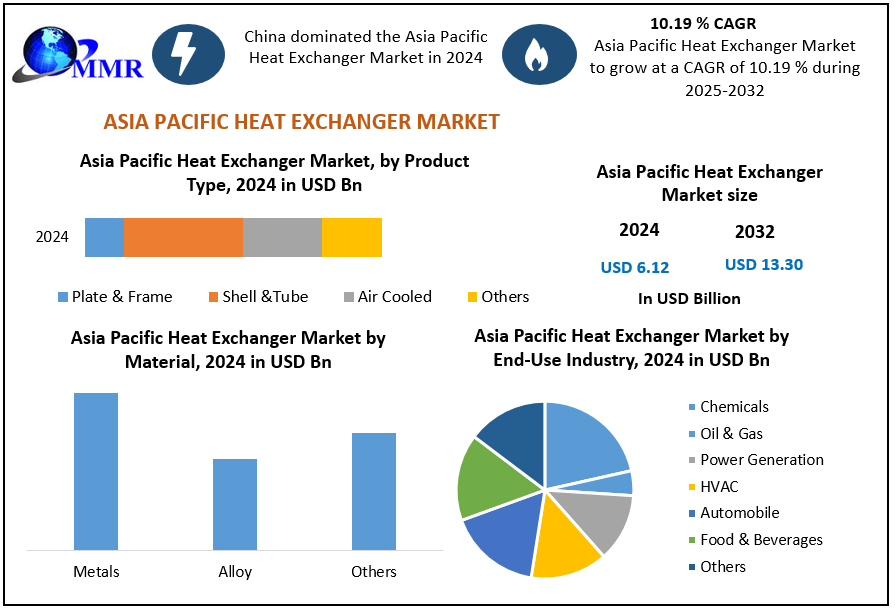
The Asia Pacific Heat Exchanger Market is entering a phase of accelerated expansion as industrial facilities prioritize energy-efficient operations and advanced process management. According to Maximize Market Research, the market was valued at USD 6.12 billion in 2024 and is expected to reach nearly USD 13.30 billion by 2032, growing at a CAGR of 10.19%.
That growth carries a broader implication for manufacturers. Every percentage point of thermal efficiency improvement can reduce operating expenses, improve equipment reliability, and strengthen competitiveness in increasingly cost-sensitive industries.
The demand base extends across chemicals, oil and gas, power generation, food processing, HVAC, and heavy manufacturing. These sectors are investing in technologies that improve heat recovery, reduce energy waste, and support sustainable production objectives. As industrial facilities become more digitized, thermal management infrastructure is becoming an essential component of overall plant performance.
Key Trends Driving Growth
Industrial efficiency has become the dominant investment theme across Asia Pacific manufacturing. Heat exchangers align directly with that objective by enabling better energy utilization and process control.
One major trend is the integration of heat recovery systems into industrial operations. Manufacturers are seeking to capture and reuse waste heat generated during production processes. This reduces energy consumption while supporting corporate sustainability goals.
Another important development is the modernization of HVAC infrastructure across commercial and industrial facilities. As smart buildings and intelligent manufacturing campuses expand, demand for efficient thermal management solutions continues to increase.
Industry 4.0 initiatives are also creating new opportunities. Connected production environments generate operational data that can be used to optimize equipment performance. Heat exchanger systems increasingly form part of broader predictive maintenance programs, allowing operators to identify performance degradation before it affects production.
Industrial IoT adoption is supporting this transition. Sensors embedded within thermal systems provide continuous monitoring of temperatures, pressure levels, flow rates, and efficiency metrics. This visibility helps maintenance teams improve uptime and reduce unexpected shutdowns.
The growing focus on carbon reduction is another catalyst. Companies seeking to lower emissions are prioritizing technologies that improve energy productivity, making advanced heat transfer systems an attractive investment.
Request a Free Sample Copy or View Report Summary:https://www.maximizemarketresearch.com/request-sample/21424/
Segment Insights
- Dominant Segment: Shell-and-tube heat exchangers continue to maintain strong market leadership due to their durability, operational flexibility, and suitability for high-pressure industrial applications. Their widespread use across process industries supports sustained demand.
- Fastest-Growing Segment: Plate-and-frame heat exchangers are emerging as the fastest-growing segment. Their compact design, higher thermal efficiency, and lower maintenance requirements make them increasingly attractive for modern industrial facilities focused on process optimization and space efficiency.
- Manufacturing operators increasingly favor solutions that deliver greater heat transfer performance while minimizing energy consumption.
- Compact and modular designs are gaining attention as factories seek flexible infrastructure that can be integrated into automated production environments.
- Process industries continue to prioritize technologies capable of supporting continuous operations with minimal downtime.
Regional Growth Story
China remains a central force in regional demand because of its extensive manufacturing ecosystem, industrial output, and ongoing investment in production modernization.
India is emerging as one of the most significant growth opportunities within the region. Expanding industrial infrastructure, manufacturing investments, and increasing energy-efficiency requirements are creating strong demand for thermal management technologies. Multiple industry forecasts identify India among the fastest-growing markets for heat exchanger adoption.
Japan and South Korea continue to support market expansion through advanced manufacturing capabilities and technology-driven industrial operations. Their focus on precision engineering and operational efficiency aligns closely with the deployment of high-performance heat transfer systems.
Across Southeast Asia, industrial expansion, urbanization, and infrastructure development are creating additional opportunities for equipment suppliers, system integrators, and engineering service providers.
Competitive Landscape
Competition is increasingly centered on technology leadership rather than equipment supply alone.
Leading manufacturers are focusing on improving thermal efficiency, corrosion resistance, lifecycle performance, and operational reliability. These priorities reflect broader shifts occurring across industrial automation and smart manufacturing environments.
The strategic significance is clear. Companies capable of delivering higher efficiency equipment position themselves as productivity partners rather than component suppliers. That transition strengthens customer relationships and creates opportunities for long-term service contracts.
Innovation is also moving toward digitally enabled asset management. As industrial facilities expand predictive maintenance capabilities, suppliers that support performance monitoring and operational analytics gain a competitive advantage.
The competitive landscape therefore signals a market evolving from hardware-focused procurement toward performance-based industrial solutions.
Recent Developments
- Increased emphasis on energy-efficient industrial infrastructure across manufacturing sectors.
- Growing adoption of advanced heat transfer technologies in process industries.
- Expansion of industrial modernization initiatives focused on reducing operational costs.
- Rising integration of monitoring and maintenance capabilities within thermal management systems.
- Strong investment activity across manufacturing, HVAC, power generation, and industrial processing applications.
Strategic Implications
For manufacturers, the market shift is about more than thermal management. It represents a broader move toward operational intelligence.
Plant operators increasingly evaluate heat exchangers based on total lifecycle value rather than upfront acquisition costs. Reliability, efficiency, maintenance requirements, and sustainability outcomes now influence purchasing decisions.
Automation leaders should view thermal systems as part of an integrated operational technology architecture. Connected equipment, predictive maintenance tools, industrial analytics, and process optimization platforms create measurable productivity gains when deployed together.
Investors also see opportunity. Companies positioned at the intersection of energy efficiency, industrial digitization, and manufacturing modernization are likely to benefit from sustained capital spending across the region.
Future Outlook
The next phase of growth will be defined by the convergence of thermal efficiency, digital operations, and sustainable manufacturing. As factories become more connected and data-driven, heat exchangers will increasingly operate as intelligent assets within broader industrial ecosystems.
Organizations that integrate advanced thermal management into Industry 4.0 strategies will gain stronger control over energy consumption, operational reliability, and production economics. Those that delay modernization risk higher operating costs and declining competitiveness as smart manufacturing becomes the standard rather than the exception.
Analyst Perspective
“The Asia Pacific Heat Exchanger Market is moving beyond conventional equipment replacement cycles and becoming a strategic investment area for manufacturers focused on energy efficiency, productivity, and sustainable industrial growth. Companies that align thermal management with digital operations will be best positioned to capture long-term value creation opportunities.” — Neha Nalawade, Research Analyst
About Maximize Market Research
Maximize Market Research Pvt. Ltd. (MMR) is a global market research and consulting company that provides reliable, data-focused, and practical business insights. The firm serves a wide range of industries, including healthcare, pharmaceuticals, technology, automotive, electronics, chemicals, personal care, and consumer goods. Through market forecasts, competitive analysis, strategic consulting, and industry impact assessments, MMR helps organizations understand changing market conditions, identify growth opportunities, and make informed business decisions for long-term success.
2nd Floor, Navale IT Park Phase 3
Pune Banglore Highway, Narhe
Pune, Maharashtra 411041, India
+91 9607365656
sales@maximizemarketresearch.com
