Market Overview
The Waste Heat Recovery System Market is gaining momentum as industries seek greater efficiency from existing assets. Historically viewed as an energy conservation tool, waste heat recovery is now becoming a strategic component of industrial transformation initiatives.
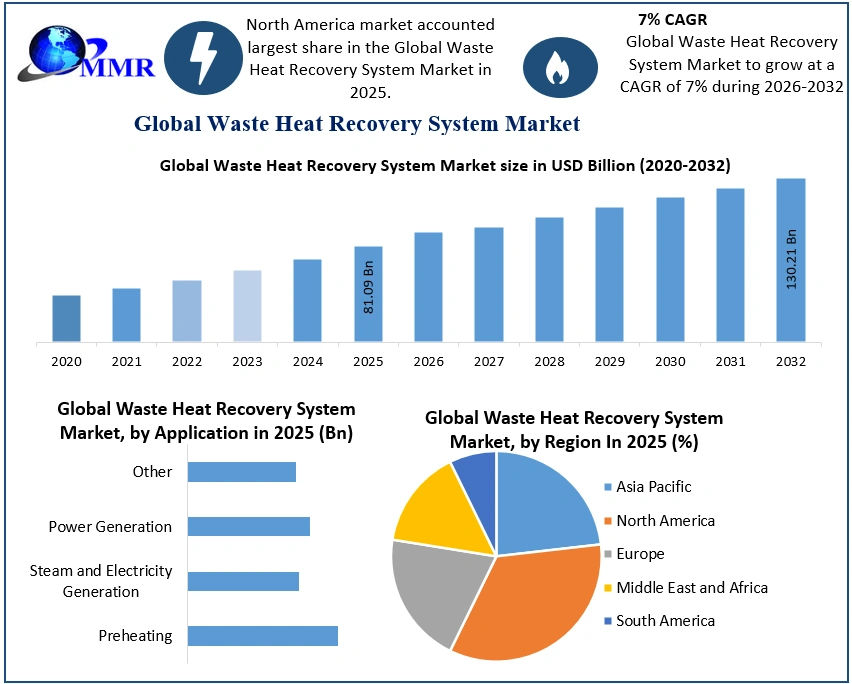
The market is expected to reach approximately US$ 68 billion by 2026, growing at a CAGR of about 6.8%. This growth reflects rising industrial energy demand, stricter environmental requirements, and increasing investment in sustainable manufacturing infrastructure. Every percentage point of energy recovered translates directly into lower operating costs, making waste heat recovery systems increasingly attractive across heavy industrial sectors.
Manufacturers are also aligning these investments with broader decarbonization goals. As enterprises pursue net-zero strategies, technologies that simultaneously reduce emissions and improve profitability are moving rapidly up the capital investment agenda.
Key Trends Driving Growth
The most significant shift is the convergence of energy recovery technologies with digital industrial platforms. Modern facilities increasingly deploy sensors, connected controls, and real-time monitoring systems to maximize thermal recovery performance.
Industrial IoT adoption is enabling operators to continuously monitor heat flows, equipment efficiency, and energy utilization across production environments. This visibility allows plant managers to identify previously hidden sources of energy loss and optimize recovery rates.
Predictive maintenance is becoming another critical enabler. Advanced analytics can identify performance degradation in heat exchangers, boilers, and recovery units before failures occur. This minimizes downtime while improving asset utilization.
Artificial intelligence is beginning to influence thermal optimization strategies as manufacturers seek automated control of energy-intensive processes. Integration with SCADA, DCS, and plant-wide energy management systems is creating more responsive and efficient industrial ecosystems.
The broader Industry 4.0 movement is accelerating these trends. Smart factories are increasingly treating waste heat as a recoverable digital asset rather than an unavoidable byproduct of production.
Request a Free Sample Copy or View Report Summary:https://www.maximizemarketresearch.com/request-sample/14979/
Segment Insights
- Dominant Segment: Petroleum Refining – Petroleum refining remains the largest end-use segment due to its high energy consumption and continuous process operations. Refiners are increasingly deploying waste heat recovery technologies to reduce fuel use, improve efficiency, and support emissions reduction targets.
- Dominant Application Segment: Steam and Power Generation – Steam and power generation continues to represent a major application area as industrial operators seek greater energy self-sufficiency and reduced dependence on external power sources.
- Dominant Phase System Segment: Liquid-Liquid Phase Systems – These systems maintain leadership due to their reliability and extensive use in petroleum refining and power applications.
- Fastest-Growing Phase System Segment: Liquid-Gas Phase Systems – Growing adoption in chemical manufacturing is supporting rapid expansion as producers seek higher energy efficiency and process optimization.
- Emerging Opportunity: Energy-intensive industries including chemicals, cement, metals, paper, and pulp are increasingly integrating waste heat recovery into broader digital transformation programs.
Regional Growth Story
Europe remains a leading market for waste heat recovery deployment. Strong regulatory frameworks, ambitious decarbonization targets, and high industrial energy costs have accelerated adoption across manufacturing sectors. The region’s emphasis on sustainable industrial competitiveness continues to support investment in energy recovery technologies.
Asia-Pacific is emerging as the next major growth engine. Rapid industrialization in China and India is increasing demand for energy-efficient manufacturing infrastructure. As these economies expand industrial output while pursuing sustainability objectives, waste heat recovery systems are becoming essential investments rather than optional upgrades.
The United States, Germany, Japan, South Korea, and India are particularly important because they combine advanced manufacturing ecosystems with strong automation adoption. These markets are expected to drive innovation in integrated energy management, smart factory deployment, and industrial digitization strategies.
Competitive Landscape
Competition is increasingly centered on technological integration rather than hardware alone. Major participants include Siemens Energy, ABB, General Electric, Mitsubishi Power, IHI Corporation, and Forbes Marshall.
Their strategic positioning reveals a broader industry shift. Companies are increasingly combining heat recovery technologies with digital monitoring, automation controls, predictive maintenance capabilities, and integrated energy management solutions.
This evolution signals a future where waste heat recovery systems become embedded within connected industrial platforms. Vendors capable of delivering both energy efficiency and operational intelligence are likely to gain competitive advantage.
The competitive landscape also suggests growing convergence between energy technology providers, automation vendors, and industrial software companies. As factories become more autonomous, energy recovery systems will increasingly function as intelligent operational assets rather than standalone equipment.
Recent Developments
- Harvest Power Systems introduced a new waste heat recovery solution designed to reduce operating costs and emissions through improved energy management.
- Solex acquired Econotherm Ltd., strengthening capabilities in industrial waste heat recovery technologies and expanding expertise across multiple heat exchange applications.
- Industrial operators continue investing in waste heat recovery power generation systems to increase energy independence and improve operational resilience.
Strategic Implications
For manufacturing executives, waste heat recovery is increasingly a productivity investment rather than an environmental expenditure.
Plant managers benefit through lower energy intensity, improved process efficiency, and reduced exposure to energy price fluctuations. Automation leaders gain opportunities to integrate thermal management into broader digital operations strategies.
Technology providers face growing demand for solutions that combine energy recovery, industrial analytics, predictive maintenance, and process automation. The market is moving toward integrated platforms capable of optimizing both production output and energy utilization simultaneously.
Investors should view this trend as part of the wider industrial efficiency transformation. Companies that help manufacturers capture previously wasted energy are becoming central to the next phase of industrial modernization.
Future Outlook
The next phase of market growth will be defined by the fusion of waste heat recovery systems with AI-driven operations, industrial IoT architectures, predictive maintenance platforms, and autonomous energy optimization.
As factories become increasingly connected, thermal energy will be monitored, analyzed, and optimized in real time alongside production assets. The competitive advantage will shift from simply recovering heat to intelligently managing energy across entire industrial ecosystems.
Manufacturers that digitize energy recovery and integrate it into Industry 4.0 operations will create measurable productivity advantages, while those that continue treating waste heat as a lost resource risk falling behind in the race toward autonomous industrial performance.
Analyst Perspective
“Waste heat recovery is transitioning from an energy-saving initiative into a strategic manufacturing capability. Organizations that combine recovery technologies with automation, digital monitoring, and process intelligence will be positioned to capture both efficiency gains and long-term competitive advantage,” said Neha Nalawade, Research Analyst.
About Maximize Market Research
Maximize Market Research Pvt. Ltd. (MMR) is a global market research and consulting company that provides reliable, data-focused, and practical business insights. The firm serves a wide range of industries, including healthcare, pharmaceuticals, technology, automotive, electronics, chemicals, personal care, and consumer goods. Through market forecasts, competitive analysis, strategic consulting, and industry impact assessments, MMR helps organizations understand changing market conditions, identify growth opportunities, and make informed business decisions for long-term success.
2nd Floor, Navale IT Park Phase 3
Pune Banglore Highway, Narhe
Pune, Maharashtra 411041, India
+91 9607365656
sales@maximizemarketresearch.com
