Market Overview
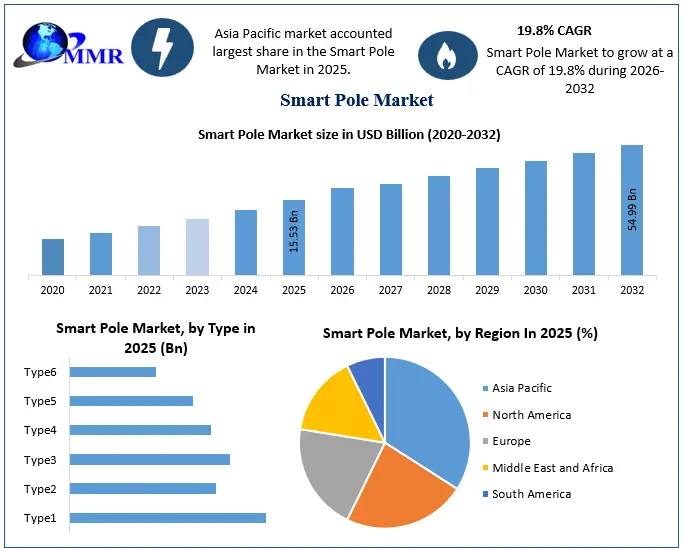
The Smart Pole Market is entering a period of accelerated expansion as governments, municipalities, telecom operators, and infrastructure developers seek to maximize the value of existing urban assets. The market was valued at USD 15.53 billion in 2025 and is expected to reach nearly USD 54.99 billion by 2032, growing at a CAGR of 19.8%. This growth signals a major infrastructure investment cycle centered on connectivity, sustainability, and urban intelligence.
Smart poles combine multiple technologies within a single structure. Modern deployments integrate LED lighting, renewable energy systems, battery storage, 5G and LTE small cells, public Wi-Fi, surveillance cameras, environmental sensors, EV charging capabilities, and public communication systems. The consolidation of these functions reduces infrastructure duplication while increasing operational efficiency.
The strategic importance extends beyond urban development. Smart poles increasingly function as edge-computing endpoints capable of collecting, processing, and transmitting data in real time. This creates new opportunities for AI-driven analytics, predictive operations, and automated city management systems.
Key Trends Driving Growth
The strongest market catalyst is the global deployment of 5G infrastructure. Telecom operators require dense networks of small cells to achieve coverage and capacity objectives. Smart poles provide an efficient platform for these installations while minimizing additional construction requirements. This transforms municipal infrastructure into revenue-generating digital assets.
Industrial IoT adoption is also influencing deployment strategies. Smart poles equipped with environmental sensors, traffic monitoring systems, cameras, and communication modules generate continuous streams of operational data. Municipal operators can leverage this information to improve traffic flow, energy consumption, public safety, and asset utilization.
AI-powered automation is emerging as a differentiator. Advanced smart pole systems increasingly support video analytics, intelligent surveillance, anomaly detection, crowd monitoring, and predictive infrastructure management. These capabilities reduce manual intervention while improving service quality and response times.
Sustainability objectives are creating another growth avenue. Smart poles equipped with solar and wind energy technologies, combined with LED lighting systems, help cities reduce energy consumption and carbon emissions while supporting broader environmental goals.
Request a Free Sample Copy or View Report Summary:https://www.maximizemarketresearch.com/request-sample/33495/
Segment Insights
- Dominant Segment: Integrated smart pole solutions featuring LED lighting, communication infrastructure, surveillance systems, and IoT sensors continue to lead adoption because they deliver multiple operational functions through a single infrastructure investment.
- Fastest-Growing Segment: 5G-enabled smart pole deployments are experiencing rapid expansion as telecom operators accelerate small-cell rollouts to meet connectivity demands and support next-generation digital services.
- Environmental monitoring applications are gaining momentum as cities prioritize air quality measurement and sustainability reporting.
- Public safety applications continue expanding through integrated surveillance, emergency communications, and real-time monitoring capabilities.
- EV charging integration is creating new infrastructure monetization opportunities while supporting transportation electrification strategies.
Regional Growth Story
Asia-Pacific remains one of the most significant growth engines for smart pole deployment. Rapid urbanization, large-scale smart city programs, and expanding telecommunications infrastructure are driving investments across China and India. These countries are increasingly integrating IoT platforms, cloud technologies, and connected infrastructure into urban development initiatives.
China continues to advance smart city modernization through extensive digital infrastructure deployment. The combination of 5G expansion and urban digitization programs creates favorable conditions for large-scale smart pole installations.
India represents another high-potential market as city modernization programs increasingly focus on connected public infrastructure, intelligent transportation systems, and energy-efficient urban services. Smart poles align closely with these objectives by delivering multiple capabilities through a unified platform.
Meanwhile, the United States, Germany, Japan, and South Korea continue investing in advanced connectivity, intelligent mobility systems, and digital public services. These markets are likely to remain innovation leaders as AI, edge computing, and smart infrastructure technologies mature.
Competitive Landscape
Competition is shifting from hardware supply toward ecosystem leadership. Success increasingly depends on integrating telecommunications infrastructure, IoT platforms, AI analytics, cybersecurity capabilities, and energy management systems into a unified solution.
Technology providers that combine connectivity, data intelligence, and operational automation are positioning themselves for long-term leadership. The market is moving beyond standalone lighting projects toward fully integrated digital infrastructure platforms capable of supporting future smart city applications.
Competitive activity also signals growing convergence between telecommunications, automation, software, and infrastructure industries. Vendors capable of delivering scalable, interoperable platforms are likely to capture the highest-value opportunities as cities seek long-term digital transformation partners rather than equipment suppliers.
Recent Developments
- Smart pole deployments increasingly incorporate 5G/LTE small-cell infrastructure to improve network coverage and capacity.
- AI-enabled surveillance and analytics functions are becoming standard features in next-generation installations.
- Renewable energy integration through solar and wind technologies is expanding sustainability-focused deployments.
- Municipalities are adopting multi-service smart pole platforms that combine connectivity, safety, environmental monitoring, and communications.
- Telecom operators and city administrations are increasing collaboration to accelerate smart infrastructure deployment.
Strategic Implications
For automation providers, smart poles represent a new edge-computing layer that extends digital intelligence into physical environments. The opportunity is no longer limited to lighting infrastructure. It includes data analytics, AI applications, sensor networks, cybersecurity, predictive maintenance, and digital service delivery.
For telecom operators, smart poles offer a cost-efficient path to network densification. For city administrators, they provide a scalable foundation for digital governance. For investors, they represent a convergence point between infrastructure modernization and digital transformation.
The broader implication is clear: infrastructure is becoming software-defined, data-driven, and increasingly autonomous.
Future Outlook
The next phase of market growth will be defined by AI-enabled urban operations, edge intelligence, integrated sensor ecosystems, and hyper-connected infrastructure. As cities evolve into real-time digital environments, smart poles will increasingly function as intelligent control points supporting automation, communications, sustainability, and public services simultaneously.
The organizations that treat smart poles as strategic digital infrastructure will lead the next era of urban automation, while those that view them as lighting assets alone risk missing a defining Industry 4.0 transformation.
Analyst Perspective
“Smart poles are evolving from municipal lighting assets into intelligent digital infrastructure platforms that enable connectivity, sustainability, public safety, and real-time operational intelligence. Their role in supporting smart city ecosystems will continue expanding as 5G, IoT, and AI adoption accelerate globally.” — Neha Nalawade, Research Analyst
About Maximize Market Research
Maximize Market Research Pvt. Ltd. (MMR) is a global market research and consulting company that provides reliable, data-focused, and practical business insights. The firm serves a wide range of industries, including healthcare, pharmaceuticals, technology, automotive, electronics, chemicals, personal care, and consumer goods. Through market forecasts, competitive analysis, strategic consulting, and industry impact assessments, MMR helps organizations understand changing market conditions, identify growth opportunities, and make informed business decisions for long-term success.
2nd Floor, Navale IT Park Phase 3
Pune Banglore Highway, Narhe
Pune, Maharashtra 411041, India
+91 9607365656
sales@maximizemarketresearch.com
