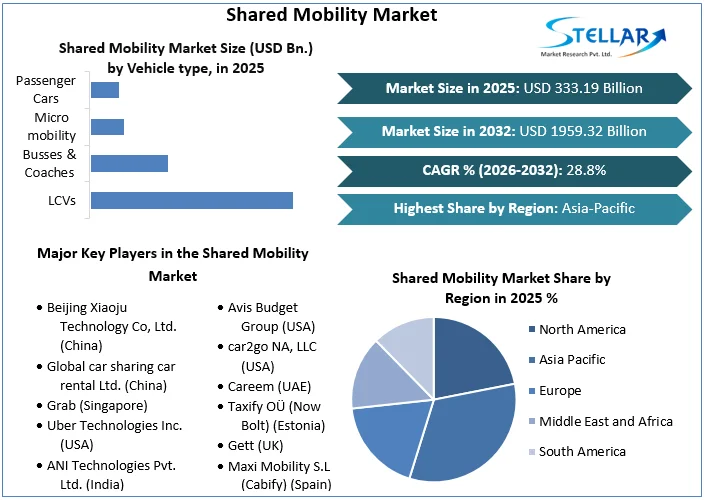
PUNE, June 18, 2026 The Shared Mobility Market is entering a transformative growth phase as consumers, businesses, and governments increasingly prioritize cost-efficient, sustainable, and digitally connected transportation solutions. According to the latest study by Stellar Market Research, the market was valued at USD 333.19 Billion in 2025 and is expected to reach approximately USD 1,959.32 Billion by 2032, expanding at a robust 28.8% CAGR during the forecast period of 2026–2032. The market’s rapid expansion reflects a fundamental shift from vehicle ownership to access-based mobility services powered by technology, electrification, and urbanization.
Market Opportunity Overview
The transportation industry is experiencing one of its most significant disruptions in decades. Shared mobility solutions—including ride-hailing, car-sharing, ride-sharing, bike-sharing, and micromobility services—are becoming central to urban transportation ecosystems. Rising congestion, increasing fuel costs, environmental regulations, and growing smartphone penetration are reshaping consumer behavior and encouraging adoption of flexible transportation alternatives.
The next wave of growth is being driven by Mobility-as-a-Service (MaaS) platforms that integrate multiple transportation modes into a unified digital experience. The convergence of AI-powered route optimization, electric vehicle fleets, real-time mobility analytics, and autonomous driving technologies is creating new opportunities for investors, fleet operators, automakers, and technology providers. As cities seek to reduce emissions and optimize transportation infrastructure, shared mobility is emerging as a strategic pillar of future urban development.
Download Free PDF Brochure:https://www.stellarmr.com/report/req_sample/Shared-Mobility-Market/289
Key Findings from the Report
- The Shared Mobility Market is expected to grow from USD 333.19 Billion in 2025 to nearly USD 1,959.32 Billion by 2032, registering a CAGR of 28.8%.
- Ride-hailing services continue to represent the dominant revenue-generating segment due to widespread consumer adoption and app-based accessibility.
- Two-wheeler and micromobility solutions are emerging as the fastest-growing transportation categories, particularly in densely populated urban areas.
- Asia-Pacific remains the leading regional market, supported by rapid urbanization, smartphone penetration, and large commuter populations.
- India and Southeast Asian countries are among the fastest-growing markets due to favorable demographics and increasing adoption of digital transportation services.
- Venture capital and private equity firms account for a substantial share of industry investments, reflecting strong confidence in long-term market expansion.
- Increasing deployment of electric vehicles is improving operational efficiency while supporting sustainability goals across major shared mobility platforms.
Market Drivers and Restraints
Key Drivers
Urbanization and Traffic Congestion
Rapid urban population growth and increasing vehicle density are encouraging consumers to shift toward flexible mobility solutions that reduce commuting costs and parking challenges.
Digital Platform Adoption
Smartphone-based booking systems, digital payments, GPS tracking, and AI-powered route optimization have significantly improved user convenience and service accessibility.
Sustainability and EV Integration
Governments and mobility providers are investing heavily in electric fleets to reduce emissions and support climate objectives, creating new opportunities across shared transportation networks.
Key Restraints
Regulatory Complexity
Varying transportation regulations, licensing requirements, and labor policies across regions continue to create operational challenges for service providers.
Consumer Trust and Safety Concerns
Data privacy, cybersecurity, passenger safety, and insurance-related issues remain critical barriers in several markets, particularly for emerging mobility models.
Technology, Regulation, and Sustainability Trends
Artificial intelligence is becoming a core enabler of fleet optimization, predictive maintenance, and demand forecasting. Shared mobility providers are increasingly deploying machine learning algorithms to improve utilization rates and reduce operating costs.
Governments worldwide are implementing policies that encourage electrified transportation, low-emission zones, and multimodal urban mobility frameworks. Regulatory support for EV infrastructure and sustainable transportation initiatives is accelerating industry growth.
Environmental, Social, and Governance (ESG) priorities are also influencing investment decisions. Operators are adopting electric vehicles, renewable-energy charging infrastructure, and carbon-reduction strategies to meet evolving sustainability expectations from regulators and investors.
Download Free PDF Brochure:https://www.stellarmr.com/report/req_sample/Shared-Mobility-Market/289
Recent Industry Developments
Uber Technologies (2025): Expanded strategic partnerships with public transit agencies and EV fleet operators to strengthen multimodal transportation integration and improve sustainability outcomes.
Lyft (2025): Accelerated electric vehicle adoption initiatives across North American driver networks, supporting lower emissions and operating costs.
Grab Holdings (2025): Increased investment in AI-powered mobility and delivery ecosystems across Southeast Asia, enhancing platform efficiency and user engagement.
Bolt Technology (2024): Expanded electric scooter and shared micromobility deployments across European cities to address last-mile transportation demand.
BlaBlaCar (2025): Strengthened intercity ride-sharing capabilities through digital platform enhancements aimed at improving occupancy rates and reducing travel costs.
Regional Insights
Leading Region: Asia-Pacific
Asia-Pacific continues to dominate the Shared Mobility Market due to high population density, urban migration, and widespread smartphone adoption. China and India remain critical growth engines, supported by large commuter bases and government initiatives promoting digital transportation ecosystems.
Emerging Region: Latin America and Southeast Asia
Countries including Brazil, Indonesia, Vietnam, and the Philippines are witnessing rising adoption of ride-hailing and micromobility services. Increasing internet penetration, expanding urban populations, and growing transportation demand are creating attractive opportunities for mobility providers and investors.
Competitive Landscape
The Shared Mobility Market is characterized by intense competition among global mobility platforms, regional ride-hailing providers, vehicle-sharing operators, and technology companies. Key participants include Uber Technologies, Lyft, Grab Holdings, Bolt Technology, BlaBlaCar, Careem, Gett, Europcar, Enterprise Holdings, and Avis Budget Group.
Competitive strategies increasingly focus on electric fleet expansion, AI-enabled platform optimization, geographic expansion, strategic partnerships, and Mobility-as-a-Service integration. Companies are also investing in autonomous vehicle technologies and advanced analytics to strengthen long-term market positioning.
Analyst Commentary
“The next phase of shared mobility growth will be defined by the convergence of electrification, digital platforms, and multimodal transportation ecosystems. Companies that successfully integrate AI, sustainability initiatives, and customer-centric mobility services will be best positioned to capture long-term market value as urban transportation models continue to evolve.” — Senior Research Analyst, Stellar Market Research
Future Outlook
Through 2032, demand for shared mobility services is expected to expand significantly as consumers increasingly favor flexible transportation options over vehicle ownership. Investment activity will remain strong across ride-hailing, micromobility, EV fleets, and Mobility-as-a-Service platforms. Regulatory support for sustainable transportation, combined with advances in autonomous driving and AI-driven fleet management, is expected to further accelerate market expansion. Competitive differentiation will increasingly depend on platform integration, sustainability performance, and operational efficiency.
About Stellar Market Research
Stellar Market Research is a global market research and business consulting firm delivering actionable intelligence across diverse industries. The company provides comprehensive market assessments, competitive benchmarking, technology trend analysis, and strategic advisory services that help organizations identify growth opportunities and make informed business decisions. Through rigorous primary and secondary research methodologies, Stellar Market Research delivers data-driven insights covering market dynamics, customer behavior, investment trends, regulatory developments, and emerging technologies. The firm’s research supports corporate leaders, investors, policymakers, and stakeholders seeking reliable intelligence to navigate rapidly evolving market environments and achieve sustainable business growth.
Media Contact
Stellar Market Research
Address: Phase 3, Navale IT Zone, S.No. 51/2A/2, Office No. 202, 2nd Floor, Near Navale Bridge, Narhe, Pune, Maharashtra 411041
Website: http://stellarmr.com/
Email: sales@stellarmr.com
Mobile: +91 9607365656
