Market Overview
The Generative Artificial Intelligence in Tourism Market is emerging as one of the most dynamic segments within the broader travel technology ecosystem.
Tourism businesses have traditionally relied on human-driven service models, manual itinerary planning, and static digital experiences. Generative AI introduces a fundamentally different approach. Intelligent systems can create personalized recommendations, generate travel content, automate interactions, and support decision-making in real time.
The market’s growth reflects a broader digital transformation trend occurring across travel, hospitality, transportation, and destination management organizations.
What changed is the maturity of artificial intelligence technology. Generative AI is no longer limited to experimental projects. Tourism companies are increasingly deploying practical applications that directly influence customer acquisition, engagement, and retention.
The business implication is substantial. Organizations can improve service quality while simultaneously reducing operational costs and increasing scalability.
As traveler expectations continue to evolve, AI-powered experiences are becoming an important competitive differentiator.
Key Trends Driving Growth
Personalization is one of the strongest growth drivers. Travelers increasingly expect customized recommendations based on preferences, budgets, destinations, and behavioral patterns. Generative AI enables highly individualized experiences that traditional systems struggle to deliver at scale.
Customer service automation is another major trend. AI-powered virtual assistants and conversational interfaces are helping tourism organizations provide continuous support across booking, itinerary management, and travel assistance functions.
Content generation is becoming an increasingly valuable application area. Tourism providers can use AI tools to create destination descriptions, marketing materials, travel guides, and promotional content more efficiently.
Digital transformation initiatives across the tourism sector are accelerating adoption. Companies are modernizing customer engagement platforms, integrating intelligent analytics, and investing in AI-driven operational capabilities.
Cloud computing continues to support market expansion. Generative AI applications often require scalable infrastructure, making cloud-based deployment models attractive for travel organizations seeking flexibility and rapid implementation.
Data analytics is becoming increasingly important. Tourism providers are leveraging AI-generated insights to better understand traveler behavior, optimize offerings, and improve decision-making processes.
Another significant trend is intelligent trip planning. AI systems can generate personalized itineraries, recommend attractions, and adjust recommendations dynamically based on traveler preferences.
Together, these developments are transforming tourism from a transaction-focused industry into a highly personalized digital experience ecosystem.
Request a Free Sample Copy or View Report Summary: https://www.maximizemarketresearch.com/request-sample/191156/
Segment Insights
- Dominant Segment: Not explicitly specified in the report.
- Fastest-Growing Segment: Not explicitly specified in the report.
- Generative AI applications are increasingly supporting travel planning and customer engagement functions.
- Personalized recommendation engines represent an important area of deployment.
- AI-powered customer support solutions continue to gain adoption across tourism businesses.
- Content creation and marketing automation are emerging as high-value use cases.
- Cloud-based deployment models are supporting scalable implementation strategies.
- Data-driven traveler insights are creating new opportunities for customer experience optimization.
Regional Growth Story
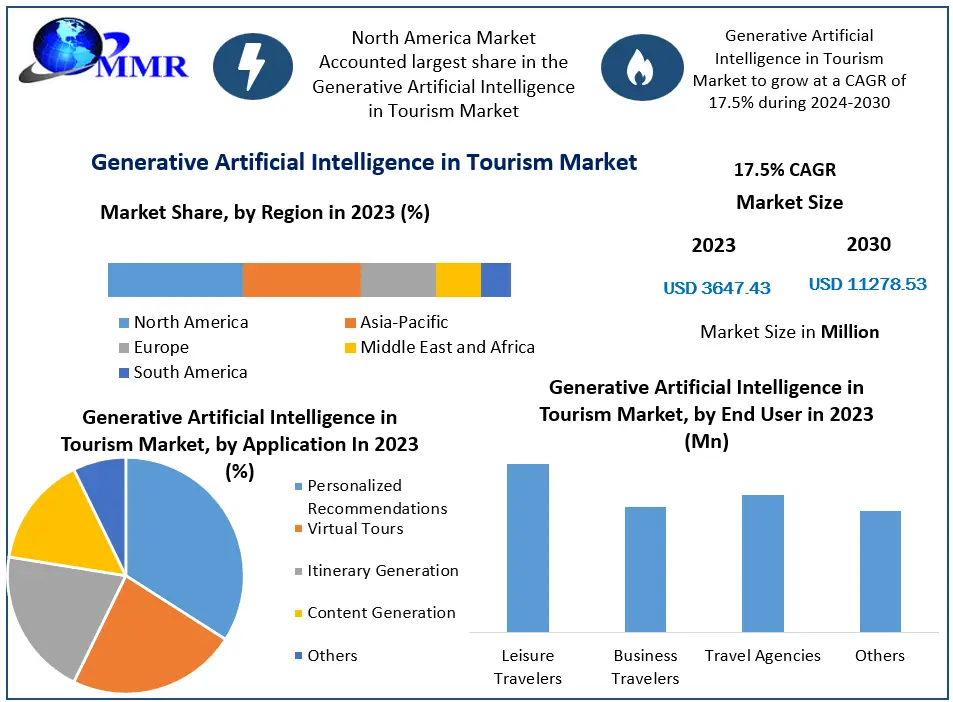
North America remains a major market for generative AI adoption within tourism due to advanced technology ecosystems, strong cloud infrastructure, and high levels of digital innovation.
The United States continues to play a central role in market development. Travel platforms, hospitality providers, and technology companies are actively exploring AI-driven customer engagement strategies to improve competitiveness.
Europe remains an important market as tourism organizations accelerate digital transformation initiatives. Countries such as Germany and the United Kingdom are investing in technology modernization programs designed to enhance traveler experiences and operational efficiency.
Asia-Pacific represents a significant growth opportunity. China, India, Japan, and South Korea continue expanding digital infrastructure while increasing investments in tourism technology innovation.
The regional story is increasingly linked to digital competitiveness. Tourism destinations capable of delivering intelligent, personalized, and technology-enabled experiences are positioning themselves to attract a greater share of future travelers.
The result is a new form of competition where digital capability becomes as important as physical tourism infrastructure.
Competitive Landscape
Competition is shifting away from traditional booking functionality and toward intelligent customer engagement ecosystems.
Technology providers, travel platforms, hospitality organizations, and tourism operators are increasingly competing on the quality of AI-driven experiences. The strategic objective is not simply automation. It is creating highly personalized journeys that improve customer satisfaction and increase lifetime value.
The emergence of generative AI signals a broader platform transformation. Organizations capable of integrating recommendation engines, conversational interfaces, predictive analytics, and content generation tools into unified platforms can create stronger competitive positions.
Cloud positioning is becoming increasingly important. AI deployment often depends on scalable computing infrastructure, making cloud-enabled platforms central to long-term market development.
The competitive landscape also highlights growing demand for data-driven decision-making. Companies with access to richer traveler data and stronger analytics capabilities are better positioned to train AI systems and deliver superior personalization.
For investors, the market represents a convergence of tourism, artificial intelligence, cloud computing, and digital experience technologies.
Future market leadership will likely be determined by who controls the most effective AI ecosystems rather than who simply offers tourism services.
Recent Developments
- Increasing adoption of generative AI technologies across tourism platforms.
- Expansion of AI-powered customer service and virtual assistant capabilities.
- Growing deployment of intelligent recommendation and trip-planning solutions.
- Rising investment in cloud-enabled AI infrastructure.
- Greater integration of data analytics into tourism decision-making processes.
- Continued digital transformation initiatives across travel and hospitality organizations.
Strategic Implications
For CIOs, generative AI is becoming a strategic technology investment capable of improving both customer engagement and operational efficiency.
For CTOs, the priority is creating scalable AI architectures that integrate customer data, analytics platforms, and cloud infrastructure into unified ecosystems.
For tourism operators, AI adoption represents an opportunity to increase personalization without proportionally increasing staffing requirements.
For cloud providers, tourism is emerging as an attractive vertical market for AI deployment services, analytics solutions, and intelligent application platforms.
Investors should view the market through the lens of platform economics. Organizations that successfully combine AI capabilities, traveler data, and digital engagement platforms can build durable competitive advantages.
The market also demonstrates a larger trend occurring across the global economy. Customer experiences are increasingly becoming software-defined and AI-driven.
Organizations capable of leveraging generative AI effectively will be positioned to capture greater value across the tourism ecosystem.
Future Outlook
Generative AI is rapidly becoming a foundational technology for the future of tourism. Personalized trip planning, intelligent customer engagement, automated content creation, and AI-driven operational optimization are moving from innovation projects to core business capabilities. The next generation of tourism leaders will be defined by their ability to transform artificial intelligence into seamless traveler experiences, while organizations that remain dependent on traditional digital models risk losing relevance in an increasingly AI-powered travel economy.
Analyst Perspective
“Generative artificial intelligence is creating new opportunities across the tourism industry by improving personalization, operational efficiency, and customer engagement. As organizations continue their digital transformation journeys, AI-powered platforms will play an increasingly important role in shaping future traveler experiences and competitive differentiation.” — Yash Ghosalkar, Analyst
About Maximize Market Research
Maximize Market Research Pvt. Ltd. (MMR) is a global market research and consulting company that provides reliable, data-focused, and practical business insights. The firm serves a wide range of industries, including healthcare, pharmaceuticals, technology, automotive, electronics, chemicals, personal care, and consumer goods. Through market forecasts, competitive analysis, strategic consulting, and industry impact assessments, MMR helps organizations understand changing market conditions, identify growth opportunities, and make informed business decisions for long-term success.
2nd Floor, Navale IT Park Phase 3
Pune Banglore Highway, Narhe
Pune, Maharashtra 411041, India
+91 9607365656
sales@maximizemarketresearch.com
