Key Highlights
- Pedestrian bridges are becoming critical assets within smart city and urban mobility ecosystems.
- Infrastructure owners increasingly adopt digital construction and connected asset-management technologies.
- Predictive maintenance and structural health monitoring are reshaping lifecycle management strategies.
- BIM, digital twins, and sensor-enabled infrastructure are improving project efficiency and operational reliability.
- Urbanization and transportation modernization continue to drive demand for pedestrian connectivity solutions.
- Governments are integrating pedestrian infrastructure into broader sustainability and mobility programs.
- Smart monitoring technologies are creating new opportunities for automation providers and infrastructure technology firms.
Why This Matters Now
Infrastructure operators face growing pressure to improve safety, mobility, and asset utilization while managing aging transportation networks. Cities must accommodate rising pedestrian traffic, support sustainability objectives, and optimize public infrastructure spending simultaneously.
That challenge is transforming pedestrian bridges from static structures into digitally managed infrastructure assets. Governments, transportation agencies, and urban planners increasingly view pedestrian bridges as components of connected mobility ecosystems where automation, real-time monitoring, and predictive maintenance drive operational value.
Market Overview
The Pedestrian Bridge Market is increasingly influenced by trends reshaping infrastructure development worldwide.
Urban growth, transportation modernization, and public safety initiatives continue to create demand for pedestrian connectivity solutions. However, the market story extends beyond construction activity. Infrastructure owners are now focused on long-term asset performance, maintenance efficiency, and operational intelligence.
What changed is the role of technology in infrastructure management.
Traditional bridge projects emphasized structural engineering and construction execution. Today’s projects increasingly incorporate digital engineering tools, sensor networks, structural health monitoring systems, and data-driven maintenance programs. This shift aligns infrastructure development with broader Industry 4.0 principles that prioritize visibility, predictive decision-making, and lifecycle optimization.
The result is a market that increasingly intersects with automation technologies, industrial IoT platforms, and digital infrastructure management systems.
Key Trends Driving Growth
Smart city investments are becoming one of the strongest forces shaping market development.
Municipal governments worldwide are deploying connected infrastructure to improve urban mobility, enhance safety, and support sustainable transportation strategies. Pedestrian bridges increasingly form part of these integrated mobility networks.
Digital construction technologies are accelerating project delivery and improving design precision.
Building Information Modeling (BIM) enables stakeholders to improve collaboration across planning, engineering, procurement, and construction activities. Digital workflows reduce design conflicts, improve resource allocation, and support more efficient project execution.
The adoption of structural health monitoring systems is creating another major shift.
Infrastructure operators increasingly deploy sensors that continuously monitor structural conditions. Data generated from these systems supports predictive maintenance programs, allowing organizations to identify potential issues before they become costly failures.
Digital twin technology is also gaining relevance.
Infrastructure owners are increasingly interested in creating digital representations of physical assets that provide visibility into performance, maintenance requirements, and operational conditions. This approach improves decision-making while supporting more efficient asset lifecycle management.
Industrial IoT adoption continues to expand across infrastructure sectors.
Connected monitoring devices provide real-time operational data that can be integrated into centralized management platforms. These capabilities support maintenance optimization, risk management, and infrastructure resilience objectives.
Sustainability initiatives are reinforcing these trends. Governments increasingly prioritize pedestrian infrastructure as part of broader efforts to reduce congestion, encourage active transportation, and improve urban environmental performance.
Get A Free Sample Now:https://www.maximizemarketresearch.com/request-sample/194746/
Segment Insights
Dominant Segment: Urban and Municipal Infrastructure Applications
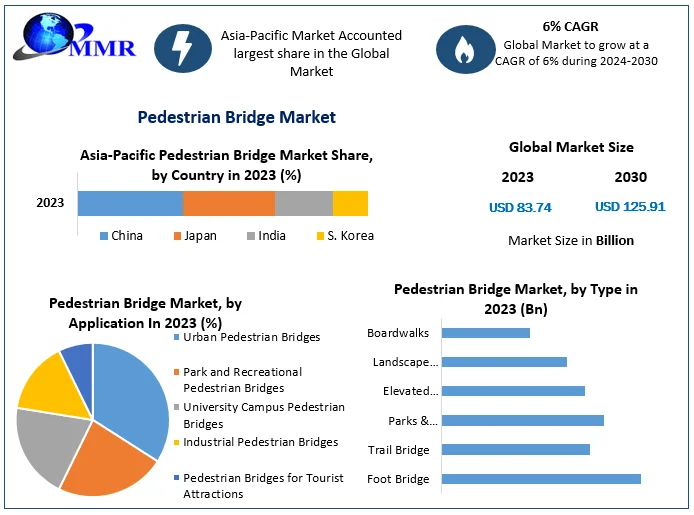
Urban pedestrian connectivity projects represent the largest source of demand within the market. Municipal governments continue to invest in pedestrian safety improvements, transportation accessibility, and public infrastructure modernization. This dominance highlights the growing importance of pedestrian mobility within urban planning strategies.
Fastest-Growing Segment: Smart Infrastructure and Transportation Integration Projects
Projects that integrate pedestrian bridges into larger transportation and smart city ecosystems are experiencing strong momentum. The trend reflects increasing emphasis on connected mobility, infrastructure digitization, and intelligent transportation networks.
Key Technology Segment: Structural Health Monitoring Systems
Sensor-enabled monitoring technologies are becoming increasingly important as infrastructure owners seek to improve safety, reduce maintenance costs, and extend asset lifecycles through predictive maintenance practices.
Regional Growth Story
Asia-Pacific remains one of the most dynamic regions for pedestrian bridge development.
China continues to invest heavily in urban infrastructure, transportation connectivity, and smart city deployment. Large-scale urbanization programs create ongoing demand for pedestrian mobility solutions integrated into broader transportation networks.
India is experiencing similar momentum. Urban development initiatives, transportation modernization projects, and smart city programs are generating opportunities for pedestrian infrastructure deployment across major metropolitan areas.
Japan and South Korea continue to emphasize infrastructure resilience, smart mobility systems, and advanced engineering solutions. Their leadership in digital technologies supports growing adoption of intelligent infrastructure management practices.
Europe remains an important market driven by sustainability objectives and infrastructure modernization.
Germany’s focus on digital engineering, smart infrastructure, and Industry 4.0 principles continues to influence infrastructure procurement and asset-management strategies. European transportation agencies increasingly prioritize lifecycle performance and predictive maintenance capabilities.
North America benefits from ongoing infrastructure renewal initiatives.
The United States is investing in transportation modernization, public safety improvements, and digital infrastructure technologies. Infrastructure owners increasingly deploy monitoring systems and asset-management platforms that align with broader operational technology modernization goals.
Across all regions, the competitive advantage is shifting toward organizations capable of integrating infrastructure assets into connected operational ecosystems.
Competitive Landscape
Competition increasingly extends beyond construction expertise.
Engineering firms, infrastructure developers, technology providers, and monitoring-system vendors are competing to deliver comprehensive lifecycle solutions. Customers increasingly evaluate providers based on digital capabilities, operational intelligence, maintenance optimization, and long-term asset performance.
This evolution reflects broader digital transformation occurring across infrastructure industries.
Technology providers are embedding sensors, monitoring systems, data analytics capabilities, and digital management tools into infrastructure projects. These investments signal growing recognition that operational performance is as important as structural performance.
The competitive landscape also demonstrates the growing convergence between construction, automation, and information technology.
Organizations capable of combining engineering excellence with digital infrastructure expertise are strengthening their market positions and influencing future procurement standards.
Recent Developments
- Increased deployment of structural health monitoring systems across transportation infrastructure.
- Growing adoption of BIM and digital construction technologies.
- Rising interest in digital twin applications for infrastructure asset management.
- Expansion of smart city initiatives incorporating pedestrian mobility infrastructure.
- Greater integration of IoT-enabled monitoring solutions.
- Increased focus on predictive maintenance and lifecycle optimization.
- Continued investment in sustainable urban transportation networks.
Strategic Implications
For infrastructure operators, pedestrian bridges are becoming data-generating assets rather than passive structures.
For technology providers, opportunities are expanding across structural monitoring, predictive maintenance, digital twins, and infrastructure analytics platforms.
For municipal governments, digital infrastructure strategies improve safety, optimize maintenance spending, and enhance public service delivery.
For investors, the market reflects broader trends in urbanization, infrastructure modernization, smart city development, and connected asset management.
Organizations that successfully combine infrastructure investment with digital operational capabilities will create stronger long-term value.
Future Outlook
The next phase of market development will be defined by connected infrastructure, digital twins, predictive maintenance systems, and intelligent mobility networks. Pedestrian bridges will increasingly operate as integrated components within broader smart city ecosystems rather than standalone transportation assets.
The infrastructure leaders of the next decade will be those that transform pedestrian bridges into digitally managed, continuously monitored assets, while laggards remain burdened by reactive maintenance models and disconnected infrastructure operations.
Analyst Perspective
“The Pedestrian Bridge Market is increasingly shaped by the convergence of infrastructure modernization, digital engineering, and smart city development. Organizations that integrate predictive maintenance, connected monitoring, and lifecycle intelligence into infrastructure planning will be best positioned to maximize safety, efficiency, and long-term asset performance.” — Gaurav Deshmukh
About Maximize Market Research
Maximize Market Research Pvt. Ltd. (MMR) is a global market research and consulting company that provides reliable, data-focused, and practical business insights. The firm serves a wide range of industries, including healthcare, pharmaceuticals, technology, automotive, electronics, chemicals, personal care, and consumer goods. Through market forecasts, competitive analysis, strategic consulting, and industry impact assessments, MMR helps organizations understand changing market conditions, identify growth opportunities, and make informed business decisions for long-term success.
2nd Floor, Navale IT Park Phase 3
Pune Banglore Highway, Narhe
Pune, Maharashtra 411041, India
+91 9607365656
sales@maximizemarketresearch.com
