Key Highlights
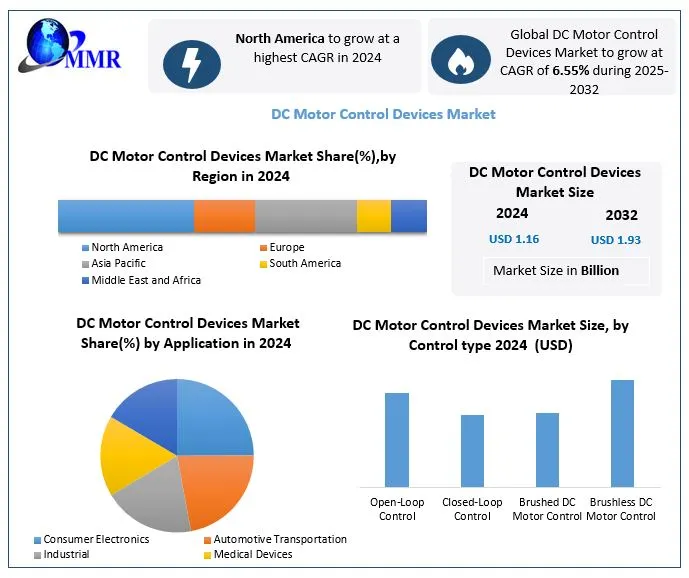
- DC Motor Control Devices Market was valued at USD 1.16 billion in 2024 and is expected to reach nearly USD 1.93 billion by 2032.
- Market growth is projected at a CAGR of 6.55% between 2025 and 2032. Every percentage point of growth reflects expanding demand across EVs, automation, medical equipment, and smart consumer devices.
- North America dominated the market in 2024, highlighting the region’s leadership in smart manufacturing and electronics innovation.
- Global EV sales exceeded 14 million units in 2024, creating sustained demand for advanced motor control technologies. This directly expands semiconductor content per vehicle and increases requirements for precision electronics.
- Integration of IoT and smart systems is emerging as a major opportunity for next-generation motor control architectures.
Why This Matters Now
The race to build intelligent machines is shifting from computing power alone to motion intelligence. As AI-enabled factories, robotics platforms, electric vehicles, and connected consumer products proliferate, precise motor control has become a strategic electronics capability rather than a supporting component.
Semiconductor manufacturers, industrial OEMs, and automation providers are investing heavily in motor control technologies because every connected machine requires efficient motion management. The convergence of electrification, digital manufacturing, and energy-efficiency mandates is creating a new growth cycle for DC motor control devices.
Market Overview
The DC Motor Control Devices Market encompasses open-loop controllers, closed-loop controllers, brushed DC motor controllers, and brushless DC motor controllers used across automotive, industrial automation, consumer electronics, aerospace, and medical applications.
What changed is the scale of deployment. Electric mobility programs, smart manufacturing initiatives, and intelligent consumer products are dramatically increasing the number of motors deployed across the global economy. Every new robotic arm, automated warehouse system, electric vehicle, medical device, and connected appliance requires increasingly sophisticated control electronics.
Why now? Governments are accelerating electrification and energy-efficiency initiatives while manufacturers face pressure to improve productivity and reduce operating costs. Advanced motor control systems enable both objectives simultaneously.
The result is a market increasingly shaped by digital intelligence, software-defined control, and energy optimization rather than purely mechanical performance.
Get a sample of the report: https://www.maximizemarketresearch.com/request-sample/106508/
Key Trends Driving Growth
The strongest demand catalyst remains electric vehicle adoption. With global EV sales surpassing 14 million units in 2024, automakers require highly efficient motor control platforms capable of delivering performance, reliability, and energy optimization. Every increase in EV production expands opportunities for semiconductor suppliers and motor control technology developers.
Industrial automation represents the second major growth engine. Manufacturers are deploying robotics, automated production systems, and intelligent machinery to offset labor shortages and improve productivity. Advanced motor control devices act as the interface between software intelligence and physical movement, making them central to Industry 4.0 deployments.
A third trend is miniaturization. Consumer electronics manufacturers continue to introduce compact devices requiring precise motion control in increasingly smaller form factors. This trend favors suppliers capable of delivering integrated, energy-efficient solutions.
The market is also benefiting from IoT integration. Connected motor systems generate operational data that can support predictive maintenance, remote monitoring, and performance optimization. These capabilities align closely with broader digital transformation initiatives across manufacturing and infrastructure sectors.
Segment Insights
- Dominant Segment: The report identifies broad adoption across automotive, industrial automation, consumer electronics, medical devices, and aerospace applications, with EVs and industrial automation serving as primary demand drivers.
- Fastest-Growing Segment: Integration with IoT-enabled smart systems and technologically advanced miniaturized motor control solutions represents a key emerging growth opportunity.
- Brushless and digitally controlled architectures are attracting greater attention because they support efficiency targets, compact designs, and intelligent control requirements.
- End users increasingly prioritize reliability, digital connectivity, and energy optimization rather than standalone hardware performance.
Regional Growth Story
North America held the leading market position in 2024. This leadership reflects strong investment in smart manufacturing, advanced electronics, and e-mobility ecosystems. The region benefits from industrial modernization initiatives and demand for digitally enabled production systems.
Asia-Pacific remains strategically important because it combines electronics manufacturing scale with expanding EV production capacity. Major automotive and electronics hubs continue to increase deployment of motor-driven systems across industrial and consumer applications.
China, Japan, South Korea, and India are strengthening regional manufacturing ecosystems through industrial modernization and electrification initiatives. These developments support long-term demand for motor control devices integrated into production equipment, transportation platforms, and smart devices.
Europe continues to benefit from energy-efficiency regulations, industrial automation investments, and electrified transportation programs, creating opportunities for advanced motor control suppliers.
Competitive Landscape
Leading companies including Texas Instruments, Infineon Technologies, NXP Semiconductors, STMicroelectronics, and Microchip Technology are focusing on smart, compact, and energy-efficient motor control solutions.
This signals a broader industry transition. Competition is moving away from standalone hardware and toward integrated platforms combining power electronics, embedded intelligence, connectivity, and software capabilities.
For semiconductor suppliers, motor control is becoming a strategic gateway into EV platforms, industrial automation systems, robotics deployments, and connected devices. Companies capable of integrating sensing, control, and power management functions gain stronger positioning within high-value electronics ecosystems.
The competitive focus on efficiency also reflects increasing sustainability pressures. Lower power consumption directly translates into reduced operating costs and improved environmental performance for industrial operators and OEM customers.
Recent Developments
- Manufacturers are increasing investment in smart and compact motor control technologies to address evolving application requirements.
- Product innovation is increasingly focused on digitally enabled and energy-efficient motor control architectures.
- Industry participants are targeting emerging opportunities created by IoT integration and intelligent automation systems.
- Miniaturization trends continue to influence product development strategies across consumer and industrial applications.
Strategic Implications
For OEMs, advanced motor control technology is becoming a competitive differentiator. Better control systems improve energy efficiency, enhance product performance, and enable predictive maintenance capabilities.
For semiconductor companies, the opportunity extends beyond component sales. Motor control platforms increasingly connect power electronics, embedded processing, sensors, and software into integrated value propositions.
For investors, the market offers exposure to multiple structural themes simultaneously: electrification, industrial automation, smart manufacturing, robotics, connected devices, and sustainability.
For supply-chain leaders, resilient sourcing of power semiconductors, controllers, and embedded electronics will become increasingly important as adoption expands across industries.
Future Outlook
The next phase of market evolution will be defined by intelligent, connected, and software-driven motion systems. As factories, vehicles, medical equipment, and consumer products become more autonomous, motor control devices will transition from functional components to strategic digital infrastructure.
The companies that combine power electronics, embedded intelligence, connectivity, and energy optimization into scalable platforms will define the next generation of industrial and mobility ecosystems, while those that remain focused on conventional hardware risk losing relevance in an increasingly software-driven automation economy.
Analyst Perspective
“The DC Motor Control Devices Market is entering a phase where electrification, automation, and digital connectivity are converging. Organizations that invest in intelligent, energy-efficient, and compact motor control technologies will be best positioned to capture emerging opportunities across industrial automation, electric mobility, and connected device ecosystems.” — Rucha Deshpande
About Maximize Market Research
Maximize Market Research Pvt. Ltd. (MMR) is a global market research and consulting company that provides reliable, data-focused, and practical business insights. The firm serves a wide range of industries, including healthcare, pharmaceuticals, technology, automotive, electronics, chemicals, personal care, and consumer goods. Through market forecasts, competitive analysis, strategic consulting, and industry impact assessments, MMR helps organizations understand changing market conditions, identify growth opportunities, and make informed business decisions for long-term success.
Contact Maximize Market Research:
2nd Floor, Navale IT Park Phase 3
Pune Banglore Highway, Narhe
Pune, Maharashtra 411041, India
+91 9607365656
sales@maximizemarketresearch.com
