Key Highlights
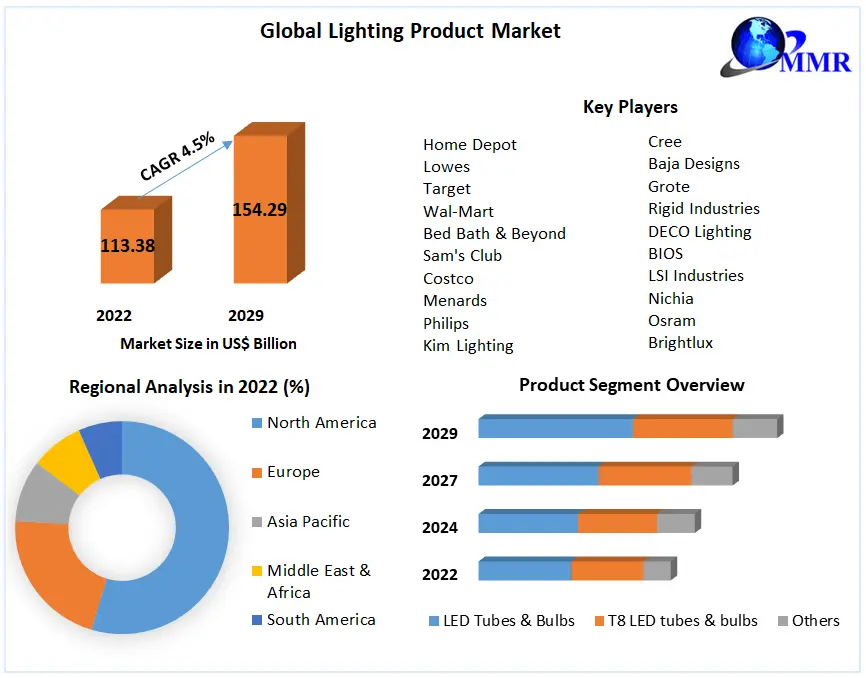
- Global Lighting Product Market valued at USD 132.97 billion in 2024.
- Market projected to reach nearly USD 179.47 billion by 2032.
- Expected CAGR of 3.82% during 2025–2032.
- LED technologies remain the primary growth engine.
- Smart lighting and remote-control capabilities are accelerating adoption.
- Government energy-efficiency regulations continue to stimulate investment.
- Urbanization and smart-city projects are expanding deployment opportunities.
- Sustainability goals are accelerating replacement of legacy lighting systems.
Why This Matters Now
The lighting industry sits at the intersection of several global technology priorities: electrification, sustainability, digital infrastructure, and connected devices.
What changed is the role of lighting itself. Modern lighting products increasingly incorporate sensors, wireless connectivity, automation software, and energy-management capabilities. Buildings now treat lighting as part of broader digital ecosystems rather than standalone fixtures. That shift creates new revenue opportunities for semiconductor suppliers, electronics manufacturers, software developers, and smart-building operators.
At the same time, governments are tightening energy-efficiency requirements. Organizations seeking lower operating costs are replacing conventional systems with LED-based alternatives. Every retrofit cycle creates demand for advanced drivers, controllers, power-management chips, and intelligent lighting controls.
Market Overview
The Lighting Product Market encompasses LED tubes and bulbs, T8 LED products, traditional lighting technologies, ceiling fixtures, recessed fixtures, strip lighting, residential lighting, commercial installations, industrial lighting, and outdoor applications.
The market’s growth trajectory is being shaped by a combination of technology innovation and policy intervention. LEDs provide higher light output while consuming significantly less power, making them central to global energy-conservation strategies. As deployment costs decline, adoption barriers continue to fall across residential, commercial, and industrial sectors.
For electronics manufacturers, this means demand is increasingly tied to integrated systems rather than individual lighting products. Value creation is moving toward smart controls, connected platforms, and energy-management capabilities.
Get a sample of the report: https://www.maximizemarketresearch.com/request-sample/11116/
Key Trends Driving Growth
One of the most significant trends is the rapid expansion of smart lighting. Connected lighting systems offer remote monitoring, automation, occupancy sensing, and energy optimization. These capabilities align directly with broader IoT adoption across commercial buildings and urban infrastructure.
Another important trend is infrastructure modernization. Urbanization and smart-city initiatives require efficient street lighting, public-space illumination, transportation infrastructure lighting, and intelligent energy-management systems. Lighting increasingly functions as a digital platform capable of supporting additional services and data collection.
Sustainability is also becoming a competitive differentiator. Environmental awareness among consumers and businesses is driving demand for products that reduce energy consumption and carbon emissions. Manufacturers that can combine efficiency with smart functionality are positioned to capture a greater share of future spending.
The integration of renewable energy sources with advanced lighting controls is creating another growth avenue. Smart systems can optimize consumption patterns, improve operational efficiency, and support broader decarbonization goals.
Segment Insights
- Dominant Segment: LED Tubes & Bulbs remain a core market driver due to their energy efficiency, high light output, and declining ownership costs. Their widespread adoption reinforces demand across residential, commercial, and industrial applications.
- Fastest-Growing Segment: Smart lighting-enabled applications are emerging as the strongest growth opportunity as enterprises seek remote control, automation, energy management, and IoT integration capabilities.
- Ceiling fixtures, recessed fixtures, strip lighting, and decorative lighting categories continue expanding as infrastructure projects and real-estate developments adopt modern lighting architectures.
- Commercial, industrial, and outdoor deployments are increasingly prioritizing intelligent controls and energy-performance metrics when selecting lighting solutions.
Regional Growth Story
Regional competition is increasingly defined by manufacturing capacity, technology leadership, and infrastructure investment.
Asia remains central to global lighting production and electronics manufacturing ecosystems. China, India, South Korea, Taiwan, and Japan continue benefiting from extensive electronics supply chains, component manufacturing expertise, and large-scale infrastructure development.
The United States and Europe are focused on energy-efficiency upgrades, smart-building deployments, and sustainability initiatives. Government incentives and regulatory frameworks are accelerating replacement cycles across commercial and public infrastructure assets.
India represents a particularly significant opportunity because urbanization, infrastructure modernization, and smart-city initiatives are creating sustained demand for efficient lighting technologies. The country’s broader electronics manufacturing ambitions also support domestic production opportunities across the lighting value chain.
Competitive Landscape
Competition is shifting away from simple product differentiation toward ecosystem leadership.
Manufacturers that previously competed on brightness, durability, or cost now compete on connectivity, software integration, energy analytics, and lifecycle value. The strategic battleground increasingly includes smart controls, sensor integration, cloud connectivity, and interoperability with building-management systems.
This signals a broader convergence between lighting, semiconductors, software platforms, and IoT infrastructure. Companies investing in intelligent lighting architectures gain stronger pricing power because they deliver operational savings rather than merely selling hardware.
The competitive advantage is also moving upstream into component innovation. LED performance improvements, advanced drivers, power-management technologies, sensors, and communications modules increasingly determine market leadership. As buildings become smarter, lighting vendors capable of integrating multiple technologies into unified platforms are likely to strengthen their ecosystem positions.
Recent Developments
- Continued expansion of LED technology adoption across major end-user industries.
- Increasing deployment of smart lighting systems with remote-control capabilities.
- Growing integration of lighting infrastructure with renewable-energy initiatives.
- Rising government support for energy-efficient lighting adoption.
- Expanded investment in smart-city and urban modernization programs.
- Accelerating adoption of advanced lighting controls and automation technologies.
Strategic Implications
The Lighting Product Market is becoming increasingly relevant to semiconductor and electronics industry participants.
LED-based systems require advanced electronic components, creating opportunities for power semiconductor suppliers, sensor manufacturers, connectivity solution providers, and electronics manufacturing services firms.
For OEMs, lighting is becoming a recurring software-and-services opportunity rather than a one-time hardware sale. Intelligent lighting networks can generate operational data, enable predictive maintenance, and support energy optimization strategies.
Investors should view the market through the lens of digital infrastructure rather than traditional lighting. The strongest opportunities are emerging where lighting intersects with IoT, automation, sustainability, and smart-building technologies.
Future Outlook
The next phase of industry expansion will be defined by connected intelligence rather than illumination alone. As lighting systems become nodes within broader digital ecosystems, the companies that combine LED innovation, smart controls, data analytics, and energy-management capabilities will define the next generation of infrastructure leadership, while those focused solely on hardware risk losing relevance in an increasingly software-driven environment.
Analyst Perspective
“The lighting industry is entering a phase where energy efficiency, digital connectivity, and intelligent control systems are becoming inseparable. Organizations that align lighting investments with broader smart infrastructure strategies will capture the greatest long-term value from this transition.” — Rucha Deshpande, Analyst
About Maximize Market Research
Maximize Market Research Pvt. Ltd. (MMR) is a global market research and consulting company that provides reliable, data-focused, and practical business insights. The firm serves a wide range of industries, including healthcare, pharmaceuticals, technology, automotive, electronics, chemicals, personal care, and consumer goods. Through market forecasts, competitive analysis, strategic consulting, and industry impact assessments, MMR helps organizations understand changing market conditions, identify growth opportunities, and make informed business decisions for long-term success.
Contact Maximize Market Research:
2nd Floor, Navale IT Park Phase 3
Pune Banglore Highway, Narhe
Pune, Maharashtra 411041, India
+91 9607365656
sales@maximizemarketresearch.com
