Key Highlights
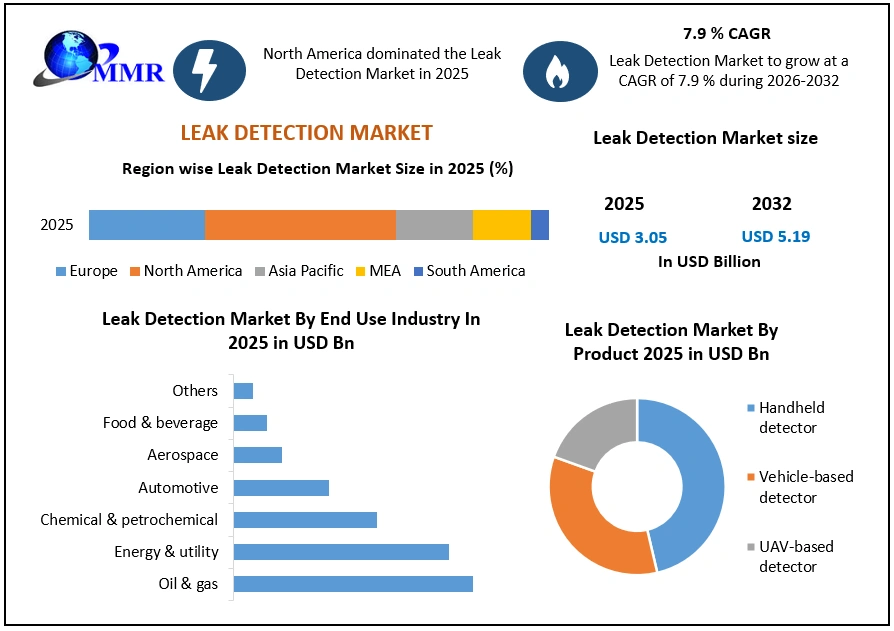
- Leak Detection Market valued at USD 3.05 billion in 2025.
- Market projected to reach USD 5.19 billion by 2032.
- CAGR estimated at 7.9% during 2026–2032.
- AI-driven predictive leak monitoring is emerging as a major technology shift.
- IoT-enabled smart sensors are transforming real-time infrastructure surveillance.
- Energy, utility, oil & gas, and industrial sectors remain primary demand centers.
- Advanced technologies including acoustic monitoring, optical imaging, laser spectroscopy, and digital twins are expanding deployment opportunities.
- Infrastructure modernization and regulatory compliance continue to drive investment.
Why This Matters Now
Industrial operators are facing a new reality. Aging infrastructure, rising environmental scrutiny, and increasing operational complexity are forcing companies to move from reactive maintenance to predictive intelligence.
Leak detection has evolved from a safety function into a strategic technology platform. As AI analytics, connected sensors, digital twins, and automated monitoring systems become standard components of industrial operations, leak detection is emerging as a critical layer in modern infrastructure resilience. Organizations that can identify failures before they become costly incidents gain measurable advantages in asset reliability, sustainability performance, and operational efficiency.
Market Overview
The global Leak Detection Market was valued at USD 3.05 billion in 2025 and is expected to reach USD 5.19 billion by 2032, growing at a CAGR of 7.9% during the forecast period. Every percentage point of growth signals increasing investment in infrastructure monitoring technologies that reduce operational losses, improve regulatory compliance, and strengthen asset performance.
What changed is the technology stack. Traditional inspection methods are being supplemented by AI-enabled analytics, IoT-connected sensors, ultrasonic monitoring systems, infrared imaging, laser-based detection platforms, and portable field devices. Leak detection is no longer simply about locating failures; it is increasingly about predicting them before they occur.
This shift is particularly significant for energy operators, utility networks, chemical processing facilities, and industrial manufacturers where even minor leaks can generate substantial financial, environmental, and operational consequences.
Get a sample of the report: https://www.maximizemarketresearch.com/request-sample/96475/
Key Trends Driving Growth
The strongest trend reshaping the market is the integration of AI with industrial monitoring systems. Advanced algorithms can analyze pressure fluctuations, flow variations, acoustic signatures, and sensor data to identify anomalies long before traditional inspection methods detect a problem. This transition reduces downtime and lowers maintenance costs while improving safety outcomes.
The second major trend is widespread IoT adoption. Smart sensors deployed across pipelines, distribution networks, industrial plants, and utility infrastructure create continuous streams of operational data. These connected ecosystems allow operators to monitor assets remotely and make faster decisions.
Digital twin technology is also gaining traction. By creating virtual representations of physical infrastructure, operators can model leak scenarios, optimize maintenance schedules, and improve asset utilization. The combination of digital twins and AI analytics creates a predictive maintenance framework that extends beyond traditional leak detection.
Drone-based inspections and UAV-enabled monitoring systems represent another growth area. These platforms reduce inspection costs, increase coverage, and improve access to remote or hazardous environments. For large infrastructure operators, aerial monitoring expands surveillance capabilities without proportionally increasing labor requirements.
Segment Insights
- Dominant Segment: Product Category
- Handheld detectors remain widely deployed due to operational flexibility, rapid deployment capability, and suitability across multiple industrial environments.
- Fastest-Growing Segment: UAV-Based Detection Systems
- Drone-enabled monitoring solutions are gaining momentum as operators seek scalable and cost-efficient inspection methods for large infrastructure networks.
- Dominant Technology Segment
- Volatile Organic Compound (VOC) analyzers remain among the most established technologies because of their effectiveness in industrial and energy applications.
- High-Growth Technology Opportunity
- Optical Gas Imaging (OGI), laser absorption spectroscopy, and AI-enabled monitoring platforms are benefiting from increasing demand for higher detection accuracy and real-time analytics.
- Leading End-User Industries
- Oil & gas, energy & utilities, chemical & petrochemical, automotive, aerospace, and food & beverage sectors continue to expand deployment as regulatory and operational requirements intensify.
Regional Growth Story
North America continues to benefit from extensive infrastructure networks, mature industrial operations, and stringent safety requirements. The region’s large installed base of pipelines and utility systems creates sustained demand for advanced monitoring technologies and predictive maintenance solutions.
Europe is advancing through sustainability initiatives and environmental compliance programs. Industrial operators increasingly deploy advanced monitoring technologies to meet emissions targets and improve operational transparency.
Asia-Pacific represents one of the most compelling long-term opportunities. Rapid industrialization, urban infrastructure expansion, energy demand growth, and modernization of utility networks are driving adoption of intelligent monitoring systems. Investments in smart cities and digital infrastructure further strengthen demand for leak detection technologies.
Emerging markets across the Middle East, Africa, and Latin America are also investing in infrastructure reliability, creating new deployment opportunities for advanced detection platforms.
Competitive Landscape
Competition is shifting from hardware differentiation toward integrated intelligence platforms.
Technology leaders are increasingly combining sensors, AI software, cloud analytics, edge computing capabilities, and predictive maintenance tools into unified offerings. This transition signals a broader move toward outcome-based value propositions rather than standalone equipment sales.
The competitive battleground now centers on detection accuracy, data analytics capability, remote monitoring performance, and integration with enterprise asset management systems. Vendors capable of combining hardware reliability with software intelligence are likely to strengthen pricing power and customer retention.
Investment activity across AI-enabled monitoring, digital twin platforms, advanced sensing technologies, and automated inspection solutions indicates that future market leadership will depend on ecosystem development rather than product performance alone. Companies building scalable data platforms are positioning themselves for recurring revenue models and long-term customer relationships.
Recent Developments
- Increased deployment of AI-driven predictive leak detection systems.
- Growing adoption of IoT-enabled smart sensor networks.
- Expansion of drone-based infrastructure inspection capabilities.
- Rising implementation of digital twin technologies for asset monitoring.
- Greater use of optical imaging and laser-based detection systems for precision monitoring.
Strategic Implications
For infrastructure operators, leak detection is becoming a data strategy rather than a maintenance expense.
Utilities can reduce water loss. Energy companies can lower operational risk. Industrial manufacturers can improve uptime. Regulators gain greater transparency. Investors benefit from stronger asset utilization and improved environmental performance.
The next phase of competition will focus on how effectively organizations transform monitoring data into actionable operational intelligence. Companies that integrate leak detection with broader digital transformation initiatives will achieve greater returns than those deploying isolated monitoring systems.
Future Outlook
The market is moving toward autonomous monitoring ecosystems where AI continuously analyzes data from connected sensors, drones, imaging systems, and digital twins to identify risks before failures occur. As industrial infrastructure becomes increasingly digitized, leak detection will evolve into a foundational component of predictive operations, sustainability management, and enterprise resilience.
The organizations that build AI-enabled monitoring networks today will define the next generation of infrastructure intelligence, while those that rely on periodic inspections risk falling behind in an increasingly automated industrial economy.
Analyst Perspective
“Leak detection technologies are transitioning from standalone inspection tools to intelligent monitoring ecosystems. The convergence of AI, IoT connectivity, advanced sensing technologies, and predictive analytics is creating significant opportunities for infrastructure operators seeking greater reliability, sustainability, and operational efficiency.” — Rucha Deshpande
About Maximize Market Research
Maximize Market Research Pvt. Ltd. (MMR) is a global market research and consulting company that provides reliable, data-focused, and practical business insights. The firm serves a wide range of industries, including healthcare, pharmaceuticals, technology, automotive, electronics, chemicals, personal care, and consumer goods. Through market forecasts, competitive analysis, strategic consulting, and industry impact assessments, MMR helps organizations understand changing market conditions, identify growth opportunities, and make informed business decisions for long-term success.
Contact Maximize Market Research:
2nd Floor, Navale IT Park Phase 3
Pune Banglore Highway, Narhe
Pune, Maharashtra 411041, India
+91 9607365656
sales@maximizemarketresearch.com
