Key Highlights
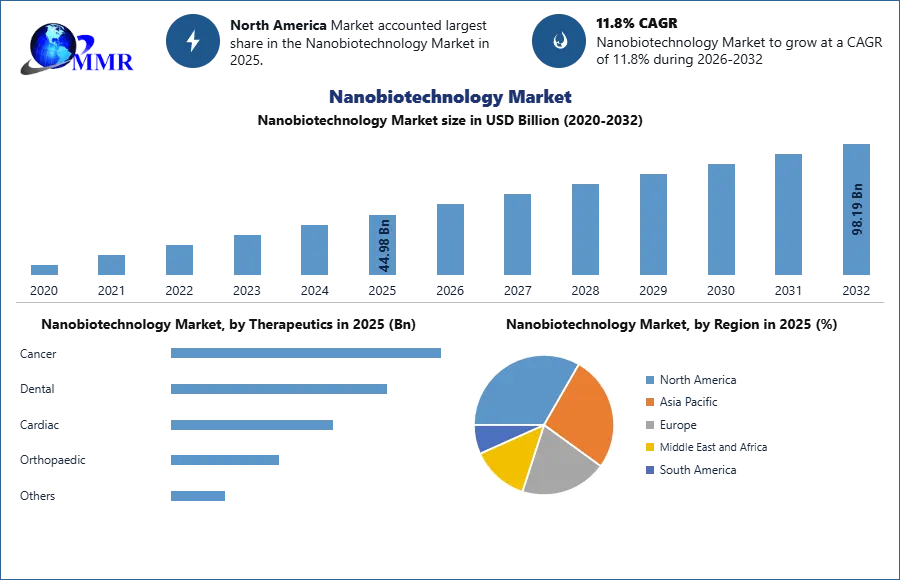
• Global Nanobiotechnology Market valued at USD 44.98 billion in 2025.
• Market projected to reach USD 98.19 billion by 2032.
• Forecast CAGR stands at 11.8% between 2026 and 2032.
• Growing prevalence of chronic diseases is increasing demand for advanced therapeutic technologies.
• Drug delivery applications continue to attract significant investment across pharmaceutical and biotechnology sectors.
• Diagnostics, biosensing, and regenerative medicine are expanding commercial opportunities.
• Precision medicine initiatives are creating new pathways for targeted treatment development.
• Pharmaceutical and biotechnology companies remain major end-use stakeholders.
Why This Matters Now
Healthcare systems face mounting pressure to improve patient outcomes while controlling treatment costs. Traditional therapies often struggle to deliver targeted efficacy, creating demand for technologies capable of improving precision, reducing side effects, and accelerating diagnosis.
Nanobiotechnology is increasingly positioned at the center of that transformation. For pharmaceutical companies, hospitals, biotechnology innovators, and investors, the technology offers a pathway toward more effective therapies, smarter diagnostics, and personalized treatment strategies. The pace of investment suggests the sector is moving from research promise toward broader clinical and commercial adoption.
Market Overview
The global Nanobiotechnology Market was valued at USD 44.98 billion in 2025 and is expected to reach nearly USD 98.19 billion by 2032, expanding at a CAGR of 11.8% during the forecast period. Growth is being driven primarily by the increasing prevalence of chronic diseases and rising demand for advanced therapeutic solutions.
Nanobiotechnology combines nanotechnology and biological sciences to develop highly targeted healthcare applications. These applications include drug delivery systems, diagnostics, regenerative medicine, imaging technologies, biosensors, and therapeutic interventions.
The industry’s commercial significance extends beyond scientific advancement. Every improvement in treatment precision can reduce healthcare costs, improve patient adherence, and strengthen reimbursement outcomes. As healthcare providers increasingly focus on value-based care, technologies capable of delivering measurable clinical benefits are attracting greater attention.
The market’s growth trajectory also signals a broader shift toward precision healthcare. Pharmaceutical developers are seeking more targeted treatment approaches, while healthcare providers aim to improve outcomes through earlier diagnosis and personalized interventions.
Key Trends Driving Growth
The most significant growth driver remains the rising burden of chronic diseases. Cancer, cardiovascular conditions, orthopedic disorders, and other long-term illnesses continue to increase demand for innovative treatment modalities. Nanobiotechnology offers mechanisms to improve therapeutic effectiveness while reducing systemic exposure and adverse effects.
Drug delivery innovation is emerging as a strategic priority across pharmaceutical pipelines. Nanotechnology-based delivery platforms can improve bioavailability, enhance targeting accuracy, and optimize treatment performance. These advantages are becoming increasingly valuable as the industry develops more complex biologic therapies.
Diagnostics and biosensing technologies are also gaining momentum. Healthcare systems are emphasizing earlier disease detection, faster diagnosis, and more personalized treatment planning. Nanobiotechnology enables enhanced sensitivity and precision, supporting these objectives.
Regenerative medicine represents another important opportunity. Research organizations and healthcare providers are exploring nanotechnology-enabled approaches that support tissue repair, cellular regeneration, and advanced therapeutic development.
Precision medicine initiatives are accelerating demand across multiple healthcare sectors. As treatments become increasingly tailored to individual patient profiles, nanobiotechnology provides tools that can improve targeting, monitoring, and treatment optimization.
Research investments continue to expand globally. Public institutions, biotechnology firms, and pharmaceutical companies are increasing funding for nanotechnology-based healthcare innovations, creating a stronger commercialization pipeline.
𝐃𝐨𝐰𝐧𝐥𝐨𝐚𝐝 𝐏𝐃𝐅 𝐁𝐫𝐨𝐜𝐡𝐮𝐫𝐞 @ https://www.maximizemarketresearch.com/request-sample/207986/
Segment Insights
• Dominant Segment: Not specified in the supplied MMR report.
• Fastest-Growing Segment: Not specified in the supplied MMR report.
• Therapeutics segmentation includes cancer, dental, cardiac, orthopedic, and other treatment applications.
• Product categories include nanoparticles, nanocarriers, nanotools, quantum dots, and liposomes.
• Application areas include drug delivery, diagnostics, regenerative medicine, imaging and biosensing, and other healthcare uses.
• Major end-use industries include pharmaceutical and biotechnology companies, research laboratories and institutes, hospitals and clinics, and other healthcare organizations.
The breadth of applications highlights the market’s strategic importance across the healthcare value chain. Rather than serving a single therapeutic area, nanobiotechnology is becoming a foundational technology platform with cross-disciplinary relevance.
Regional Growth Story
North America remains a significant innovation center due to strong research ecosystems, advanced healthcare infrastructure, and substantial investment in biotechnology and pharmaceutical development. The United States continues to attract considerable funding for nanotechnology research and clinical translation.
Europe benefits from established healthcare systems, active academic research networks, and increasing interest in precision medicine. Germany and the United Kingdom remain important contributors to biotechnology innovation and translational research.
Asia-Pacific is emerging as a major growth engine. China, Japan, India, and South Korea are investing heavily in biotechnology infrastructure, healthcare modernization, and scientific research. Expanding healthcare access and growing demand for advanced treatments are creating favorable market conditions.
Japan continues to emphasize advanced medical technologies and innovation-driven healthcare. South Korea’s biotechnology ecosystem is expanding rapidly, supported by government initiatives and private-sector investment.
India and China are witnessing increasing healthcare expenditure and research activity, creating opportunities for both domestic innovation and international collaboration.
Across all regions, healthcare stakeholders are pursuing technologies capable of improving treatment efficiency, clinical outcomes, and long-term healthcare sustainability.
Competitive Landscape
Competition increasingly centers on innovation, intellectual property development, and commercialization capabilities. Companies that successfully bridge scientific discovery and clinical application are positioned to capture disproportionate value.
Pharmaceutical organizations are integrating nanobiotechnology into therapeutic pipelines to improve drug performance and differentiate products. Biotechnology firms are leveraging specialized expertise to develop targeted applications across diagnostics, drug delivery, and regenerative medicine.
Research institutions continue to play a critical role in advancing technology readiness. Collaborations between academic organizations, healthcare providers, and commercial entities are accelerating product development and market adoption.
Mergers, acquisitions, and strategic partnerships are expected to remain important competitive tools as organizations seek access to proprietary technologies, specialized expertise, and clinical development capabilities.
Recent Developments
• Increasing investment in nanotechnology-enabled drug delivery systems.
• Expanded research activity focused on chronic disease treatment applications.
• Growing commercialization of diagnostics and biosensing technologies.
• Rising adoption of regenerative medicine applications.
• Continued development of nanoparticle, nanocarrier, and liposome technologies.
• Greater collaboration between pharmaceutical companies, research institutes, and healthcare providers.
Strategic Implications
Healthcare executives should view nanobiotechnology as a long-term platform technology rather than a niche innovation category. Its applications span diagnosis, treatment, monitoring, and regenerative care, creating opportunities across multiple revenue streams.
For pharmaceutical companies, the technology offers pathways to improve clinical performance and extend product differentiation. For healthcare providers, more targeted therapies can improve patient outcomes and operational efficiency.
Investors should monitor organizations that combine strong intellectual property portfolios with demonstrated clinical translation capabilities. The most valuable assets are likely to emerge where scientific innovation intersects with scalable commercialization.
Payers and regulators will increasingly evaluate nanobiotechnology through the lens of clinical outcomes and economic value. Technologies capable of reducing complications, improving treatment success rates, and lowering long-term healthcare costs may achieve stronger adoption.
Future Outlook
The next generation of healthcare leaders will be defined not by who develops nanobiotechnology first, but by who translates it fastest into measurable patient outcomes and scalable clinical value.
Analyst Perspective
“The convergence of nanotechnology, biotechnology, and precision medicine is creating one of healthcare’s most significant innovation opportunities. Organizations that invest in targeted therapeutics, advanced diagnostics, and clinical translation capabilities will be best positioned to capture long-term market growth.”
— Rucha Deshpande, Research Manager
About Maximize Market Research
Maximize Market Research Pvt. Ltd. (MMR) is a global market research and consulting company that provides reliable, data-focused, and practical business insights. The firm serves a wide range of industries, including healthcare, pharmaceuticals, technology, automotive, electronics, chemicals, personal care, and consumer goods. Through market forecasts, competitive analysis, strategic consulting, and industry impact assessments, MMR helps organizations understand changing market conditions, identify growth opportunities, and make informed business decisions for long-term success.
2nd Floor, Navale IT Park Phase 3
Pune Banglore Highway, Narhe
Pune, Maharashtra 411041, India
+91 9607365656
sales@maximizemarketresearch.com
