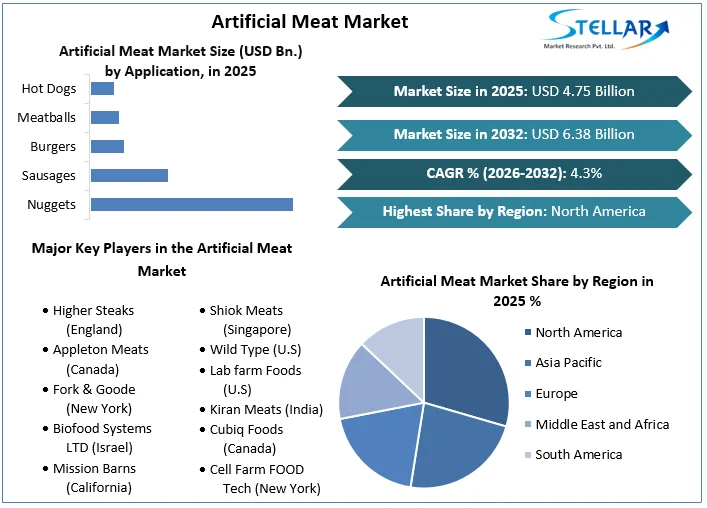
Rising investments, food technology advances, and sustainability priorities are reshaping the Artificial Meat Market, which is projected to expand at a CAGR of 4.3% through 2032.
PUNE, India, June 19, 2026 — The Artificial Meat Market, according to the latest study released by Stellar Market Research, is witnessing a significant transformation as food manufacturers, investors, and governments increasingly prioritize sustainable protein alternatives. The market, valued at approximately USD 4.75 billion in 2025, is forecast to reach nearly USD 33.42 billion by 2032, expanding at a CAGR of 4.3% during the forecast period of 2025–2032.
The report highlights how evolving consumer preferences, environmental concerns, and technological innovation are accelerating the commercialization of alternative proteins and creating new opportunities across the global food ecosystem.
Market Opportunity Overview
The artificial meat industry is moving beyond niche vegan products and entering mainstream food consumption. Rising awareness regarding greenhouse gas emissions, animal welfare concerns, and resource-efficient food production is driving substantial investments into cultivated meat and plant-based protein technologies.
Large food manufacturers and biotechnology companies are increasingly focusing on taste optimization, texture enhancement, and cost reduction. As supply chains mature and production technologies improve, artificial meat products are expected to become more competitive with conventional animal protein.
The market transformation is also being supported by retail expansion, food-service partnerships, and increasing consumer demand for clean-label and sustainable foods.
Download Free PDF Brochure: https://www.stellarmr.com/report/req_sample/Artificial-Meat-Market/366
Key Findings from the Report
The global Artificial Meat Market was valued at USD 4.75 billion in 2024.
The market is projected to reach approximately USD 33.42 billion by 2032, registering a CAGR of 4.3%.
By source, the soy protein segment accounted for the largest market share owing to its affordability and nutritional profile.
Plant-based meat products continue to dominate overall market demand.
The burger patties and nuggets category represents one of the fastest-growing product segments driven by quick-service restaurant adoption.
North America remains the leading regional market due to strong consumer awareness and extensive product availability.
Asia-Pacific is emerging as a high-growth region supported by rising investments and increasing health-conscious populations.
Market Drivers and Restraints
Key Drivers
Growing Demand for Sustainable Protein
Consumers are increasingly seeking environmentally responsible food products with lower carbon footprints, supporting long-term growth in alternative proteins.
Technological Advancements in Food Engineering
Continuous innovation in fermentation, cell cultivation, and plant-protein processing is improving texture, flavor, and nutritional value.
Expanding Investment Activity
Private equity firms, venture capital investors, and food conglomerates are allocating capital toward next-generation protein technologies and manufacturing facilities.
Key Restraints
High Production Costs
Cultivated meat and premium plant-based products continue to face cost challenges compared with conventional meat products.
Regulatory Complexity
Approval procedures and labeling requirements vary considerably across countries, creating barriers to rapid commercialization.
Technology, Regulation, and Sustainability Trends
Artificial intelligence and precision fermentation technologies are increasingly being utilized to accelerate product development and optimize ingredient formulations. Advanced extrusion technologies are enabling manufacturers to replicate the texture and mouthfeel of conventional meat more effectively.
Governments in Singapore, the United States, and several European countries are establishing frameworks for cultivated meat commercialization and food safety compliance.
From an ESG perspective, artificial meat products offer substantial advantages in terms of water consumption, land utilization, and greenhouse gas emissions, making them increasingly attractive to sustainability-focused investors and food manufacturers.
Download Free PDF Brochure: https://www.stellarmr.com/report/req_sample/Artificial-Meat-Market/366
Regional Insights
North America Maintains Market Leadership
The United States and Canada continue to dominate the Artificial Meat Market due to strong innovation ecosystems, consumer awareness, and extensive retail distribution networks. Increasing partnerships between food-service operators and alternative protein manufacturers are supporting market expansion.
Asia-Pacific Emerging as a Strategic Growth Hub
China, India, Japan, and Singapore are experiencing rapid growth as governments and investors support food security initiatives and next-generation protein technologies. Singapore remains one of the most progressive markets for cultivated meat approvals.
Europe Strengthens Sustainability Focus
Germany, the United Kingdom, and the Netherlands are benefiting from rising vegan populations and increasing emphasis on carbon reduction initiatives. Favorable consumer attitudes toward sustainable foods are accelerating market penetration.
Recent Industry Developments
Upside Foods (2025): Expanded pilot-scale cultivated meat production capabilities, enhancing commercial readiness and supporting larger-scale market entry.
Mosa Meat (2025): Secured additional funding to accelerate cultivated beef development and optimize production economics, strengthening Europe’s alternative protein ecosystem.
Impossible Foods (2025): Introduced upgraded plant-based formulations aimed at improving taste and nutritional performance, supporting broader consumer adoption.
Beyond Meat (2025): Expanded partnerships with food-service operators and retailers to improve product accessibility and market penetration.
Meatable (2025): Advanced cell-cultivation technology initiatives designed to shorten production timelines and lower manufacturing costs, contributing to commercialization efforts.
Competitive Landscape
Competition within the Artificial Meat Market is intensifying as established food manufacturers and biotechnology companies pursue product innovation, capacity expansion, and strategic collaborations.
Major participants include:
- Higher Steaks (England)
- Appleton Meats (Canada)
- Fork & Goode (New York)
- Biofood Systems LTD (Israel)
- Mission Barns (California)
- BlueNalu, Inc. (California)
- Mutable (U.S)
- Seafuture Sustainable Biotech (Canada)
- Shiok Meats (Singapore)
- Wild Type (U.S)
Leading companies are focusing on flavor enhancement, production efficiency, retail partnerships, and regulatory approvals to strengthen their competitive positioning.
Analyst Commentary
“Artificial meat is evolving from a niche category into a strategic component of future food systems. As technological efficiencies improve and regulatory pathways become clearer, the industry is expected to witness broader consumer acceptance and increased institutional investment,” said a Senior Research Analyst at Stellar Market Research.
Future Outlook
Through 2032, the Artificial Meat Market is expected to benefit from continued advances in food biotechnology, increasing sustainability commitments, and growing demand for protein diversification.
Production economics are anticipated to improve significantly, enabling broader commercialization and greater price competitiveness with traditional meat products. Strategic partnerships between food manufacturers, biotechnology firms, and retailers are likely to shape the next phase of industry development.
As governments intensify efforts to promote sustainable food systems and consumers increasingly prioritize health and environmental considerations, artificial meat products are expected to become an integral part of the global protein landscape.
About Stellar Market Research
Stellar Market Research is a global market research and business consulting company providing actionable intelligence across diverse industries including food and beverages, healthcare, automotive, chemicals, energy, technology, and manufacturing. The company delivers in-depth market studies, competitive benchmarking, trend analysis, and strategic consulting services that help organizations identify growth opportunities and make informed decisions. Through rigorous methodologies and data-driven insights, Stellar Market Research supports manufacturers, investors, policymakers, and business leaders in navigating evolving market dynamics and building sustainable competitive advantages.
Media Contact
Stellar Market Research
Website: http://stellarmr.com/
Email: sales@stellarmr.com
