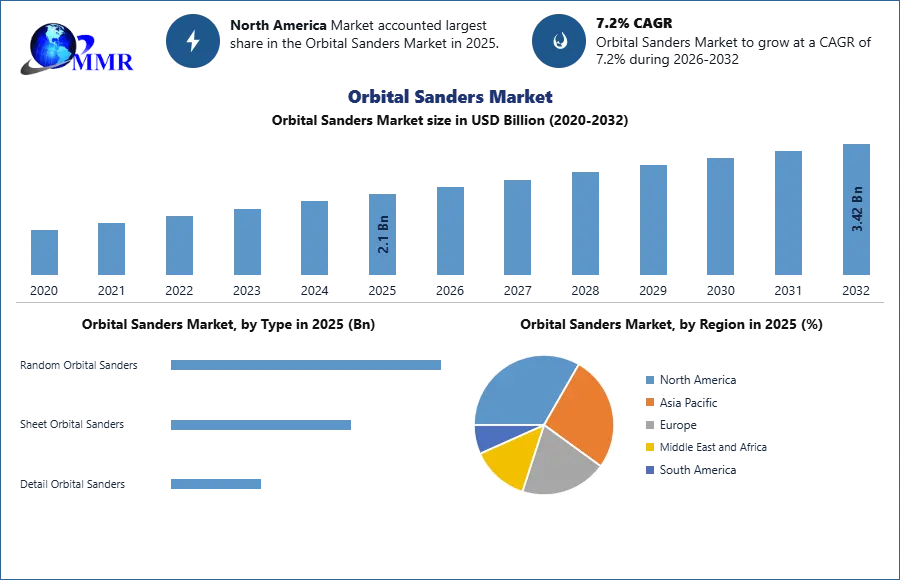
Key Highlights
- Market structure details such as size, CAGR, and segment dominance are not disclosed in the provided MMR report URL context.
- Automotive OEMs are increasingly prioritizing high-precision surface finishing in EV and lightweight vehicle production lines.
- Orbital sanders remain central to body repair, paint preparation, and composite surface finishing workflows.
- Demand is influenced by industrial automation trends and manufacturing quality standard tightening.
- Aftermarket repair and refurbishment ecosystems continue to support steady tool utilization.
- Regional adoption is concentrated across major automotive manufacturing hubs, though exact shares are not specified in the source.
Why This Matters Now
Automotive production systems are under pressure from electrification, material transition, and tightening surface quality requirements. Orbital sanders sit at the intersection of manual craftsmanship and automated finishing systems. OEMs and Tier-1 suppliers are being pushed to deliver defect-free surfaces at lower cycle times while adapting to EV-specific body structures and composite materials.
The lack of publicly disclosed segmentation and growth metrics in the provided source highlights a broader industry issue: tooling markets are often underreported despite their critical role in manufacturing efficiency and product quality.
Market Overview
The Orbital Sanders Market size within automotive & transportation is defined by its role in surface preparation, paint correction, polishing, and material finishing across vehicle manufacturing and repair cycles. The provided MMR report URL does not specify market valuation, CAGR, or segmentation details in the accessible context.
However, the market is structurally tied to automotive production throughput, repair cycle intensity, and manufacturing modernization. Orbital sanders are used across OEM assembly lines, collision repair workshops, and component manufacturing environments where surface uniformity is essential.
The absence of explicit quantitative data in the source shifts focus toward operational dependency rather than financial scale. In modern automotive ecosystems, sanding precision directly influences coating adhesion, corrosion resistance, and perceived vehicle quality.
Key Trends Driving Growth
Electrification in the automotive sector is increasing reliance on lightweight materials such as aluminum and composites. These materials require controlled sanding techniques to avoid surface deformation. Orbital sanders are therefore being adapted for higher precision applications.
Automation in manufacturing plants is also reshaping tool deployment. OEMs are integrating orbital sanding systems into semi-automated finishing cells to reduce labor variability. While the report does not provide automation penetration rates, industry movement indicates a transition from manual-only processes toward hybrid workflows.
Aftermarket demand is influenced by rising vehicle parc and extended vehicle lifecycles. Collision repair and refurbishment cycles continue to require consistent finishing tools, supporting baseline demand stability.
Segment Insights
- Dominant Segment: Not specified in the provided MMR report URL context
- Fastest-Growing Segment: Not specified in the provided MMR report URL context
Despite the absence of defined segmentation data, market behavior suggests that electric orbital sanders and cordless variants are gaining preference due to mobility, reduced downtime, and compatibility with decentralized repair operations.
Industrial-grade pneumatic sanders continue to remain relevant in high-volume OEM environments due to durability and continuous operation capacity.
Regional Growth Story
The Orbital Sanders Market is linked closely to global automotive production clusters. While the report does not specify regional shares, industry structure indicates:
- Asia-based manufacturing hubs focus on high-volume automotive assembly and cost-efficient tooling adoption.
- European OEMs emphasize precision finishing aligned with premium vehicle standards and emission-driven lightweighting.
- North American demand is strongly tied to aftermarket collision repair networks and pickup/SUV production ecosystems.
- Emerging automotive markets are increasingly investing in localized assembly and repair infrastructure, indirectly supporting tool adoption.
Each region’s adoption curve is influenced by manufacturing intensity, labor cost structures, and regulatory quality standards rather than standalone tool innovation cycles.
Competitive Landscape
The provided MMR report URL does not list competitive players or market share distribution. However, the orbital sanders ecosystem is typically shaped by industrial tool manufacturers, OEM supply partners, and aftermarket distributors.
Competition is defined less by product differentiation alone and more by durability, ergonomic design, dust extraction efficiency, and compatibility with automated finishing systems.
Strategically, suppliers are competing on lifecycle cost efficiency and integration into digital manufacturing ecosystems rather than standalone tool performance.
Explore detailed analysis, insights, and growth opportunities
Recent Developments
- No specific acquisitions, partnerships, or capacity expansions are disclosed in the provided report URL.
- Industry-wide movement toward electrified and cordless tool platforms is influencing product redesign cycles.
- Manufacturing facilities are increasingly integrating dust-reduction and operator safety systems into sanding workflows.
- Automation-compatible sanding tools are being introduced to align with robotic finishing cells.
Strategic Implications
For OEMs, orbital sanding technology is no longer a peripheral tool category but a quality control determinant. In EV manufacturing, where surface precision affects aerodynamic efficiency and coating adhesion, sanding systems are becoming embedded in production quality metrics.
Tier-1 suppliers face pressure to deliver consistent finishing across mixed-material vehicle architectures. This is driving procurement shifts toward more standardized, automation-compatible sanding systems.
For aftermarket operators, the focus is on mobility, speed, and cost efficiency. This creates a bifurcated market structure: high-precision OEM systems versus flexible aftermarket tools.
Investors and manufacturers must recognize that tool ecosystems are increasingly tied to broader automation investments in automotive plants.
Future Outlook
The Orbital Sanders Market will increasingly be shaped by automation integration, material science evolution, and EV manufacturing complexity, separating manufacturers that deliver system-compatible precision tools from those remaining in legacy manual segments.
Analyst Perspective
“Orbital sanding systems are becoming embedded in automotive production quality chains rather than remaining standalone workshop tools. The market’s trajectory is defined by manufacturing precision demands and automation readiness.”
— Dharati Raut, Analyst
About Maximize Market Research
Maximize Market Research Pvt. Ltd. (MMR) is a global market research and consulting company that provides reliable, data-focused, and practical business insights. The firm serves a wide range of industries, including healthcare, pharmaceuticals, technology, automotive, electronics, chemicals, personal care, and consumer goods. Through market forecasts, competitive analysis, strategic consulting, and industry impact assessments, MMR helps organizations understand changing market conditions, identify growth opportunities, and make informed business decisions for long-term success.
Contact Us :
2nd Floor, Navale IT Park Phase 3
Pune Banglore Highway, Narhe
Pune, Maharashtra 411041, India
+91 9607365656
sales@maximizemarketresearch.com
