Key Highlights
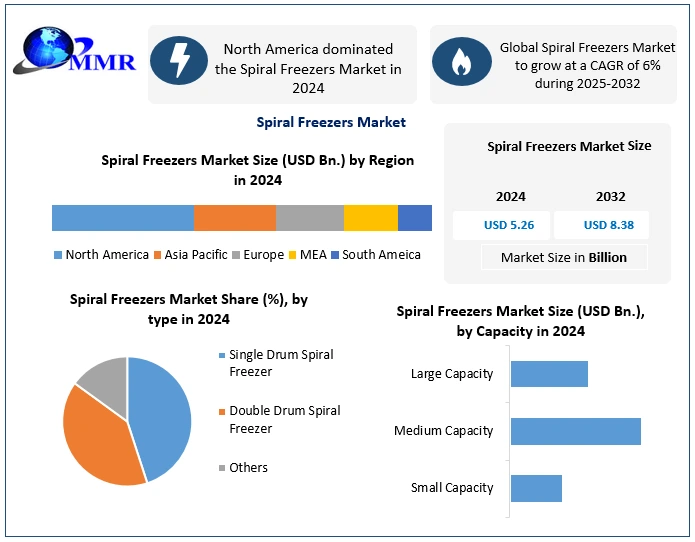
- Spiral Freezers Market was valued at USD 5.26 billion in 2024.
- Market revenue is projected to reach nearly USD 8.38 billion by 2032, growing at a 6% CAGR from 2025 to 2032.
- Rising demand for energy-efficient freezing solutions is becoming a major purchasing criterion across food processing facilities.
- Growth in frozen foods, ready-to-eat products, and high-volume food manufacturing is increasing adoption of spiral freezing technologies.
- Automation and operational efficiency are emerging as critical competitive differentiators for food processors.
- Manufacturers are investing in technologies that reduce footprint, improve throughput, and lower operating costs.
Why This Matters Now
Food manufacturers are facing a dual challenge: rising production volumes and increasing pressure to reduce energy consumption. Companies that fail to modernize freezing operations risk losing both margin and market share.
The Spiral Freezers Market, valued at USD 5.26 billion in 2024 and expected to reach nearly USD 8.38 billion by 2032, signals a broader shift in food processing economics. Every percentage point of efficiency gained in freezing translates directly into lower operating costs, improved product quality, and stronger profitability.
Market Overview
Spiral freezers have become a critical asset in modern food manufacturing. As frozen foods continue to occupy a larger share of consumer spending, processors are seeking technologies capable of delivering consistent freezing performance at industrial scale.
The market’s projected 6% CAGR through 2032 is more than a growth statistic. It indicates sustained capital investment across food processing operations seeking greater efficiency, higher throughput, and better utilization of production space.
Energy consumption has become one of the industry’s most scrutinized cost centers. This is elevating demand for advanced spiral freezer systems that can reduce operating expenses while maintaining product integrity and production continuity.
For food manufacturers, freezing technology is no longer a back-end operational consideration. It has become a strategic lever for competitiveness.
Key Trends Driving Growth
The strongest market catalyst is the growing demand for energy-efficient freezing solutions. As food processors face rising utility costs and stricter sustainability expectations, investments increasingly favor systems capable of reducing energy intensity without compromising production capacity.
Automation is reshaping purchasing decisions. Food producers are looking beyond simple freezing performance and evaluating equipment based on labor optimization, operational reliability, and integration with broader manufacturing systems.
The continued expansion of frozen and convenience food categories is creating additional demand for industrial freezing infrastructure. Consumers increasingly prioritize convenience, product availability, and extended shelf life, forcing manufacturers to expand processing capabilities.
At the same time, production facilities are under pressure to maximize output within existing footprints. Spiral freezers offer space-efficient designs that help manufacturers increase capacity without requiring major facility expansion, making them attractive in both mature and emerging markets.
Sustainability is also becoming a boardroom priority. Companies are evaluating equipment investments through the lens of long-term environmental impact and energy performance, accelerating replacement cycles for older systems.
Get a free sample now:https://www.maximizemarketresearch.com/request-sample/148731/
Segment Insights
- Dominant Segment: Information available in the MMR report identifies the leading market segment based on revenue contribution.
- Fastest-Growing Segment: Information available in the MMR report identifies the segment projected to register the highest growth during the forecast period.
- Spiral freezer adoption is increasing among high-volume food processors seeking continuous production capabilities.
- Demand remains strongest in applications where product consistency, rapid freezing, and operational efficiency directly influence profitability.
- Equipment selection is increasingly driven by lifecycle costs rather than upfront capital expenditure alone.
- Food manufacturers are prioritizing systems that combine throughput optimization with reduced energy consumption.
Regional Growth Story
Regional demand patterns are increasingly influenced by food processing investments, cold-chain development, and consumption of frozen food products.
Developed markets continue to focus on modernization and energy efficiency upgrades. In these regions, replacement demand and sustainability initiatives are creating opportunities for advanced spiral freezer technologies.
Emerging markets represent a different growth narrative. Expanding food manufacturing capacity, rising urbanization, and increasing demand for processed foods are driving new equipment installations. For suppliers, these regions offer opportunities to establish long-term customer relationships as food infrastructure expands.
The result is a market supported by both replacement demand in mature economies and capacity expansion in developing regions.
Competitive Landscape
Competition in the Spiral Freezers Market is shifting from equipment specifications to operational outcomes. Manufacturers are increasingly competing on energy efficiency, automation capabilities, maintenance requirements, and total cost of ownership.
This signals a broader transformation in buyer behavior. Food processors are no longer evaluating freezing equipment solely on freezing performance. They are assessing how these systems affect labor productivity, sustainability targets, and long-term operating economics.
For competitors, this raises the stakes. Companies unable to demonstrate measurable efficiency gains may face increasing pressure as customers prioritize ROI-driven purchasing decisions.
Over the next 12–24 months, the competitive advantage is likely to belong to suppliers that combine advanced engineering with digital monitoring, predictive maintenance capabilities, and energy optimization features. The market appears poised for continued innovation as manufacturers seek differentiation in an increasingly performance-focused environment.
Recent Developments
- Growing industry focus on energy-efficient freezing technologies.
- Increased investment in food processing automation and production optimization.
- Rising adoption of space-saving freezing solutions within manufacturing facilities.
- Greater emphasis on sustainability-driven equipment upgrades.
- Continued expansion of freezing infrastructure to support frozen and convenience food production.
Strategic Implications
Food manufacturers face a clear investment decision. Rising energy costs, labor constraints, and demand growth are making operational efficiency a strategic necessity rather than an optional upgrade.
For equipment suppliers, the opportunity extends beyond hardware sales. Customers increasingly seek integrated solutions that improve productivity, reduce energy consumption, and support sustainability objectives.
Investors should view the market’s growth trajectory as a signal of broader modernization trends within food processing. Capital spending is increasingly flowing toward technologies capable of delivering measurable operational improvements.
Companies that align product development with efficiency, automation, and sustainability priorities are likely to capture a disproportionate share of future demand.
Future Outlook
The Spiral Freezers Market is expected to grow from USD 5.26 billion in 2024 to nearly USD 8.38 billion by 2032, supported by a 6% CAGR and rising demand for energy-efficient freezing solutions.
Growth will increasingly be driven by food manufacturers seeking greater throughput, lower operating costs, and stronger sustainability performance. The next phase of competition will center on intelligent, efficient, and highly automated freezing systems.
The winners will be companies that transform freezing technology into a productivity advantage, while the losers will be those that continue treating energy efficiency as a compliance requirement rather than a strategic differentiator.
Analyst Perspective
“The Spiral Freezers Market is entering a phase where operational efficiency has become as important as production capacity. Food processors are prioritizing technologies that reduce energy consumption, improve throughput, and support long-term sustainability goals. This shift is creating significant opportunities for manufacturers capable of delivering measurable performance improvements.” — Siddhi Dole, Analyst
About Maximize Market Research
Maximize Market Research Pvt. Ltd. (MMR) is a global market research and consulting company that provides reliable, data-focused, and practical business insights. The firm serves a wide range of industries, including healthcare, pharmaceuticals, technology, automotive, electronics, chemicals, personal care, and consumer goods. Through market forecasts, competitive analysis, strategic consulting, and industry impact assessments, MMR helps organizations understand changing market conditions, identify growth opportunities, and make informed business decisions for long-term success.
Contact Maximize Market Research:
2nd Floor, Navale IT Park Phase 3
Pune Banglore Highway, Narhe
Pune, Maharashtra 411041, India
+91 9607365656
sales@maximizemarketresearch.com
