Key Highlights
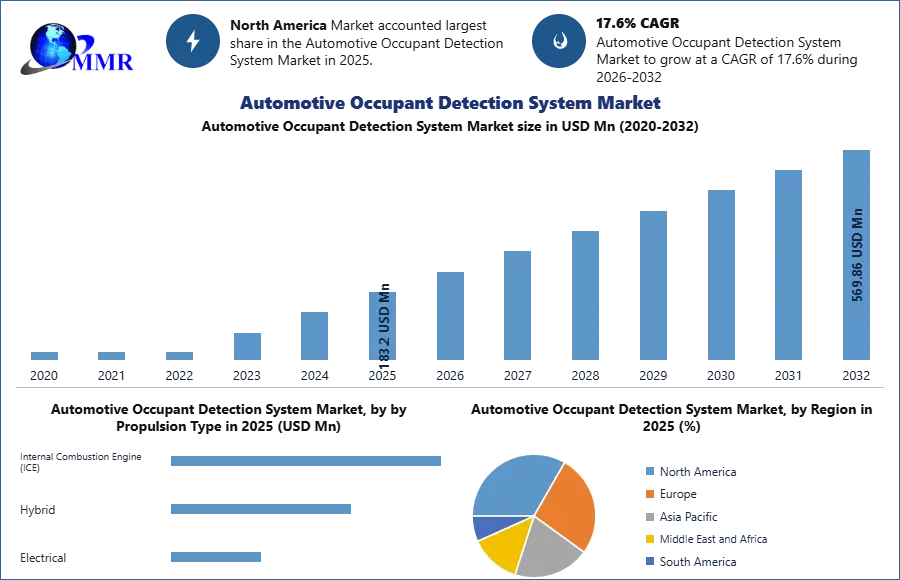
- Market to expand from USD 183.2 Mn (2025) to USD 569.86 Mn (2032) at 17.6% CAGR
- Strong demand driven by ADAS integration and regulatory safety mandates
- AI-based occupant detection reshaping in-cabin intelligence systems
- EV cabin architecture enabling deeper sensor integration
- Semiconductor demand rising for radar, camera, and infrared sensing
- Asia-Pacific scaling rapidly due to vehicle production growth
Why This Matters Now
Vehicle safety is shifting from passive protection systems to intelligent, real-time occupant monitoring. Regulators are increasingly mandating child presence detection and in-cabin awareness systems, forcing OEMs to embed advanced sensing technologies across vehicle platforms.
At the same time, EV platform redesign is enabling deeper sensor integration, making occupant detection a core safety and user-experience layer rather than a premium add-on.
Market Overview
The Automotive Occupant Detection System Market Size is centered on sensing technologies that identify and monitor vehicle occupants using cameras, radar, infrared sensors, and weight-based systems. These solutions are increasingly integrated into ADAS architectures and smart cabin ecosystems.
The market is expected to rise from USD 183.2 Mn in 2025 to USD 569.86 Mn by 2032 at a CAGR of 17.6%, reflecting rapid adoption across passenger vehicles, particularly in safety-regulated markets.
Occupant detection is evolving into a foundational vehicle intelligence system, supporting airbags, seatbelt alerts, driver monitoring, and emergency response features.
Key Trends Driving Growth
Safety regulations are the primary growth driver, with governments mandating child presence detection systems and advanced occupant monitoring in new vehicles.
ADAS expansion is accelerating integration, linking occupant detection with crash prevention, alert systems, and autonomous driving safety protocols.
EV architecture transformation is enabling improved sensor placement and multi-camera cabin monitoring, improving detection accuracy and system reliability.
AI and semiconductor advancements are enhancing real-time decision-making capabilities through sensor fusion and machine learning-based classification systems.
Segment Insights
Dominant Segment: Camera-based occupant detection systems due to high precision and seamless ADAS integration
Fastest-Growing Segment: AI-driven multi-sensor fusion systems powered by autonomous driving and EV cabin intelligence demand
Passenger vehicle applications dominate due to regulatory pressure and high production volumes, while commercial fleets are gradually adopting these systems for safety compliance and liability management.
Regional Growth Story
North America leads adoption due to strict vehicle safety regulations and early integration of ADAS platforms across OEM lineups.
Europe is driven by strong regulatory enforcement and rapid EV adoption, particularly in premium and luxury vehicle segments.
Asia-Pacific is the fastest-expanding region, supported by high vehicle production volumes in China, India, Japan, and South Korea, along with increasing safety standard enforcement.
Emerging markets are gradually adopting occupant detection systems as global OEM platforms penetrate local manufacturing ecosystems.
Competitive Landscape
The market is shaped by Tier-1 suppliers and semiconductor companies competing on sensing accuracy, AI capability, and system integration efficiency.
Competition is shifting from hardware-only systems to AI-enabled software-defined sensing platforms that integrate multiple data streams for real-time occupant intelligence.
Strategic partnerships between OEMs and sensor manufacturers are increasing as occupant detection becomes a mandatory safety layer in next-generation vehicles.
Recent Developments
- Expansion of AI-based in-cabin monitoring systems
- Growth in radar and camera fusion technologies for occupant detection
- OEM–Tier-1 collaborations for regulatory compliance systems
- Rising semiconductor investments supporting ADAS and cabin sensing
- Integration of occupant detection into EV smart cabin platforms
Strategic Implications
OEMs are repositioning occupant detection from optional safety features to core vehicle architecture requirements. This increases dependency on semiconductor supply chains and AI-based sensing ecosystems.
Tier-1 suppliers must ensure scalable solutions compatible across ICE and EV platforms while meeting diverse regulatory frameworks.
Fleet operators and mobility providers are adopting these systems to improve passenger safety assurance and reduce liability risks in shared mobility models.
Investors should monitor AI sensor fusion innovation and regulatory expansion as primary drivers of long-term market acceleration.
Future Outlook
The Automotive Occupant Detection System Market will evolve into a fully AI-driven cabin intelligence ecosystem, separating OEMs that deliver real-time occupant awareness from those relying on legacy safety architectures.
Analyst Perspective
“Occupant detection is rapidly becoming a core intelligence layer in modern vehicles. Its future growth will be defined by AI integration, regulatory expansion, and deeper EV cabin digitization.”
— Dharati Raut
About Maximize Market Research
Maximize Market Research Pvt. Ltd. (MMR) is a global market research and consulting company that provides reliable, data-focused, and practical business insights. The firm serves a wide range of industries, including healthcare, pharmaceuticals, technology, automotive, electronics, chemicals, personal care, and consumer goods. Through market forecasts, competitive analysis, strategic consulting, and industry impact assessments, MMR helps organizations understand changing market conditions, identify growth opportunities, and make informed business decisions for long-term success.
Contact Us :
2nd Floor, Navale IT Park Phase 3
Pune Banglore Highway, Narhe
Pune, Maharashtra 411041, India
+91 9607365656
sales@maximizemarketresearch.com
