Key Highlights
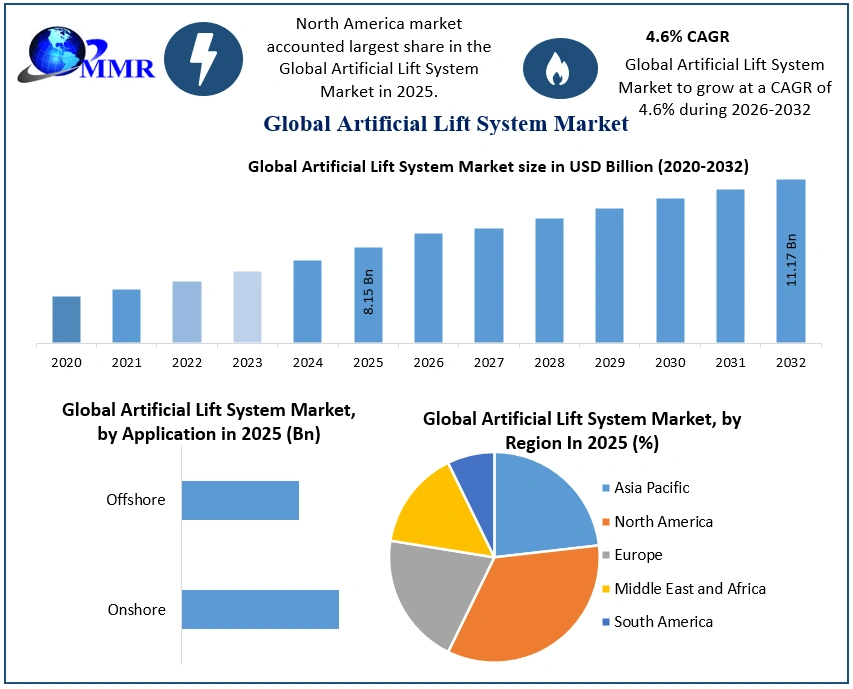
- Artificial Lift System Market valued at USD 8.15 Billion in 2025.
- Market expected to reach USD 11.17 Billion by 2032.
- Forecast CAGR stands at 4.6% from 2025 to 2032.
- Increasing focus on maximizing production from mature oil fields is driving investment.
- Technology adoption is reshaping production economics across upstream operations.
- North America remains a key market due to extensive oil and gas infrastructure.
- Digital monitoring and automation are improving operational efficiency.
Why This Matters Now
The economics of oil and gas production are changing. Operators are under pressure to increase output from aging reservoirs while controlling costs and improving operational efficiency. Artificial lift systems have moved from being production-support tools to strategic assets that determine field profitability.
As energy companies prioritize production optimization over exploration risk, demand for advanced lifting technologies is accelerating. The shift is creating opportunities for equipment manufacturers, technology providers, service companies, investors, and upstream operators seeking higher recovery rates and improved asset performance.
Market Overview
The Artificial Lift System Market was valued at USD 8.15 Billion in 2025 and is projected to reach nearly USD 11.17 Billion by 2032, growing at a CAGR of 4.6% during the forecast period.
The growth trajectory reflects a broader transformation in upstream energy strategy. Many of the world’s producing reservoirs are maturing, forcing operators to deploy technologies capable of maintaining commercial production levels. Artificial lift systems enable wells to continue producing efficiently when natural reservoir pressure declines.
The business significance extends beyond production enhancement. Artificial lift technologies help reduce operating costs per barrel, improve reservoir management, and extend field life. For operators facing volatile energy markets, these systems have become essential tools for sustaining profitability.
What changed is the industry’s approach to asset management. Instead of relying solely on new discoveries, producers are increasingly focused on maximizing existing reserves. Artificial lift systems sit at the center of that strategy.
Key Trends Driving Growth
A major trend shaping the market is the growing emphasis on mature field redevelopment. Energy companies are investing in technologies that can extract additional reserves from existing assets rather than committing capital exclusively to new exploration projects.
Digitalization is also transforming artificial lift operations. Advanced monitoring systems, automation platforms, and predictive maintenance technologies are enabling operators to improve uptime and reduce equipment failures. The result is higher production efficiency and better returns on infrastructure investments.
The expansion of unconventional oil and gas production is creating another growth avenue. Many unconventional wells require artificial lift solutions early in their production lifecycle. This dynamic is increasing equipment demand across key producing regions.
Energy security concerns are further supporting investment. Governments and operators are prioritizing domestic production capabilities, encouraging technology deployment that enhances reservoir recovery and production sustainability.
The market is also benefiting from growing awareness of lifecycle economics. Operators increasingly evaluate technologies based on long-term production performance rather than initial installation costs, strengthening the value proposition of advanced artificial lift solutions.
Get a free sample:https://www.maximizemarketresearch.com/request-sample/11745/
Segment Insights
- Dominant Segment: Electric Submersible Pumps (ESP) segment leads the market due to its ability to handle high production volumes and operate effectively in challenging well conditions.
- Fastest-Growing Segment: Electric Submersible Pumps (ESP) segment is also emerging as the fastest-growing category, supported by increasing deployment across mature and high-output wells.
- Rod lift systems continue to maintain relevance because of their reliability and widespread adoption in conventional oil production environments.
- Gas lift technologies remain important for operators seeking flexible production enhancement solutions in specific reservoir conditions.
- Offshore applications are creating opportunities for technologically advanced lifting systems capable of operating in complex environments.
- Onshore production continues to account for significant demand as operators focus on maximizing output from established fields.
Regional Growth Story
North America continues to dominate the Artificial Lift System Market, supported by extensive oil and gas production infrastructure, technological innovation, and significant investments in upstream operations.
The United States remains a major center of demand due to widespread deployment of artificial lift technologies across conventional and unconventional production assets. Operators in the region increasingly view production optimization technologies as critical to maintaining competitiveness.
Asia-Pacific is emerging as a significant growth region. Countries including China and India are seeking to enhance domestic energy production and improve recovery rates from existing fields. This is encouraging investment in advanced production technologies and creating opportunities for equipment manufacturers.
The Middle East remains strategically important because national oil companies continue to focus on maximizing reservoir performance and production efficiency. Artificial lift technologies play a critical role in supporting long-term output objectives.
Latin America is also attracting attention as operators seek solutions that improve field economics and extend the productive life of mature assets.
Across regions, the common theme is clear: production optimization has become a boardroom priority, and artificial lift systems are increasingly viewed as essential infrastructure rather than optional equipment.
Competitive Landscape
Competition in the Artificial Lift System Market is increasingly centered on technology leadership, operational efficiency, and lifecycle value creation.
Leading companies are investing in digital capabilities, automation platforms, and performance monitoring solutions that help operators improve production outcomes. This shift signals a broader transition from equipment-focused competition to outcome-based value delivery.
Technology providers that combine hardware expertise with digital intelligence are gaining strategic advantages. Operators are no longer purchasing lift systems solely based on installation requirements. They are evaluating solutions according to reliability, uptime, maintenance efficiency, and production optimization potential.
The competitive environment also reflects changing customer expectations. Energy producers increasingly seek integrated solutions capable of delivering measurable operational improvements. Companies that can demonstrate production gains, reduced downtime, and lower operating costs are likely to strengthen their market positions.
Partnerships between technology developers and energy operators are becoming more important. These collaborations accelerate innovation, support field-specific customization, and improve commercial adoption of advanced lifting technologies.
The market’s competitive direction indicates a future where data-driven production optimization becomes as important as mechanical performance.
Recent Developments
- Growing deployment of digital monitoring systems across artificial lift operations.
- Increased investment in production optimization technologies for mature reservoirs.
- Expansion of automation capabilities to improve operational reliability.
- Rising focus on predictive maintenance strategies to reduce downtime.
- Stronger integration of production data analytics into field management decisions.
- Continued investments by upstream operators in recovery enhancement technologies.
Strategic Implications
For equipment manufacturers, the market presents an opportunity to move beyond traditional hardware sales and offer integrated performance solutions. Companies that combine lifting technologies with digital capabilities can capture greater value throughout the asset lifecycle.
For oil and gas operators, artificial lift systems are becoming central to production strategy. The ability to maintain output, improve recovery rates, and optimize operating costs directly affects field profitability and investment returns.
Investors should view the market as a reflection of broader upstream modernization trends. Demand growth is increasingly tied to production efficiency initiatives rather than purely commodity price cycles.
For policymakers focused on energy security, artificial lift technologies support domestic production goals by enabling more effective utilization of existing reserves.
Future Outlook
The next phase of market evolution will be defined by the convergence of advanced lifting technologies, automation, and real-time production intelligence. As operators prioritize asset optimization and recovery efficiency, artificial lift systems will become increasingly integrated into digital oilfield strategies. The companies that transform artificial lift from a mechanical function into an intelligent production platform will define the next generation of energy industry leaders, while those that remain equipment-centric risk losing relevance in a data-driven production environment.
Analyst Perspective
“Artificial lift systems are becoming indispensable as operators focus on maximizing production from mature assets while improving operational efficiency. The market’s growth reflects a broader industry transition toward technology-enabled production optimization, where performance, reliability, and digital integration increasingly determine competitive advantage,” — Neha Nalawade, Research Analyst
About Maximize Market Research
Maximize Market Research Pvt. Ltd. (MMR) is a global market research and consulting company that provides reliable, data-focused, and practical business insights. The firm serves a wide range of industries, including healthcare, pharmaceuticals, technology, automotive, electronics, chemicals, personal care, and consumer goods. Through market forecasts, competitive analysis, strategic consulting, and industry impact assessments, MMR helps organizations understand changing market conditions, identify growth opportunities, and make informed business decisions for long-term success.
2nd Floor, Navale IT Park Phase 3
Pune Banglore Highway, Narhe
Pune, Maharashtra 411041, India
+91 9607365656
sales@maximizemarketresearch.com
