Key Highlights
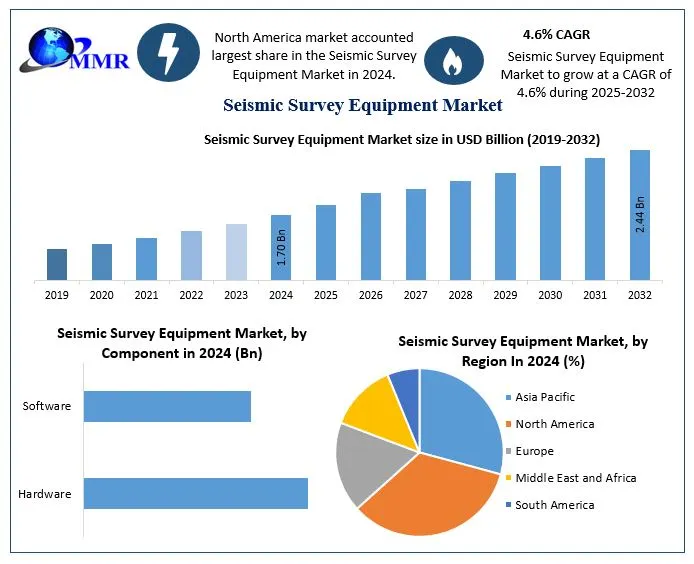
- Global market valued at USD 1.70 Billion in 2024
- Expected to reach USD 2.44 Billion by 2032
- Forecast CAGR of 4.6% from 2025 to 2032
- Hardware segment identified as the fastest-growing component category
- 3D imaging remains the dominant technology segment
- 4D imaging projected to record the highest growth rate
- Offshore surveys emerging as the fastest-growing deployment segment
- Oil and gas exploration remains the primary industrial application
Why This Matters Now
Energy producers are intensifying exploration programs as easily accessible reserves become harder to discover. At the same time, operators are demanding more precise subsurface intelligence to improve drilling economics and reduce project risk.
This shift is transforming seismic survey equipment from a support technology into a strategic asset. Advanced imaging systems, digital sensors, and offshore survey platforms are becoming critical tools for identifying commercially viable reserves and improving exploration efficiency.
Market Overview
The Seismic Survey Equipment Market Size is entering a new growth cycle driven by renewed exploration and production activity across major energy-producing regions. The market was valued at USD 1.70 Billion in 2024 and is expected to reach USD 2.44 Billion by 2032, expanding at a 4.6% CAGR.
Seismic survey equipment enables the collection and interpretation of subsurface geological data. The technology helps identify mineral deposits, hydrocarbon reservoirs, and geological structures before expensive drilling programs begin.
Rising multi-client survey projects and increasing exploration activity in emerging resource regions are creating sustained demand for advanced survey systems. As exploration targets become more complex, operators are investing in higher-resolution imaging technologies capable of delivering more accurate geological models.
The market is also benefiting from activity across construction, mining, and energy sectors, where subsurface mapping has become essential for project planning and risk mitigation.
Key Trends Driving Growth
A major industry trend is the migration toward high-resolution seismic imaging. Energy companies increasingly require detailed geological data to improve exploration success rates and optimize capital allocation.
The industry is also moving beyond traditional two-dimensional mapping. Three-dimensional and four-dimensional imaging technologies are providing richer geological insights, allowing operators to monitor reservoir changes over time and improve production planning.
Offshore exploration is another major catalyst. As companies pursue deepwater and offshore reserves, demand for marine seismic equipment continues to rise. These projects require sophisticated survey technologies capable of operating in challenging environments while maintaining data accuracy.
Hardware innovation remains central to market development. Advanced geophones, hydrophones, seismic sources, and data acquisition systems are improving survey quality and operational efficiency. These improvements enable faster interpretation and better decision-making throughout exploration programs.
Another significant trend is the growing use of integrated survey solutions that combine acquisition, processing, and interpretation capabilities. This approach reduces project timelines and enhances the value of collected data.
Request Sample Data with Industry Trends and Forecast Analysis
Segment Insights
- Dominant Segment (Technology): 3D Imaging
- 3D imaging generated the highest revenue share in 2024.
- The technology offers easier interpretation of subsurface structures through grid-based survey layouts.
- Energy companies continue to favor 3D imaging for exploration planning and reservoir characterization.
- Fastest-Growing Segment (Technology): 4D Imaging
- 4D imaging is projected to record the highest growth rate during the forecast period.
- The technology enables time-lapse monitoring of reservoir performance.
- Operators benefit from improved production management and enhanced recovery strategies.
- Dominant Component Segment
- Hardware remains the market’s most significant component category.
- The segment includes geophones, hydrophones, air guns, vibroseis systems, and related acquisition equipment.
- Fastest-Growing Component Segment
- Hardware is also expected to achieve the highest growth rate over the forecast period.
- Continuous innovation in sensor performance and data acquisition capabilities supports expansion.
- Fastest-Growing Location Segment
- Offshore surveys are expected to register the strongest growth.
- Increased marine exploration activity is accelerating investment in specialized survey systems.
Regional Growth Story
North America continues to play a critical role in the global seismic survey ecosystem due to its established oil and gas industry and ongoing exploration activity. The region’s emphasis on technological innovation supports demand for advanced imaging and acquisition systems.
Asia-Pacific is becoming increasingly important as energy demand grows and exploration programs expand. Countries across the region are investing in resource development and infrastructure projects that require advanced geological assessment capabilities.
The Middle East remains strategically significant because of its vast hydrocarbon resources. Although demand fluctuations have affected activity levels, long-term exploration requirements continue to support technology adoption.
Africa and Latin America represent emerging growth opportunities. Increasing exploration programs and new resource discoveries are attracting investment in seismic survey operations and associated equipment.
Europe continues to adopt advanced survey technologies for resource assessment, infrastructure development, and environmental applications, contributing to market stability.
Competitive Landscape
Competition in the Seismic Survey Equipment Market is increasingly centered on imaging quality, operational efficiency, and offshore capabilities.
Technology providers are focusing on developing more accurate acquisition systems, higher-resolution imaging platforms, and improved data interpretation tools. The objective is no longer simply collecting seismic data; it is delivering actionable geological intelligence that reduces exploration risk.
The growing importance of offshore exploration is also reshaping competitive dynamics. Companies with strong marine survey capabilities and advanced acquisition technologies are positioned to capture a larger share of future investment.
Innovation in sensor technology, data acquisition systems, and imaging software is becoming a key differentiator. Firms capable of improving survey accuracy while reducing operational costs are likely to strengthen their market position.
As exploration targets become more complex, vendors that combine hardware excellence with advanced analytical capabilities will be best positioned to lead the next phase of market evolution.
Recent Developments
- Growing investment in offshore seismic survey projects
- Increased deployment of advanced 3D imaging technologies
- Rising adoption of 4D seismic monitoring solutions
- Expansion of multi-client survey initiatives
- Continued innovation in hardware-based acquisition systems
- Greater focus on improving survey efficiency and data accuracy
Strategic Implications
For energy companies, seismic technology is becoming a competitive advantage rather than a routine exploration expense. Better imaging translates directly into improved drilling decisions, reduced dry-well risk, and stronger capital efficiency.
Equipment manufacturers benefit from increasing demand for advanced acquisition systems capable of supporting complex exploration environments. The shift toward high-resolution imaging creates opportunities for premium technology offerings.
Investors should monitor offshore exploration activity, imaging technology adoption, and hardware innovation. These factors are likely to determine future market leadership and revenue growth.
Mining, construction, and infrastructure sectors also represent diversification opportunities for equipment providers seeking growth beyond traditional oil and gas applications.
Future Outlook
The next phase of market growth will be defined by the industry’s ability to generate deeper, faster, and more accurate subsurface intelligence. Companies that lead in 4D imaging, offshore survey technologies, and advanced acquisition systems will shape the future of exploration economics, while slower adopters risk losing relevance as data precision becomes the decisive competitive advantage.
Analyst Perspective
“The market is moving toward higher-resolution imaging and more sophisticated survey capabilities as exploration programs become increasingly complex. Organizations that invest in advanced seismic technologies will be better positioned to improve discovery rates, reduce operational uncertainty, and maximize resource development efficiency.” — Rucha Deshpande, Analyst
About Maximize Market Research
Maximize Market Research Pvt. Ltd. (MMR) is a global market research and consulting company that provides reliable, data-focused, and practical business insights. The firm serves a wide range of industries, including healthcare, pharmaceuticals, technology, automotive, electronics, chemicals, personal care, and consumer goods. Through market forecasts, competitive analysis, strategic consulting, and industry impact assessments, MMR helps organizations understand changing market conditions, identify growth opportunities, and make informed business decisions for long-term success.
Contact Us
2nd Floor, Navale IT Park Phase 3
Pune Banglore Highway, Narhe
Pune, Maharashtra 411041, India
+91 9607365656
sales@maximizemarketresearch.com
