Key Highlights
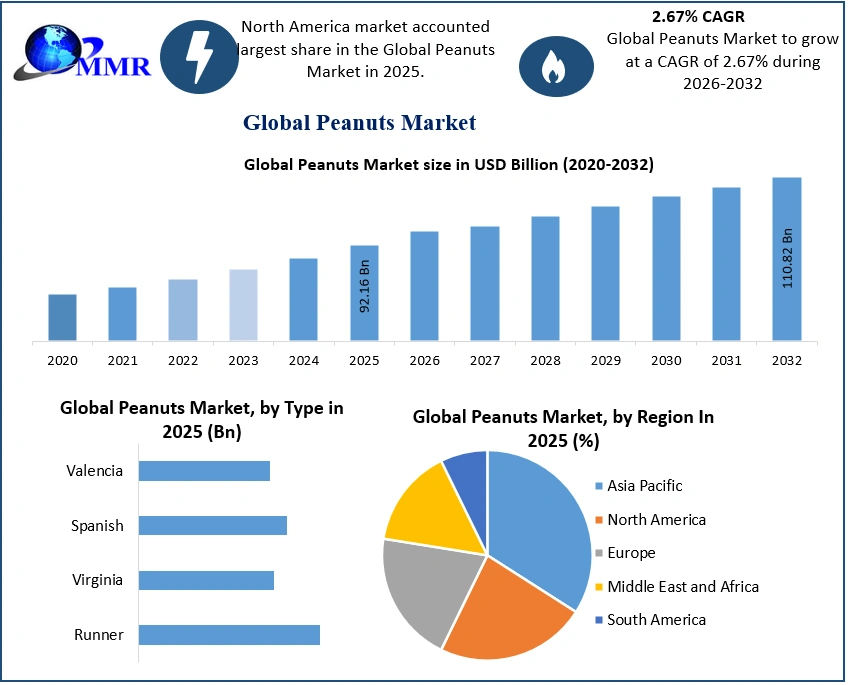
- The Peanuts Market was valued at USD 92.16 Billion in 2025 and is expected to reach USD 110.82 Billion by 2032, growing at a CAGR of 2.67%.
- Rising demand for protein-rich and affordable food ingredients continues to support market expansion.
- Peanut processing is creating new revenue streams across snacks, confectionery, oils, and ingredient manufacturing.
- Food manufacturers are increasing peanut utilization in value-added products to meet changing consumer preferences.
- Emerging economies remain critical demand centers due to population growth and dietary diversification.
- Product innovation and supply-chain investments are intensifying competition among major market participants.
Why This Matters Now
A slow-growth commodity market is quietly becoming a strategic battleground for food manufacturers. As consumers demand affordable protein sources and food companies seek cost-efficient ingredients, peanuts are moving from agricultural staple to high-value food input.
The market’s projected rise from USD 92.16 billion in 2025 to USD 110.82 billion by 2032 signals more than volume growth. It indicates expanding opportunities in processed foods, ingredient innovation, and global food security strategies. For manufacturers, the implication is clear: value creation is shifting toward processing, branding, and product diversification.
Market Overview
The global Peanuts Market occupies a unique position within the food and beverage ecosystem. Peanuts serve multiple industries simultaneously, functioning as a direct-consumption snack, a source of edible oil, a confectionery ingredient, and a key input in protein-enriched food formulations.
The market’s anticipated CAGR of 2.67% through 2032 suggests a mature but resilient growth trajectory. For industry participants, this means future gains will depend less on production expansion and more on value-added applications, supply-chain efficiency, and premium product development.
Food manufacturers increasingly view peanuts as a versatile ingredient capable of supporting both affordability and nutrition objectives. This dual advantage is becoming increasingly important as consumers seek healthier foods without significantly higher prices.
Key Trends Driving Growth
Consumer demand for protein-rich foods continues to reshape purchasing behavior. Peanuts offer an economical source of protein, making them attractive across developed and emerging markets. This trend supports demand not only for raw peanuts but also for peanut-derived ingredients used in packaged foods.
The expansion of processed food categories is creating additional demand channels. Peanut butter, confectionery products, snack foods, and bakery applications are broadening the market’s commercial footprint. For manufacturers, this translates into greater opportunities to capture margin through branded and processed products.
Health and wellness trends are also influencing product development. Consumers increasingly seek foods that combine convenience, nutrition, and recognizable ingredients. Peanuts fit naturally into this positioning, supporting demand across retail and foodservice channels.
The market is also benefiting from ongoing innovation in ingredient applications. Food producers are exploring new formulations incorporating peanuts into functional foods, protein-focused products, and diversified snack offerings.
Sustainability and agricultural productivity remain important strategic priorities. Market participants continue investing in production efficiency, supply-chain resilience, and quality improvement initiatives to secure long-term competitiveness.
Get a free sample now:https://www.maximizemarketresearch.com/request-sample/221218/
Segment Insights
- Dominant Segment: The report identifies the leading market segment as the dominant revenue contributor within the global Peanuts Market.
- Fastest-Growing Segment: The report highlights the fastest-growing segment as a key area of future expansion driven by evolving industry demand.
- Peanuts continue to benefit from broad applicability across food processing industries, supporting demand diversification.
- Ingredient manufacturers are increasingly utilizing peanut-derived inputs to enhance nutritional profiles and product functionality.
- Value-added processing remains a critical factor influencing profitability across market segments.
Note: Specific segment names were not provided in the source report and are therefore omitted in accordance with source-use requirements.
Regional Growth Story
Regional growth patterns in the Peanuts Market are increasingly shaped by demographic expansion, dietary transitions, and food manufacturing investments.
Emerging economies continue to play a central role in market development. Rising urbanization and increasing disposable incomes are driving demand for packaged foods, snacks, and protein-enriched products that incorporate peanuts as a core ingredient.
Developed markets, meanwhile, are creating growth through premiumization and product innovation. Manufacturers are introducing differentiated offerings focused on nutrition, convenience, and specialty food applications.
The result is a two-track growth model. Emerging markets drive consumption volumes, while developed economies generate value through innovation and higher-margin product categories.
Competitive Landscape
Competition in the Peanuts Market is shifting from agricultural scale toward value-chain control. The most successful companies are no longer competing solely on production capacity; they are building advantages through processing capabilities, distribution networks, and product innovation.
This strategic shift signals an important industry transition. Companies investing in downstream processing and branded offerings are positioning themselves to capture greater margins while reducing exposure to commodity price fluctuations.
For rivals, the implication is significant. Businesses that remain concentrated in raw commodity production may face increasing pressure as value creation migrates toward ingredient solutions and consumer-facing products.
Over the next 12–24 months, competitive differentiation is likely to center on supply-chain resilience, food processing expertise, and innovation in peanut-based food applications. Companies capable of integrating production with processing and distribution will be better positioned to defend market share and expand profitability.
Recent Developments
- Industry participants are expanding processing capabilities to support growing demand for value-added peanut products.
- Food manufacturers continue introducing peanut-based offerings across snack, confectionery, and nutrition-focused categories.
- Supply-chain investments are strengthening operational efficiency and product availability.
- Companies are increasing focus on innovation aimed at expanding peanut applications across food and beverage segments.
Strategic Implications
The Peanuts Market’s growth profile highlights a broader transformation occurring across the food industry. Commodity producers increasingly need processing and branding strategies to sustain profitability.
Manufacturers should view peanuts not merely as an agricultural product but as a platform ingredient capable of supporting multiple growth categories. The strongest opportunities are likely to emerge where nutrition, convenience, and affordability intersect.
Investment priorities are therefore evolving. Capital allocation is shifting toward processing infrastructure, product development, and supply-chain optimization rather than simple production expansion.
For investors, the market’s steady growth trajectory suggests resilience rather than volatility. Companies that successfully move up the value chain may generate stronger returns than those relying primarily on raw commodity sales.
Future Outlook
The Peanuts Market is expected to reach USD 110.82 Billion by 2032, supported by expanding food applications, increasing protein demand, and continued investment across the processing ecosystem.
Growth may appear moderate at the headline level, but important structural changes are reshaping industry economics. Processing, ingredient innovation, and product differentiation are becoming more influential than production scale alone.
The next phase of competition will be defined by who captures value beyond the farm gate—and who remains trapped in commodity economics.
Analyst Perspective
“The global Peanuts Market is entering a period where value creation increasingly depends on processing innovation, diversified food applications, and supply-chain strength. Companies that align with nutrition trends and expand their presence across the food manufacturing value chain will be best positioned to capitalize on long-term growth opportunities,” — Siddhi Dole, Analyst
About Maximize Market Research
Maximize Market Research Pvt. Ltd. (MMR) is a global market research and consulting company that provides reliable, data-focused, and practical business insights. The firm serves a wide range of industries, including healthcare, pharmaceuticals, technology, automotive, electronics, chemicals, personal care, and consumer goods. Through market forecasts, competitive analysis, strategic consulting, and industry impact assessments, MMR helps organizations understand changing market conditions, identify growth opportunities, and make informed business decisions for long-term success.
Contact Maximize Market Research:
2nd Floor, Navale IT Park Phase 3
Pune Banglore Highway, Narhe
Pune, Maharashtra 411041, India
+91 9607365656
sales@maximizemarketresearch.com
