Key Highlights
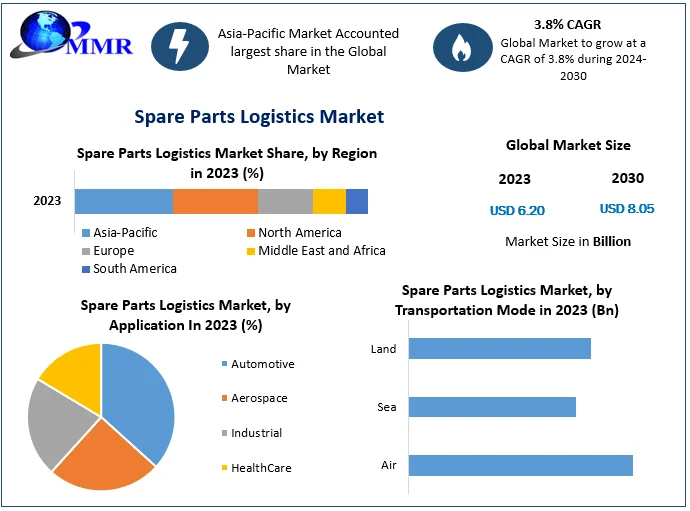
- Spare Parts Logistics Market projected at USD 8.05 Billion by 2030
- Valued at USD 6.20 Billion in 2023
- Expanding at 3.8% CAGR (2024–2030)
- Critical enabler for OEM aftermarket and industrial supply chains
- Growth tied to global trade expansion and service-driven logistics models
- Increasing reliance on digital logistics and inventory optimization systems
Why This Matters Now
Global supply chains are shifting from cost-first models to speed-and-availability-driven networks. Spare parts logistics sits at the center of this transition, where downtime costs now outweigh transport costs for OEMs, industrial operators, and fleet owners.
A 3.8% CAGR signals steady but structurally important expansion. It reflects rising demand for high-precision inventory availability, tighter service-level agreements, and real-time distribution systems. Logistics providers that fail to optimize spare parts flow risk losing OEM contracts to faster, digitally integrated competitors.
Market Overview
The Spare Parts Logistics Market Size is valued at USD 6.20 billion in 2023 and is projected to reach USD 8.05 billion by 2030, growing at a CAGR of 3.8% during 2024–2030, according to Maximize Market Research.
The market plays a critical role in aftermarket operations, industrial maintenance ecosystems, and OEM service networks. It ensures rapid availability of components across automotive, manufacturing, aerospace, and heavy machinery sectors.
Unlike bulk freight logistics, spare parts logistics is defined by urgency, fragmentation, and precision. The value lies not in shipment scale but in delivery speed, inventory accuracy, and network responsiveness.
Key Trends Driving Growth
Supply chain digitization is reshaping spare parts logistics from warehouse-driven operations to data-driven distribution ecosystems. Real-time tracking, predictive inventory systems, and automated order routing are reducing downtime across industrial and automotive sectors.
E-commerce expansion is also accelerating demand for faster fulfillment networks. OEMs and aftermarket suppliers are increasingly shifting toward decentralized warehousing models to reduce delivery lead times.
Freight operators are integrating transportation management systems (TMS) and AI-based routing tools to optimize cost-to-speed ratios. This is critical in high-value spare parts, where delays directly impact operational uptime.
Explore detailed analysis, insights, and growth opportunities
Segment Insights
- Dominant Segment: Automotive spare parts logistics, driven by large aftermarket demand and OEM service networks
- Fastest-Growing Segment: Industrial and machinery spare parts logistics, supported by manufacturing automation and predictive maintenance adoption
Automotive remains the backbone due to global vehicle parc expansion and replacement cycles. Industrial logistics is accelerating faster due to Industry 4.0 adoption, where equipment uptime depends on instant parts availability.
Regional Growth Story
North America remains a high-value logistics hub driven by advanced warehousing infrastructure and strong OEM service networks. The US market emphasizes digital freight visibility and just-in-time spare parts delivery models.
Europe, led by Germany, is focused on precision manufacturing supply chains, where downtime costs are significantly high, driving demand for optimized spare parts distribution systems.
Asia-Pacific, led by China and India, is emerging as the volume engine of the market. Expanding manufacturing bases, rising automotive ownership, and industrial expansion are increasing demand for localized spare parts warehousing and distribution hubs.
Japan and South Korea continue to emphasize high-efficiency logistics systems integrated with robotics and automation, particularly in automotive and electronics sectors.
Competitive Landscape
The Spare Parts Logistics Market is characterized by global logistics providers, regional freight operators, and specialized third-party logistics firms competing on speed, accuracy, and network density.
Competitive advantage is shifting away from scale alone toward digital integration and service reliability. Firms investing in real-time inventory visibility, predictive analytics, and automated fulfillment systems are strengthening OEM partnerships.
Strategic warehouse expansions near industrial corridors signal a shift toward decentralized logistics networks. This reduces lead times but increases pressure on cost efficiency and last-mile coordination.
Partnerships between logistics providers and OEMs are becoming central to contract wins. These collaborations are increasingly data-driven, where logistics performance metrics directly influence supplier retention.
Recent Developments
- Expansion of automated warehousing systems across key logistics hubs
- Increased adoption of AI-based inventory forecasting tools in spare parts distribution
- Growth in regional distribution centers to reduce delivery lead times
- Rising integration of digital freight platforms for real-time shipment visibility
- Investment in multimodal logistics networks to improve cross-border efficiency
Strategic Implications
Spare parts logistics is transitioning into a service-critical infrastructure layer for global manufacturing and mobility systems. The ability to deliver parts within tight service windows is becoming a competitive differentiator for OEMs and logistics providers alike.
Companies that integrate predictive analytics with physical distribution networks will reduce inventory holding costs while improving service reliability. Those relying on legacy warehouse-first models will face margin pressure and contract losses.
The rise of electrification and complex machinery is increasing parts variety, making inventory optimization more complex and more valuable simultaneously.
Future Outlook
The market will evolve into a digitally orchestrated logistics ecosystem where real-time visibility, automation, and predictive fulfillment define operational success rather than shipment volume.
Future leaders will not be those who move the most freight, but those who eliminate downtime fastest across global supply chains.
Analyst Perspective
“The Spare Parts Logistics Market reflects a steady structural shift toward digitized, time-sensitive distribution networks where operational uptime is now the key performance benchmark,” says Dharati Raut, Analyst at Maximize Market Research.
About Maximize Market Research
Maximize Market Research Pvt. Ltd. (MMR) is a global market research and consulting company that provides reliable, data-focused, and practical business insights. The firm serves a wide range of industries, including healthcare, pharmaceuticals, technology, automotive, electronics, chemicals, personal care, and consumer goods. Through market forecasts, competitive analysis, strategic consulting, and industry impact assessments, MMR helps organizations understand changing market conditions, identify growth opportunities, and make informed business decisions for long-term success.
Contact Us :
2nd Floor, Navale IT Park Phase 3
Pune Banglore Highway, Narhe
Pune, Maharashtra 411041, India
+91 9607365656
sales@maximizemarketresearch.com
