Key Highlights
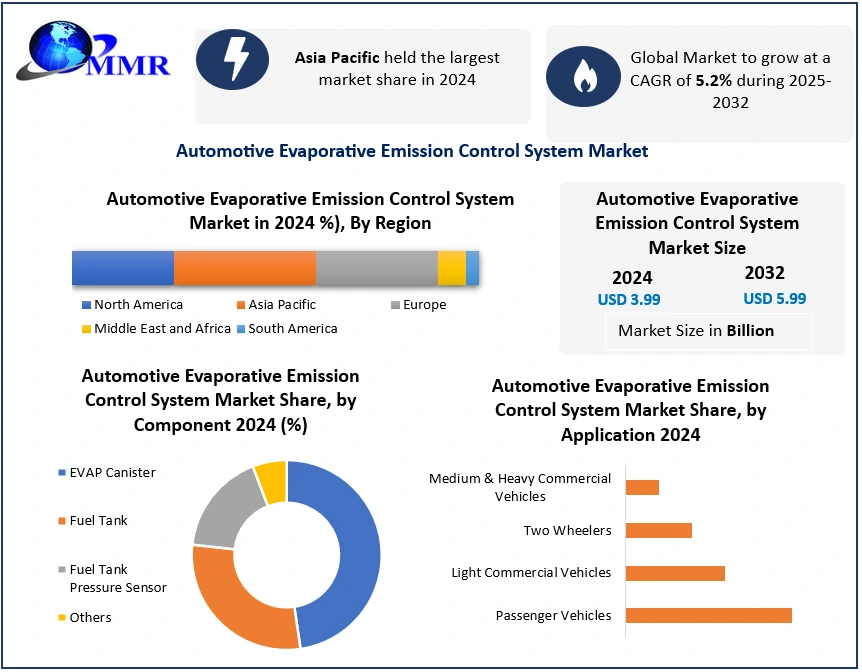
- Market valued at USD 3.99 Billion in 2024
- Expected to reach USD 5.99 Billion by 2032
- Growing at a 5.2% CAGR (2025–2032)
- Asia Pacific leads global demand due to strict emission regulations
- EVAP systems increasingly integrated into passenger and commercial vehicles
- Market expansion driven by regulatory enforcement and fuel vapor control standards
Why This Matters Now
Regulators are tightening hydrocarbon emission limits at a faster pace than OEM product cycles can adjust. That gap is forcing automakers and Tier-1 suppliers to accelerate deployment of evaporative emission control systems across ICE and hybrid platforms. The Automotive EVAP system market is no longer compliance-driven alone; it is becoming a design-integrated requirement in global vehicle architectures.
For logistics and transportation-linked manufacturing supply chains, this shift increases complexity in component sourcing, testing compliance, and platform-level engineering coordination across regions.
Market Overview
The Automotive Evaporative Emission Control System Market Size stood at USD 3.99 Billion in 2024 and is projected to reach USD 5.99 Billion by 2032, expanding at a 5.2% CAGR from 2025 to 2032, according to Maximize Market Research.
This growth reflects tightening global emissions frameworks targeting fuel vapor leakage from vehicle fuel systems. EVAP systems have become essential across passenger vehicles, light commercial fleets, and hybrid platforms where fuel containment and vapor recovery directly impact regulatory compliance.
Asia Pacific leads global adoption, driven by enforcement intensity and rapid vehicle production scaling. This regional dominance signals a shift in compliance-driven manufacturing hubs toward stricter environmental alignment.
Key Trends Driving Growth
Regulatory enforcement is the primary force reshaping EVAP system adoption. Governments are tightening evaporative emission thresholds as part of broader air quality and carbon reduction strategies. This is accelerating integration of advanced vapor recovery technologies across OEM platforms.
Another major shift is the expansion of hybrid vehicle production. Unlike pure EVs, hybrids still require fuel systems, increasing reliance on EVAP technologies for compliance. This creates a transitional demand cycle where emission control systems remain critical even as electrification expands.
OEMs are also standardizing modular EVAP architectures to reduce platform complexity across global vehicle variants. This is improving scalability but increasing supplier dependency on precision-engineered components.
Explore detailed analysis, insights, and growth opportunities
Segment Insights
The report does not provide explicit segmentation data; therefore, dominant and fastest-growing segments cannot be identified from the source.
- Dominant Segment: Not specified in the report
- Fastest-Growing Segment: Not specified in the report
- Vehicle Type Segmentation: Not available in the source
- Technology Breakdown: Not provided in the report
The absence of segmentation suggests a macro-level market assessment focused on total value and regulatory-driven demand rather than component-level differentiation.
Regional Growth Story
Asia Pacific leads the Automotive EVAP market due to strict emission standards and high automotive production volumes. Regulatory enforcement across China and India is accelerating adoption of advanced evaporative emission control technologies.
North America remains a mature regulatory market, where compliance requirements continue to sustain replacement and integration demand across OEM platforms. Europe follows similar patterns, driven by stringent environmental standards and ongoing ICE-hybrid coexistence.
While regional growth rates differ, all major automotive hubs are aligned on stricter hydrocarbon emission control frameworks, reinforcing global demand stability.
Competitive Landscape
The report does not provide company-level breakdowns, acquisitions, or supplier rankings. However, the competitive structure is defined by Tier-1 automotive suppliers and emission system specialists integrated into OEM platforms.
Competition is shifting from component supply toward system-level integration capability. Suppliers that can deliver modular, compliance-ready EVAP systems across multiple vehicle platforms gain stronger OEM positioning.
This shift signals increasing pricing pressure on low-complexity suppliers while strengthening market control for vertically integrated emission technology providers. It also reflects rising barriers to entry due to regulatory validation requirements and testing complexity.
Recent Developments
The source does not list specific company announcements, partnerships, or investments. However, the market direction is shaped by broader regulatory and OEM platform alignment trends.
- No documented acquisitions or partnerships in the source
- No listed capacity expansions or manufacturing investments
- No technology-specific launches provided
- No regulatory event details beyond market drivers
Strategic Implications
EVAP systems are becoming embedded compliance infrastructure within automotive platforms rather than optional emission control add-ons. This shifts procurement decisions closer to long-term OEM architecture planning.
For Tier-1 suppliers, value creation is moving toward integrated emission management modules rather than standalone components. Suppliers with multi-platform compatibility and global compliance certifications gain stronger leverage in OEM contracts.
For logistics and supply-chain operators supporting automotive manufacturing, the impact is increased validation complexity, tighter delivery timelines, and higher dependence on specialized material sourcing and precision assembly networks.
For investors, the market signals stable mid-single-digit growth tied directly to regulation cycles rather than consumer demand volatility.
Future Outlook
The Automotive Evaporative Emission Control System Market will increasingly evolve into a compliance-embedded subsystem market, where regulatory alignment defines competitive positioning more than product differentiation.
Future leaders will be those who integrate emission control technologies directly into platform engineering cycles, while laggards will be excluded by rising certification complexity and tightening global emissions enforcement.
Analyst Perspective
“Based on Maximize Market Research findings, the Automotive Evaporative Emission Control System Market shows steady expansion driven by regulatory tightening and increased EVAP adoption across global automotive platforms,” says Dharati Raut, Analyst at Maximize Market Research.
About Maximize Market Research
Maximize Market Research Pvt. Ltd. (MMR) is a global market research and consulting company that provides reliable, data-focused, and practical business insights. The firm serves a wide range of industries, including healthcare, pharmaceuticals, technology, automotive, electronics, chemicals, personal care, and consumer goods. Through market forecasts, competitive analysis, strategic consulting, and industry impact assessments, MMR helps organizations understand changing market conditions, identify growth opportunities, and make informed business decisions for long-term success.
Contact Us :
2nd Floor, Navale IT Park Phase 3
Pune Banglore Highway, Narhe
Pune, Maharashtra 411041, India
+91 9607365656
sales@maximizemarketresearch.com
