Key Highlights
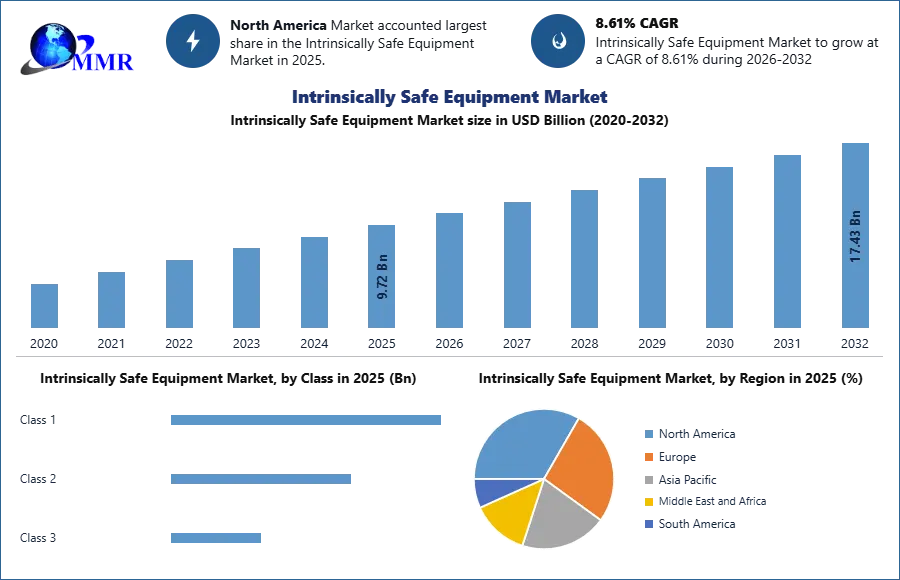
- Market valued at USD 9.72 Billion in 2025.
- Expected to reach USD 17.43 Billion by 2032.
- Forecast CAGR stands at 8.61% from 2026 to 2032.
- Industrial automation is accelerating deployment of intrinsically safe devices.
- IoT-enabled monitoring systems are transforming hazardous-area operations.
- Oil & gas remains the leading end-use sector.
- Mining is emerging as a high-growth adoption segment.
- Wireless communication and smart sensors are expanding market opportunities.
- Regulatory compliance continues to influence purchasing decisions.
- Digital transformation is reshaping industrial safety architectures.
Why This Matters Now
Industrial operators are digitizing critical infrastructure faster than ever. Refineries, mines, chemical facilities, and power plants increasingly rely on connected devices to improve operational visibility, reduce downtime, and enhance worker safety.
That shift creates a strategic requirement for intrinsically safe equipment. Every new sensor, transmitter, communication device, and monitoring platform deployed in hazardous environments must operate without creating ignition risks. As industrial facilities pursue automation and real-time analytics, demand for certified intrinsically safe technologies is moving from compliance necessity to operational imperative.
Market Overview
The Intrinsically Safe Equipment Market Size was valued at USD 9.72 Billion in 2025 and is expected to reach USD 17.43 Billion by 2032, growing at a CAGR of 8.61%.
The market focuses on electrical and electronic equipment engineered to prevent ignition in hazardous environments containing flammable gases, vapors, dust, or fibers. These systems are widely used across oil & gas, mining, chemicals, power generation, and industrial processing facilities where safety and uptime directly influence profitability.
What changed is the role of these devices within industrial operations. Historically viewed as compliance products, intrinsically safe systems are increasingly becoming part of broader digital infrastructure strategies. Companies are integrating sensors, wireless communication devices, and intelligent monitoring systems into safety-critical environments to support predictive maintenance and remote operations.
Key Trends Driving Growth
Industrial automation is becoming a major catalyst for market expansion. Organizations are deploying connected assets to gain greater visibility into plant performance, asset health, and workforce safety. This transition increases the number of devices operating in hazardous locations, creating sustained demand for intrinsically safe technologies.
IoT adoption is also reshaping purchasing priorities. Smart sensors capable of collecting and transmitting real-time data are becoming central to operational decision-making. The combination of connectivity and safety certification enables industrial operators to modernize facilities without compromising regulatory compliance.
Wireless monitoring solutions are gaining momentum as operators seek greater flexibility and lower installation costs. Remote asset monitoring allows companies to reduce manual inspections while improving response times during critical events.
Digital communication protocols are advancing deployment opportunities. Facilities are upgrading legacy systems to support more sophisticated monitoring architectures, creating demand for next-generation intrinsically safe transmitters and field devices.
Safety regulations continue to influence procurement decisions globally. Compliance requirements encourage organizations to replace older equipment with certified alternatives capable of meeting modern operational standards.
Download Sample Research Report for Strategic Industry Insights
Segment Insights
- Dominant Segment: Oil & Gas
- Oil & gas represents the largest end-use segment.
- Exploration, production, refining, and pipeline infrastructure require extensive deployment of intrinsically safe devices.
- Operators are adopting wireless monitoring systems and mobile technologies to improve safety and operational efficiency in high-risk environments.
- Fastest-Growing Segment: Mining
- Mining is emerging as the fastest-growing end-use segment.
- Increased automation, underground monitoring requirements, and worker safety initiatives are accelerating adoption.
- Demand is rising for intrinsically safe communication devices, gas monitoring systems, and ruggedized sensors.
- Leading Product Segment: Sensors
- Sensors account for the largest share of product demand.
- Multi-parameter monitoring capabilities support predictive maintenance and real-time operational intelligence.
- Integration with Industrial IoT platforms strengthens their strategic value.
- Fastest-Growing Product Segment: Transmitters
- Advanced transmitters are experiencing rapid growth.
- Digital communication capabilities and improved data accuracy are driving upgrades from legacy infrastructure.
- Adoption supports broader digital transformation initiatives across industrial facilities.
Regional Growth Story
North America currently represents the leading regional market. Strong regulatory frameworks, advanced industrial infrastructure, and extensive investment in worker safety continue to support adoption across oil & gas, mining, and chemical industries.
The United States remains a critical market due to stringent workplace safety requirements and widespread deployment of hazardous-area technologies. Investment in operational modernization and industrial digitization further strengthens demand.
Europe benefits from a mature industrial base and strict safety standards. Manufacturing, chemicals, energy, and industrial automation sectors continue to drive equipment upgrades.
Asia-Pacific is becoming increasingly important as industrialization, energy investments, and manufacturing expansion accelerate. Mining activity, process industries, and infrastructure development are creating substantial opportunities for intrinsically safe equipment suppliers.
Emerging economies are also adopting globally recognized safety standards, supporting market penetration and expanding addressable demand across industrial sectors.
Competitive Landscape
Competition is increasingly shifting beyond product certification toward technology integration. Manufacturers are differentiating through connectivity, analytics capabilities, and compatibility with digital industrial ecosystems.
Key companies include Honeywell, Siemens, ABB, Eaton, Emerson Electric, Pepperl+Fuchs, Rockwell Automation, R. STAHL, Fluke Corporation, and Extronics.
The competitive race signals a broader transformation in industrial safety. Vendors are positioning intrinsically safe devices as foundational elements of connected operations rather than standalone protection systems.
Technology leadership increasingly depends on the ability to combine safety certification with wireless communications, predictive maintenance capabilities, Industrial IoT integration, and intelligent diagnostics.
Companies investing in digital platforms gain stronger ecosystem influence because customers increasingly seek integrated solutions rather than isolated hardware deployments. This trend could reshape pricing power and long-term market leadership.
Recent Developments
- Expansion of wireless monitoring technologies in hazardous environments.
- Increased adoption of Industrial IoT-enabled sensors.
- Growing deployment of smart communication systems in mining operations.
- Modernization of refinery and processing infrastructure.
- Integration of predictive maintenance capabilities into intrinsically safe devices.
- Rising demand for remote asset monitoring solutions.
- Stronger focus on digital safety architectures across industrial facilities.
Strategic Implications
For industrial operators, intrinsically safe equipment is becoming a productivity investment as much as a safety requirement. Connected monitoring systems reduce downtime, improve maintenance planning, and strengthen operational resilience.
For technology providers, the opportunity extends beyond hardware. Software platforms, analytics capabilities, and ecosystem partnerships are becoming increasingly important sources of differentiation.
For investors, the market benefits from multiple long-term growth drivers including industrial automation, digital transformation, worker safety mandates, and infrastructure modernization.
For manufacturers, success will increasingly depend on delivering integrated solutions that connect safety, operational intelligence, and automation within a single architecture.
Future Outlook
The next phase of growth will be defined by the convergence of industrial automation, IoT connectivity, wireless monitoring, and intelligent safety systems. As hazardous industries digitize operations, intrinsically safe equipment will move from the perimeter of industrial infrastructure to the center of operational decision-making. The companies that successfully combine certified safety, real-time analytics, and connected industrial intelligence will define the next generation of industrial leadership, while slower adopters risk becoming disconnected from the future of automated operations.
Analyst Perspective
“Industrial organizations are no longer viewing intrinsically safe equipment solely as a compliance requirement. The market is increasingly driven by digital transformation strategies, where connected safety devices deliver operational intelligence alongside protection. Companies that align safety technologies with automation and IoT initiatives are positioned to capture the greatest long-term value,” said Rucha Deshpande, Analyst.
About Maximize Market Research
Maximize Market Research Pvt. Ltd. (MMR) is a global market research and consulting company that provides reliable, data-focused, and practical business insights. The firm serves a wide range of industries, including healthcare, pharmaceuticals, technology, automotive, electronics, chemicals, personal care, and consumer goods. Through market forecasts, competitive analysis, strategic consulting, and industry impact assessments, MMR helps organizations understand changing market conditions, identify growth opportunities, and make informed business decisions for long-term success.
Contact Us
2nd Floor, Navale IT Park Phase 3
Pune Banglore Highway, Narhe
Pune, Maharashtra 411041, India
+91 9607365656
sales@maximizemarketresearch.com
