Key Highlights
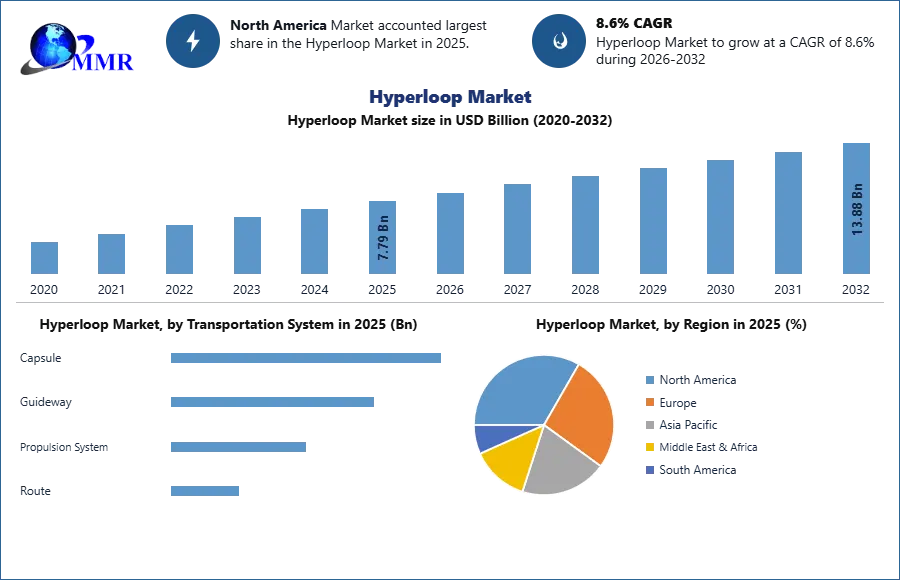
- Hyperloop Market valued at USD 7.79 Billion in 2025
- Expected to reach USD 13.88 Billion by 2032
- Expanding at 8.6% CAGR (2026–2032)
- Positioned as next-generation high-speed transport infrastructure
- Focus spans passenger mobility and freight logistics efficiency
- Strong relevance for smart logistics and trade corridor modernization
Why This Matters Now
Global logistics networks are entering a capacity and speed stress phase. Supply chains built on conventional rail, road, and air freight are struggling to balance cost, congestion, and delivery time pressures. The Hyperloop Market signals an infrastructure-level attempt to compress transit time and rewire long-distance logistics economics.
At USD 7.79 Billion in 2025, the market is no longer conceptual. It is entering early-stage commercialization planning, where governments and infrastructure investors evaluate corridor-level deployment. The 8.6% CAGR signals accelerating confidence in ultra-high-speed mobility as part of next-generation freight architecture.
Market Overview
The Hyperloop Market Size stands at USD 7.79 Billion in 2025, with projections reaching USD 13.88 Billion by 2032, expanding at a CAGR of 8.6% from 2026 to 2032, according to Maximize Market Research.
The market represents a structural shift in transportation design philosophy. Instead of incremental speed gains in rail or road systems, hyperloop introduces near-vacuum tube-based ultra-high-speed travel frameworks aimed at reducing intercity and interregional transit time.
The 8.6% CAGR indicates early but accelerating capital allocation into experimental and pilot-stage infrastructure projects. For logistics operators, this signals potential disruption in high-value freight corridors, particularly in regions where congestion and land-based transport bottlenecks are intensifying.
The valuation reflects not just technology adoption but long-horizon infrastructure planning cycles involving governments, mobility developers, and private capital.
Key Trends Driving Growth
The market’s trajectory is shaped by infrastructure modernization and long-term logistics reconfiguration rather than short-cycle demand shifts. The 8.6% growth rate suggests sustained investment interest in next-generation transport systems.
A major driver is the increasing pressure on global supply chains to reduce transit time variability. Hyperloop systems are positioned as a potential solution for high-speed freight movement across dense economic corridors.
Urbanization and intercity trade intensification are pushing governments to evaluate alternatives to conventional rail and air freight congestion. While the report does not specify technology segmentation, the growth rate indicates increasing feasibility studies and pilot deployments.
Energy efficiency considerations in transport infrastructure planning also contribute to long-term interest, particularly in regions targeting decarbonized logistics networks.
Explore detailed analysis, insights, and growth opportunities
Segment Insights
The report does not provide explicit segmentation or breakdown by application, geography, or system type.
- Dominant Segment: Not specified in the source report
- Fastest-Growing Segment: Not specified in the source report
- Freight vs Passenger Split: Not provided
- Regional Segmentation: Not available in the report
The absence of segmentation reflects the early-stage nature of the market, where development is still concentrated on conceptual design, pilot infrastructure, and feasibility corridors rather than mature operational segmentation.
Regional Growth Story
The report does not provide detailed regional analysis or country-level leadership data.
However, the market’s global valuation structure implies that early adoption discussions are concentrated in major infrastructure and logistics hubs such as North America, Europe, and parts of Asia-Pacific where high-density transport corridors and advanced mobility investment ecosystems exist.
The lack of defined regional dominance indicates that deployment readiness remains uneven, with investment decisions likely tied to regulatory frameworks, land availability, and public-private partnership capacity.
Competitive Landscape
The report does not list specific companies or competitive players, indicating a highly developmental ecosystem rather than a consolidated commercial market.
The competitive structure is best understood as a technology-infrastructure race involving mobility developers, engineering firms, and transport innovation companies working toward pilot-scale deployment.
Strategically, participation in this market signals positioning for long-term infrastructure control rather than near-term revenue capture. Early movers in hyperloop development are effectively shaping future corridor ownership, standards architecture, and system interoperability frameworks.
This creates a high-barrier environment where engineering capability, regulatory alignment, and capital intensity define competitive advantage rather than price-based competition.
Recent Developments
The report does not provide specific announcements, partnerships, or infrastructure deployments.
- No documented commercial launches
- No reported government approvals
- No listed technology partnerships
- No capacity expansion disclosures
The absence of reported developments reinforces the market’s early-stage commercialization profile.
Strategic Implications
The Hyperloop Market represents a structural challenge to traditional freight and passenger transport systems. An 8.6% CAGR reflects accelerating strategic interest in redefining corridor economics rather than incremental transport upgrades.
For logistics providers, the implication is long-term disruption in high-value, high-density freight corridors where speed becomes a dominant competitive factor. For governments, it signals infrastructure competition between conventional rail upgrades and next-generation transport systems.
For investors, the market is a long-duration infrastructure bet with asymmetric upside tied to regulatory approvals, corridor selection, and technology validation milestones.
For supply-chain leaders, hyperloop adoption could eventually compress multi-hour freight lanes into near-real-time transport windows, forcing redesign of warehousing placement and inventory buffering strategies.
Future Outlook
The Hyperloop Market is transitioning from theoretical mobility design to corridor-level infrastructure consideration, where feasibility decisions will define future freight architecture across global trade routes.
Market leadership will belong to players capable of converting experimental transport systems into regulated, scalable logistics infrastructure, while laggards remain anchored to conventional speed-constrained networks.
Analyst Perspective
“The Hyperloop Market’s 8.6% CAGR highlights growing institutional interest in ultra-high-speed transportation systems as part of future logistics infrastructure transformation,” says Dharati Raut, Analyst at Maximize Market Research.
About Maximize Market Research
Maximize Market Research Pvt. Ltd. (MMR) is a global market research and consulting company that provides reliable, data-focused, and practical business insights. The firm serves a wide range of industries, including healthcare, pharmaceuticals, technology, automotive, electronics, chemicals, personal care, and consumer goods. Through market forecasts, competitive analysis, strategic consulting, and industry impact assessments, MMR helps organizations understand changing market conditions, identify growth opportunities, and make informed business decisions for long-term success.
Contact Us :
2nd Floor, Navale IT Park Phase 3
Pune Banglore Highway, Narhe
Pune, Maharashtra 411041, India
+91 9607365656
sales@maximizemarketresearch.com
