Key Highlights
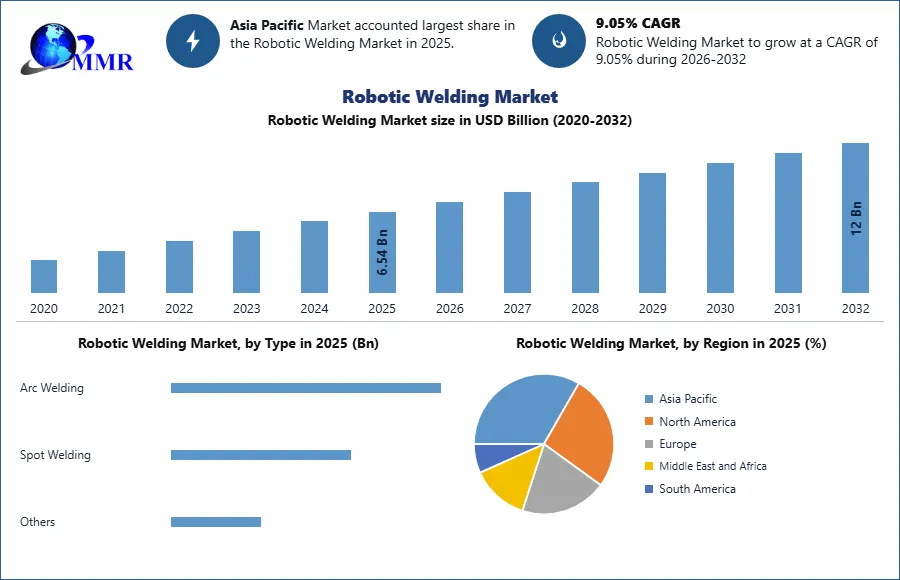
- Robotic Welding Market valued at USD 6.54 Billion in 2025
- Expected to reach USD 12 Billion by 2032
- Growing at 9.05% CAGR (2026–2032)
- Strong adoption across EV and automotive manufacturing lines
- Rising integration of smart factory and Industry 4.0 systems
- Expanding use in high-precision, multi-material vehicle structures
Why This Matters Now
Automotive production is shifting into a high-precision, software-driven manufacturing era. EV platforms, lightweight materials, and multi-material assemblies are pushing OEMs to replace manual welding with robotic systems that deliver repeatable accuracy at scale.
At USD 6.54 Billion in 2025, robotic welding is no longer an upgrade layer. It is becoming core infrastructure for EV production lines. The 9.05% CAGR signals aggressive factory-level automation investments across global automotive hubs.
Market Overview
The Robotic Welding Market Size is valued at USD 6.54 Billion in 2025 and is projected to reach USD 12 Billion by 2032, growing at a CAGR of 9.05% during 2026–2032, according to Maximize Market Research.
This growth reflects a structural shift in automotive manufacturing, where welding automation is essential for scaling EV production. Vehicle architectures are becoming more complex with aluminum-intensive bodies, battery enclosures, and hybrid material designs requiring high-precision joining.
OEMs are redesigning production lines to support flexible, multi-platform manufacturing. Robotic welding systems enable continuous production efficiency while reducing defect rates and labor dependency.
Key Trends Driving Growth
Electrification is the strongest structural driver reshaping welding automation demand. EV platforms require tighter tolerances and advanced material joining, increasing reliance on robotic welding cells across assembly plants.
Smart factory adoption is accelerating integration of AI-powered welding robots with real-time quality inspection systems. This shift improves throughput, reduces rework, and supports zero-defect manufacturing targets.
Labor shortages in advanced economies are accelerating automation adoption across the US, Germany, Japan, and South Korea. China continues to scale high-density robotic manufacturing systems for mass EV production.
OEM supply chain restructuring is also driving investment in localized, automated production ecosystems to reduce dependency on fragmented global supplier networks.
Explore detailed analysis, insights, and growth opportunities
Segment Insights
The report does not provide explicit segmentation data for type, application, or geography.
- Dominant Segment: Not specified in the source report
- Fastest-Growing Segment: Not specified in the source report
- Application Split: Not available in the report
- Technology Segmentation: Not provided
Despite the lack of segmentation data, automotive manufacturing remains the primary adoption area, particularly EV body welding, chassis assembly, and battery housing fabrication.
Regional Growth Story
The report does not provide region-wise breakdowns or leadership data.
However, robotic welding adoption is concentrated in major automotive manufacturing hubs. The United States and Germany are increasing automation to support EV transition and high-precision manufacturing.
China leads in large-scale deployment across EV gigafactories, driven by high-volume production requirements. Japan and South Korea focus on precision robotics and advanced manufacturing integration. India is gradually scaling automation in export-oriented automotive production clusters.
Competitive Landscape
The report does not list specific companies, but the competitive environment is shaped by global industrial automation and robotics providers competing on AI integration, welding precision, and production scalability.
Competition is shifting from standalone robotics hardware to integrated manufacturing ecosystems combining welding robots, vision systems, and industrial software platforms. This transition increases vendor stickiness and strengthens long-term OEM dependency on selected automation partners.
OEMs are prioritizing suppliers that offer end-to-end welding solutions capable of supporting EV platform flexibility. This is reshaping pricing power toward advanced robotics providers with strong software and systems integration capabilities.
The rise of EV manufacturing is also intensifying demand for robots capable of handling aluminum alloys and multi-material structures, creating a technology differentiation gap among suppliers.
Recent Developments
The report does not provide specific developments or announcements.
- No documented partnerships or acquisitions
- No disclosed capacity expansions
- No product-level robotic welding launches
- No regulatory updates included
Strategic Implications
Robotic welding is becoming a core pillar of EV manufacturing scalability. At a 9.05% CAGR, the market reflects structural automation investment rather than cyclical equipment replacement.
For OEMs, welding automation now defines production flexibility across EV platforms. Without advanced robotic systems, manufacturers face limitations in scaling multi-variant EV production lines.
For Tier-1 suppliers, robotics adoption is directly tied to cost competitiveness, defect reduction, and OEM contract retention. Suppliers without automation risk margin compression and exclusion from high-volume EV programs.
For investors, the market represents a strong industrial automation growth cycle linked to EV adoption and smart factory transformation.
Future Outlook
The Robotic Welding Market is evolving into a foundational layer of EV-first manufacturing ecosystems, where production speed, precision, and automation depth determine competitiveness.
Future leaders will operate fully automated, AI-integrated welding factories, while laggards relying on semi-automated or manual systems will struggle to meet EV production efficiency, cost, and quality benchmarks.
Analyst Perspective
“The Robotic Welding Market’s 9.05% CAGR highlights accelerating automation in automotive manufacturing, driven by EV production complexity and smart factory transformation,” says Dharati Raut, Analyst at Maximize Market Research.
About Maximize Market Research
Maximize Market Research Pvt. Ltd. (MMR) is a global market research and consulting company that provides reliable, data-focused, and practical business insights. The firm serves a wide range of industries, including healthcare, pharmaceuticals, technology, automotive, electronics, chemicals, personal care, and consumer goods. Through market forecasts, competitive analysis, strategic consulting, and industry impact assessments, MMR helps organizations understand changing market conditions, identify growth opportunities, and make informed business decisions for long-term success.
Contact Us :
2nd Floor, Navale IT Park Phase 3
Pune Banglore Highway, Narhe
Pune, Maharashtra 411041, India
+91 9607365656
sales@maximizemarketresearch.com
