Key Highlights
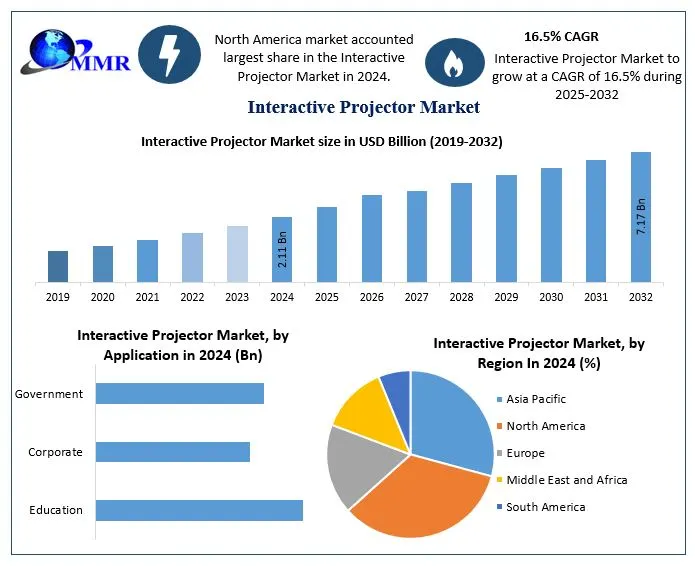
- Interactive Projector Market valued at USD 2.11 billion in 2024
- Market expected to reach USD 7.17 billion by 2032
- Forecast CAGR of 16.5% during 2025–2032
- DLP technology remains the dominant technology segment
- Education is both the dominant and fastest-growing application segment
- Growing deployment of smart classrooms is accelerating market penetration
- Corporate collaboration and hybrid working models are expanding commercial adoption
- Demand for ultra-short-throw projectors is reshaping product development strategies
Why This Matters Now
The race to digitize classrooms and collaborative workplaces has shifted from experimentation to large-scale deployment. Organizations are investing in technologies that improve engagement, collaboration, and content delivery while reducing infrastructure complexity.
Interactive projectors sit at the center of this transition. Unlike traditional display systems, they combine visualization and interactivity in a single platform, enabling schools, universities, and enterprises to create dynamic learning and working environments. As digital transformation budgets expand, vendors capable of delivering integrated, interactive experiences are capturing disproportionate market opportunities.
Market Overview
The Interactive Projector Market Size was valued at USD 2.11 billion in 2024 and is projected to reach USD 7.17 billion by 2032, registering a CAGR of 16.5% during the forecast period.
Market expansion is being driven by increasing adoption across educational institutions, corporate offices, and collaborative environments. Interactive projectors are increasingly replacing conventional presentation systems by enabling real-time interaction, annotation, and engagement.
The value proposition has become particularly compelling for schools and universities seeking cost-effective alternatives to interactive whiteboards. Educational institutions can modernize classrooms without extensive infrastructure investments, creating a strong business case for adoption.
At the same time, enterprises are using interactive projection systems to support brainstorming sessions, hybrid meetings, and collaborative decision-making. The convergence of digital learning, remote collaboration, and immersive communication is expanding the market’s addressable opportunity.
Key Trends Driving Growth
The strongest growth catalyst remains the global shift toward digital education. Schools and higher education institutions are investing in technologies that improve student participation, knowledge retention, and collaborative learning.
Demand for ultra-short-throw projectors is also increasing. These systems allow large image projection from short distances, reducing shadow interference and improving classroom usability. This capability has become a critical purchasing criterion for educational and business environments.
Rapid technological advancements in projection systems continue to enhance image quality, reliability, and ease of deployment. Vendors are focusing on improving user experience while lowering total ownership costs, helping accelerate adoption across both developed and emerging markets.
The growing emphasis on collaborative workspaces is creating additional momentum. Businesses increasingly require tools that support interactive presentations, team engagement, and visual communication. Interactive projectors are emerging as an effective solution for modern meeting environments.
However, market participants face competitive pressure from interactive flat-panel displays. As display technologies evolve, projector manufacturers must continue innovating to maintain differentiation and value.
Request Sample Report and Evaluate Market Opportunities Before Investment
Segment Insights
Dominant Segment: DLP Technology
- DLP (Digital Light Processing) represents the leading technology segment.
- Strong adoption is supported by superior contrast performance, portability, reliability, and image quality.
- The technology’s ability to deliver consistent performance across educational and commercial environments strengthens its market position.
- Manufacturers continue prioritizing DLP-based solutions because of proven deployment success and broad customer acceptance.
Dominant Segment: Education Application
- Education accounted for the largest market share in 2024.
- Schools, colleges, and universities are increasingly integrating interactive learning technologies into classroom environments.
- Interactive teaching improves engagement, collaboration, presentation capabilities, and knowledge retention.
- Government-backed education modernization initiatives further support adoption.
Fastest-Growing Segment: Education Application
- The education segment is also projected to record the fastest growth during the forecast period.
- Increasing investments in digital classrooms continue to create substantial demand.
- Educational institutions are prioritizing technologies that enhance learning outcomes while supporting hybrid and technology-enabled teaching models.
Regional Growth Story
North America continues to benefit from widespread digital learning adoption, advanced educational infrastructure, and strong enterprise technology spending. Institutions across the region have been early adopters of collaborative technologies, creating a mature demand environment.
Asia-Pacific represents a major long-term opportunity as governments accelerate education modernization and digital transformation initiatives. Rapid technology adoption, expanding educational infrastructure, and increasing awareness of interactive learning solutions are creating favorable market conditions.
Europe maintains steady growth through investments in smart education and workplace modernization programs. The region’s focus on digital transformation supports continued demand for interactive communication technologies.
Emerging economies are becoming increasingly important growth engines. As awareness increases and technology costs decline, adoption barriers are gradually decreasing, opening new opportunities for vendors seeking geographic expansion.
Competitive Landscape
Competition is increasingly shifting from hardware specifications toward ecosystem value. Market leaders are no longer competing solely on brightness, resolution, or projection quality. Success increasingly depends on delivering integrated collaboration experiences.
Technology providers that combine interactive software, collaboration tools, and seamless device connectivity are strengthening their competitive positions. This signals a broader transition from standalone projection products toward comprehensive engagement platforms.
The dominance of DLP technology indicates that customers continue prioritizing reliability, image quality, and deployment flexibility. Vendors capable of enhancing these advantages while addressing emerging display competition are likely to retain pricing power.
The market also reflects broader electronics industry trends. Product innovation is increasingly focused on improving user interaction, reducing installation complexity, and supporting digital-first environments. These priorities align closely with the needs of educational institutions and enterprises undergoing digital transformation.
As smart learning and collaborative work become standard operating models, competitive advantage will increasingly depend on software integration, user experience, and long-term ecosystem development rather than hardware differentiation alone.
Recent Developments
- Rising deployment of interactive projectors across primary schools, colleges, and universities.
- Growing demand for ultra-short-throw projection systems.
- Increased adoption in corporate collaboration and presentation environments.
- Continued technological improvements in projection performance and user interaction capabilities.
- Expansion of digital learning initiatives supporting interactive classroom deployment.
Strategic Implications
For electronics manufacturers, the market highlights growing demand for intelligent visualization technologies that blend hardware and software capabilities.
For education technology providers, interactive projectors offer a scalable pathway to digital classroom transformation without requiring extensive infrastructure upgrades.
For investors, the combination of double-digit growth and expanding application diversity signals a market transitioning from niche adoption to mainstream deployment.
For enterprises, interactive projection systems represent an increasingly important tool for enhancing workforce collaboration and communication effectiveness.
The broader implication is clear: organizations are investing less in passive display technologies and more in platforms that facilitate engagement, participation, and real-time interaction.
Future Outlook
The Interactive Projector Market is entering a phase where educational modernization, workplace collaboration, and digital engagement converge into a single growth narrative. As institutions continue prioritizing interactive experiences over static content delivery, demand for advanced projection technologies will strengthen.
The next competitive battleground will not be image projection alone—it will be the ability to create intelligent, connected, and collaborative environments that transform how people learn, communicate, and make decisions. Companies that build these ecosystems will define the future of interactive engagement, while those that remain hardware-centric risk losing relevance in an increasingly experience-driven technology landscape.
Analyst Perspective
“Interactive projectors are evolving from presentation tools into engagement platforms. As education and enterprise sectors accelerate digital transformation, organizations are prioritizing technologies that improve collaboration, participation, and learning outcomes. The companies that successfully combine projection capabilities with interactive experiences will be best positioned to capture future market growth.” — Rucha Deshpande, Analyst
About Maximize Market Research
Maximize Market Research Pvt. Ltd. (MMR) is a global market research and consulting company that provides reliable, data-focused, and practical business insights. The firm serves a wide range of industries, including healthcare, pharmaceuticals, technology, automotive, electronics, chemicals, personal care, and consumer goods. Through market forecasts, competitive analysis, strategic consulting, and industry impact assessments, MMR helps organizations understand changing market conditions, identify growth opportunities, and make informed business decisions for long-term success.
Contact Us
2nd Floor, Navale IT Park Phase 3
Pune Banglore Highway, Narhe
Pune, Maharashtra 411041, India
+91 9607365656
sales@maximizemarketresearch.com
