Key Highlights
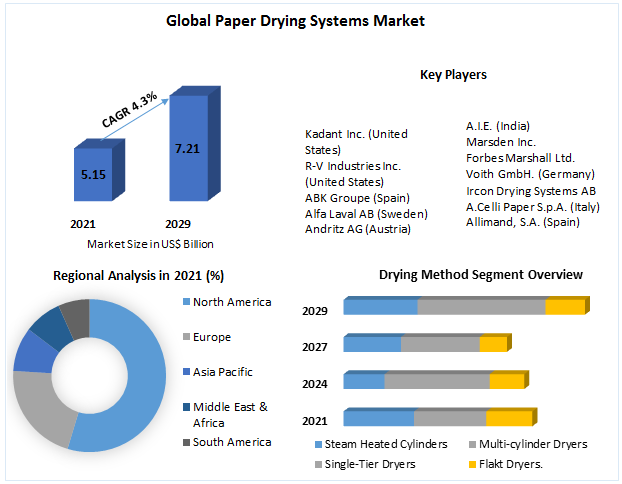
- The Paper Drying Systems Market was valued at USD 5.15 Billion in 2021 and is expected to reach USD 7.21 Billion by 2029 at a CAGR of 4.3%, creating opportunities for automation providers and paper manufacturers focused on efficiency improvement.
- Industrial digitization is changing paper production by increasing demand for automated drying control, energy optimization, and real-time production monitoring.
- Smart manufacturing initiatives are accelerating adoption of industrial IoT, predictive maintenance, and advanced process control technologies.
- Manufacturers are investing in automation solutions that improve productivity, reduce downtime, and support sustainable production goals.
Why This Matters Now
Paper manufacturers are facing a new operational reality: energy costs, workforce constraints, production efficiency targets, and sustainability requirements are forcing plants to modernize their drying operations. Paper drying systems, once viewed mainly as mechanical production assets, are becoming connected industrial platforms where automation, data analytics, and intelligent control determine competitiveness.
The shift toward Industry 4.0 is changing how paper mills manage critical processes. Automated drying control, digital monitoring, and predictive maintenance technologies are enabling operators to improve production stability while reducing operational disruptions. For plant managers and automation leaders, drying system modernization is becoming a strategic investment rather than a simple equipment upgrade.
Market Overview
The Global Paper Drying Systems Market was valued at USD 5.15 Billion in 2021 and is projected to grow at a CAGR of 4.3% to reach USD 7.21 Billion by 2029. This expansion highlights increasing demand for advanced drying technologies that support efficient paper manufacturing operations.
Paper drying systems play a critical role in removing moisture from paper sheets during production. Their performance directly influences product quality, energy consumption, production speed, and operational reliability. As paper manufacturers modernize facilities, automated drying systems are becoming integrated with broader factory control environments.
The adoption of PLC, DCS, and SCADA-based monitoring solutions is improving process visibility across paper mills. These technologies allow operators to track temperature, moisture levels, airflow, and equipment performance in real time, supporting faster decision-making and improved production control.
Key Trends Driving Growth
The paper industry is moving toward connected manufacturing environments where industrial automation systems coordinate production activities across the factory floor. Drying operations are increasingly linked with manufacturing execution systems (MES), operational technology platforms, and industrial data networks.
Industrial IoT adoption is enabling continuous monitoring of drying equipment performance. Connected sensors collect operational data that can be analyzed to identify efficiency gaps, predict equipment failures, and optimize production parameters. This transition supports the broader movement toward autonomous industrial operations.
Artificial intelligence and machine learning applications are also gaining attention in manufacturing environments. AI-driven analytics can help identify process deviations and improve drying efficiency by analyzing historical and real-time production data. For paper manufacturers, these capabilities create opportunities to reduce waste and improve consistency.
Predictive maintenance is becoming a major focus area as companies seek to minimize unplanned downtime. Instead of relying only on scheduled maintenance, manufacturers are using condition monitoring and digital diagnostics to identify potential equipment issues before failures occur.
Digital twin technology is emerging as another important development area. Virtual representations of production systems allow engineers to simulate operating conditions, test process improvements, and optimize equipment performance before implementing physical changes.
Industrial cybersecurity is also becoming a priority as paper plants become more connected. Increased integration of OT systems, cloud platforms, and industrial networks requires stronger protection strategies to secure critical manufacturing infrastructure.
Get a free sample:https://www.maximizemarketresearch.com/request-sample/148689/
Segment Insights
- Dominant Segment: The dominant segment of the Paper Drying Systems Market represents the technology category with the strongest market presence, supported by widespread adoption in paper manufacturing operations and the need for reliable moisture removal processes.
- Fastest-Growing Segment: The fastest-growing segment reflects increasing demand for advanced automation-enabled drying solutions as manufacturers adopt smart factory technologies, real-time monitoring, and energy-efficient production systems.
The segmentation highlights a broader industrial transition from conventional drying equipment toward intelligent systems capable of supporting automated production environments. Manufacturers are increasingly evaluating systems based on connectivity, operational efficiency, and integration with existing factory automation infrastructure.
Regional Growth Story
The United States remains an important market for industrial automation adoption, supported by manufacturing modernization programs, process optimization initiatives, and investments in advanced production technologies. Paper manufacturers are increasingly focused on improving operational efficiency through automation and data-driven decision-making.
Germany continues to influence industrial technology development through its strong Industry 4.0 ecosystem. Advanced manufacturing practices, automation expertise, and smart factory initiatives are encouraging adoption of connected production systems across industrial sectors, including paper manufacturing.
China represents a major manufacturing hub where industrial modernization and factory digitization are expanding. Investments in automation, production efficiency, and intelligent manufacturing are creating opportunities for advanced paper processing technologies.
Japan and South Korea continue to advance industrial automation through robotics integration, precision manufacturing, and technology innovation. Their focus on productivity improvement and operational excellence supports demand for intelligent industrial systems.
India is emerging as a growth opportunity as manufacturers increasingly adopt automation technologies to improve productivity, strengthen competitiveness, and modernize industrial infrastructure.
Competitive Landscape
The competitive environment in the Paper Drying Systems Market is shifting from traditional equipment competition toward technology-driven differentiation. Companies that combine mechanical expertise with automation capabilities, digital monitoring, and intelligent control solutions are better positioned to support modern paper manufacturers.
Technology leadership is increasingly defined by the ability to integrate drying systems with broader industrial ecosystems. Equipment providers and automation companies are focusing on solutions that improve energy efficiency, enable predictive maintenance, and support real-time operational decisions.
The future competitive advantage will depend on how effectively companies connect physical production assets with digital platforms. Manufacturers are looking beyond standalone machinery and seeking integrated solutions that improve productivity, reliability, and lifecycle performance.
Automation providers, system integrators, and industrial technology suppliers are expected to play a larger role as paper manufacturers transition toward connected and data-driven production environments.
Recent Developments
- Paper manufacturers are increasing investments in factory automation projects focused on process control, production efficiency, and equipment reliability.
- Industrial technology providers are advancing solutions involving IIoT connectivity, analytics platforms, and intelligent monitoring for manufacturing operations.
- Smart manufacturing initiatives are encouraging integration of automation systems with digital production management platforms.
- Predictive maintenance and real-time monitoring technologies are becoming important tools for improving equipment availability and reducing operational interruptions.
Strategic Implications
For plant operators, the modernization of drying systems represents an opportunity to improve production performance while addressing operational challenges. Companies that integrate automation, analytics, and connected technologies can gain stronger control over production processes.
For automation engineers, the market creates demand for advanced control architectures combining PLC, DCS, SCADA, MES, and industrial IoT technologies. System integration capabilities will become increasingly important as factories adopt interconnected production models.
For investors and industrial technology companies, the market signals continued opportunity in smart manufacturing solutions. The strongest growth potential will come from technologies that improve energy management, operational intelligence, and manufacturing flexibility.
Future Outlook
The future of the Paper Drying Systems Market will be shaped by the transition from equipment-focused manufacturing toward intelligent, connected, and autonomous production environments. As Industry 4.0 adoption accelerates, drying systems will increasingly become part of integrated digital factories where automation, AI, and real-time analytics drive operational decisions.
The next phase of competition will not be defined only by drying performance but by how effectively manufacturers use digital technologies to optimize production, protect industrial assets, and build resilient smart factories. Future automation leaders will be those that transform connected data into measurable factory advantage, while laggards risk operating in an increasingly outdated manufacturing model.
Analyst Perspective
“Paper drying systems are moving beyond conventional production equipment as manufacturers prioritize automation, operational efficiency, and digital transformation. The integration of smart technologies, process optimization, and advanced monitoring solutions is creating new opportunities for industrial modernization across the paper sector,” said Gaurav Deshmukh, Research Analyst.
About Maximize Market Research
Maximize Market Research Pvt. Ltd. (MMR) is a global market research and consulting company that provides reliable, data-focused, and practical business insights. The firm serves a wide range of industries, including healthcare, pharmaceuticals, technology, automotive, electronics, chemicals, personal care, and consumer goods. Through market forecasts, competitive analysis, strategic consulting, and industry impact assessments, MMR helps organizations understand changing market conditions, identify growth opportunities, and make informed business decisions for long-term success.
2nd Floor, Navale IT Park Phase 3
Pune Banglore Highway, Narhe
Pune, Maharashtra 411041, India
+91 9607365656
sales@maximizemarketresearch.com
