Key Highlights
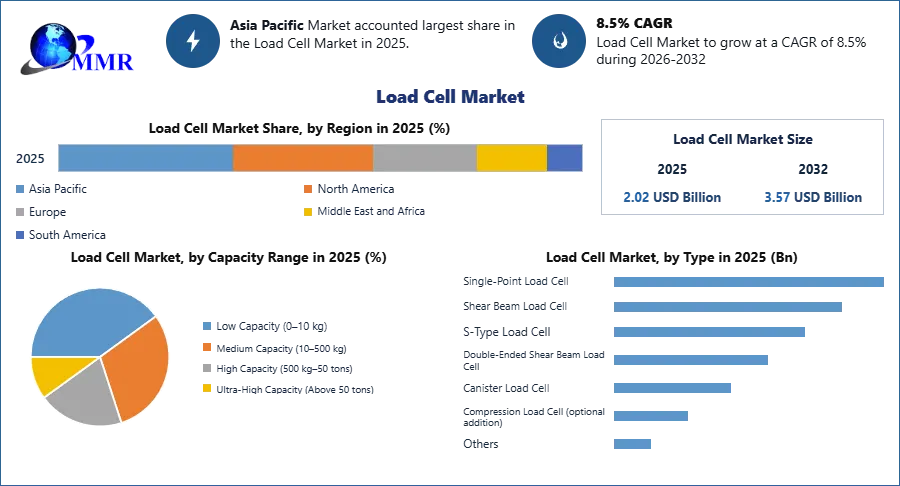
- Global Load Cell Market valued at USD 2.02 Billion in 2025
- Market projected to reach USD 3.57 Billion by 2032
- Expected to grow at a CAGR of 8.5% during 2026–2032
- Europe remains the leading regional market
- Single-Point Load Cells accounted for the largest type segment share
- Medium Capacity Load Cells (10–500 kg) represented the dominant capacity segment
- Healthcare equipment and industrial automation remain major growth drivers
- Demand rising from manufacturing, aerospace, automotive, logistics, and material handling applications
Why This Matters Now
Manufacturers are redesigning production lines around automation, precision measurement, and real-time monitoring. Load cells have become a critical sensing component in these systems because accurate force and weight measurement directly impacts quality control, productivity, and operational efficiency.
At the same time, healthcare equipment manufacturers are increasing deployment of advanced medical devices that require highly reliable force measurement technologies. This combination of industrial modernization and medical technology expansion is creating a sustained demand cycle for load cell suppliers worldwide.
Market Overview
The Load Cell Market Size is entering a period of sustained expansion as industries prioritize automation, digital manufacturing, and precision process control. According to Maximize Market Research, the market was valued at USD 2.02 Billion in 2025 and is expected to reach USD 3.57 Billion by 2032, growing at a CAGR of 8.5% during the forecast period.
Load cells have evolved from traditional weighing components into strategic sensing technologies used across industrial automation, healthcare systems, aerospace testing, automotive manufacturing, logistics infrastructure, and advanced material handling operations.
The market’s growth is increasingly tied to operational efficiency. Manufacturers require accurate measurement systems to reduce waste, improve production consistency, and support automated decision-making. As production environments become more connected, load cells are becoming integral to smart factory architectures.
Key Trends Driving Growth
Industrial automation remains one of the strongest demand catalysts. Modern factories rely on continuous measurement and monitoring systems to maintain production quality while reducing manual intervention. Load cells enable precise weighing, force monitoring, and process validation throughout manufacturing environments.
Healthcare is emerging as a strategic growth segment. The expansion of dialysis machines, implantation pumps, surgical instruments, and home haemodialysis systems is increasing demand for highly accurate load measurement technologies. As healthcare systems shift toward patient-centric and home-based care models, sensor reliability becomes increasingly important.
Aerospace and defense organizations continue expanding testing requirements. Material testing, structural validation, and force measurement applications require highly precise load sensing systems capable of operating under demanding conditions.
Another major trend is the increasing use of load cells within logistics and warehousing operations. As supply chains become more automated, businesses are investing in intelligent weighing and material handling systems to improve throughput and inventory accuracy.
Explore the latest market dynamics—grab your free sample and uncover key insights today
Segment Insights
- Dominant Segment (Type): Single-Point Load Cells
- Accounted for approximately 30% of global revenue in 2025
- Widely used in retail scales, packaging systems, and platform balances
- Strong adoption across food processing and consumer electronics manufacturing
- Fastest-Growing Opportunity (Type): Shear Beam and S-Type Load Cells
- Together represented more than 25% of market demand
- Growth supported by industrial process monitoring and material testing requirements
- Dominant Segment (Capacity Range): Medium Capacity (10–500 kg)
- Held nearly 38% market share in 2025
- Supported by manufacturing, packaging, logistics, and warehousing applications
- Expected to expand at a 6.1% CAGR through 2032
- High-Capacity Segment (500 kg–50 tons)
- Represented approximately 27% of global demand
- Driven by mining, construction, and chemical processing operations
- Low-Capacity Segment (0–10 kg)
- Accounted for roughly 20% market share
- Benefiting from laboratory equipment and precision electronics applications
Regional Growth Story
Europe remains the largest regional market for load cells. The region’s leadership stems from strong demand across automotive manufacturing, aerospace programs, oil and gas operations, defense applications, and bulk material handling industries.
The region’s industrial base continues investing in advanced automation technologies and high-precision measurement systems. This creates a favorable environment for load cell manufacturers focused on premium sensing solutions.
Asia-Pacific is emerging as a critical growth engine due to expanding manufacturing capacity, industrial modernization initiatives, and increasing adoption of automated production technologies. Countries including China, Japan, India, South Korea, and Taiwan continue investing in industrial infrastructure and advanced manufacturing capabilities.
North America maintains steady demand through aerospace, healthcare, industrial automation, and logistics sectors. The region’s emphasis on operational efficiency and smart manufacturing continues to support sensor technology investments.
Competitive Landscape
Competition is increasingly centered on measurement accuracy, durability, digital integration capabilities, and application-specific customization.
Leading participants include Honeywell International Inc., Vishay Precision Group Inc., Hottinger Baldwin Messtechnik GmbH (HBK), Flintec Group AB, OMEGA Engineering Inc., FUTEK Advanced Sensor Technology Inc., Mettler Toledo Inc., Spectris plc, MinebeaMitsumi Inc., and Interface Inc.
The competitive landscape signals a broader shift toward intelligent sensing ecosystems. Companies are focusing on higher-performance measurement platforms that can integrate seamlessly into automated production environments.
For technology leaders, the opportunity extends beyond hardware sales. The future competitive advantage lies in delivering complete measurement solutions capable of supporting digital manufacturing, predictive maintenance, and industrial analytics initiatives.
Market leaders are also strengthening their positions through application specialization in healthcare, aerospace testing, logistics automation, and heavy industrial operations. This strategy helps improve pricing power while reducing exposure to commoditization pressures.
Recent Developments
- Expansion of load cell adoption in healthcare and home haemodialysis equipment
- Increasing deployment in industrial automation and process monitoring systems
- Growing use in aerospace and aviation testing applications
- Rising demand from logistics, warehousing, and material handling operations
- Greater focus on high-load industrial weighing applications
- Continued integration of precision measurement technologies into smart manufacturing environments
Strategic Implications
For industrial equipment manufacturers, load cells are becoming foundational components of automation strategies. Companies that invest in advanced sensing technologies can improve operational visibility and production efficiency.
For healthcare device manufacturers, precision measurement capabilities are becoming increasingly important as medical equipment grows more sophisticated and patient-focused.
For investors, the market offers exposure to multiple long-term industrial trends, including automation, digital manufacturing, healthcare technology expansion, and industrial modernization.
For supply-chain operators, accurate weighing and force measurement technologies support inventory management, logistics optimization, and process reliability.
Future Outlook
The next phase of market expansion will be shaped by the convergence of industrial automation, smart manufacturing, healthcare innovation, and connected sensing technologies. Demand will increasingly favor intelligent load measurement systems capable of supporting data-driven operations across manufacturing, logistics, aerospace, and healthcare environments.
As factories become more autonomous and precision requirements intensify, companies that combine advanced sensing capabilities with digital integration will define the next generation of industrial measurement leadership, while slower adopters risk losing competitiveness in increasingly automated global markets.
Analyst Perspective
“The Load Cell Market is moving beyond traditional weighing applications toward becoming a critical component of industrial automation and healthcare technology ecosystems. Organizations that prioritize precision measurement, operational efficiency, and intelligent sensing integration will be best positioned to capture the market’s next wave of value creation,” said Rucha Deshpande, Analyst.
About Maximize Market Research
Maximize Market Research Pvt. Ltd. (MMR) is a global market research and consulting company that provides reliable, data-focused, and practical business insights. The firm serves a wide range of industries, including healthcare, pharmaceuticals, technology, automotive, electronics, chemicals, personal care, and consumer goods. Through market forecasts, competitive analysis, strategic consulting, and industry impact assessments, MMR helps organizations understand changing market conditions, identify growth opportunities, and make informed business decisions for long-term success.
Contact Us
2nd Floor, Navale IT Park Phase 3
Pune Banglore Highway, Narhe
Pune, Maharashtra 411041, India
+91 9607365656
sales@maximizemarketresearch.com
