Key Highlights
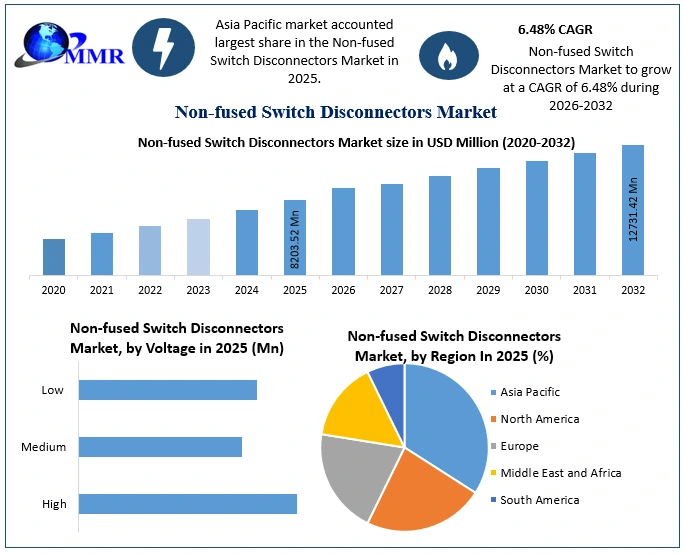
- Global Non-Fused Switch Disconnectors Market valued at US$ 8203.52 Mn in 2025
- Market projected to reach US$ 12731.42 Mn by 2032
- Forecast CAGR stands at 6.48% during 2026–2032
- Low-voltage non-fused disconnectors represent the dominant market segment
- Asia Pacific holds the leading market position
- Expansion of transmission and distribution networks is creating new revenue opportunities
- Industrialization and electrical safety regulations remain primary growth catalysts
- Renewable energy deployment is increasing demand for switching and isolation technologies
Why This Matters Now
The race to modernize power infrastructure is accelerating across major economies. Utilities, manufacturers, renewable energy developers, and industrial operators are investing heavily in electrical reliability, operational safety, and grid resilience.
Non-fused switch disconnectors have become a critical component of this transition. As power networks expand and renewable energy assets connect to the grid, operators require reliable isolation technologies that support maintenance, improve worker safety, and reduce downtime. The market’s growth trajectory reflects broader investment cycles across electrification, industrial automation, and energy infrastructure.
Market Overview
The Non-Fused Switch Disconnectors Market Size was valued at US$ 8203.52 million in 2025 and is expected to reach US$ 12731.42 million by 2032, expanding at a CAGR of 6.48% during the forecast period.
The market sits at the intersection of industrial safety and power reliability. As electrical systems become more complex, organizations are prioritizing equipment that enables safe circuit isolation while supporting uninterrupted operations.
Industrial facilities, commercial buildings, renewable power installations, and utility networks increasingly rely on disconnectors to ensure maintenance safety and regulatory compliance. The result is a growing market supported by both replacement demand and new infrastructure deployment.
What changed is the scale of electrification. Power consumption growth, renewable integration, and industrial digitization are forcing operators to rethink electrical protection architectures. Non-fused switch disconnectors are emerging as a foundational component of that strategy.
Key Trends Driving Growth
Industrialization across emerging economies remains a major catalyst. Manufacturing expansion creates new electrical installations that require dependable isolation equipment for safe operations and maintenance.
Electrical safety standards are also becoming stricter. Companies are investing in upgraded switching systems to comply with regulations and reduce operational risks. Every new industrial facility, distribution center, and commercial complex increases demand for reliable disconnect solutions.
Renewable energy is creating another growth engine. Solar, wind, and other distributed energy resources require extensive switching and protection infrastructure. As renewable installations multiply, disconnectors become essential for grid connection and maintenance procedures.
Transmission and distribution modernization is equally important. Aging power networks are being upgraded to improve reliability and support increasing electricity demand. These projects generate sustained demand for disconnect switches and related electrical equipment.
The market is also benefiting from expanding industrial sectors such as automotive and heavy machinery manufacturing, where operational continuity and worker safety remain strategic priorities.
Get Instant Access to a Sample Report with Strategic Market Intelligence and Forecast Data
Segment Insights
- Dominant Segment: Low Voltage Non-Fused Disconnect Switches
- The low-voltage segment leads the global market.
- These switches are widely used in photovoltaic installations, commercial facilities, and power distribution applications.
- Their ability to safely isolate downstream circuits during inspection and maintenance makes them essential across multiple industries.
- The segment benefits from broad deployment across switchboards, feeder systems, and electrical distribution networks.
- Application Insights
- Commercial and industrial applications continue to generate substantial demand.
- Growing electrification of manufacturing facilities supports installation growth.
- Power distribution infrastructure remains a key deployment area.
- Electric Phase Insights
- Single-phase and three-phase systems both contribute to market expansion.
- Three-phase installations are particularly important in industrial and utility environments where higher power loads require robust electrical isolation solutions.
Regional Growth Story
Asia Pacific remains the market’s dominant region and represents the center of future infrastructure investment.
Rapid industrial development across countries including India, China, Japan, South Korea, and other emerging Asian economies is increasing demand for electrical switching equipment. Manufacturing expansion, urbanization, and infrastructure construction continue to strengthen market fundamentals.
The region is also undergoing significant transmission and distribution upgrades. Utilities are investing in modern power grids capable of supporting rising electricity demand and renewable energy integration.
Renewable energy development is another major factor. Solar, wind, and tidal energy projects require expanded grid infrastructure, creating sustained demand for disconnect switches and related components.
North America is expected to register strong growth during the forecast period. Increasing renewable power generation and continued investment in electrical infrastructure are driving adoption across utility and industrial sectors.
The regional opportunity extends beyond new installations. Aging infrastructure replacement programs are creating additional demand for modern electrical isolation technologies.
Competitive Landscape
The competitive environment includes major electrical equipment manufacturers such as Siemens AG, Schneider Electric, ABB Ltd., General Electric Company, Eaton Corporation, WEG SA, Havells India Ltd., Littelfuse Inc., Mitsubishi Electric, Delixi Electric Co. Ltd., Legrand, Kraus & Naimer, Craig & Derricott Limited, MK Electric, Altech, CHINT Group, and LOVATO Electric S.p.A.
Competition is increasingly centered on product reliability, safety performance, operational efficiency, and integration with modern electrical systems.
Strategic investments, product launches, partnerships, and geographic expansion indicate that leading manufacturers are positioning themselves for long-term electrification trends. Companies capable of supporting renewable energy projects, industrial automation initiatives, and power infrastructure upgrades are expected to strengthen their market positions.
The competitive landscape also signals a broader shift toward integrated electrical ecosystems. Suppliers are moving beyond standalone products and focusing on comprehensive solutions that improve operational visibility, maintenance efficiency, and safety compliance.
Recent Developments
- Expansion initiatives aimed at strengthening regional market presence
- Product innovation focused on enhanced safety and operational reliability
- Strategic investments to support growing infrastructure demand
- Partnerships designed to expand distribution and service capabilities
- Development activities targeting renewable energy and power distribution applications
Strategic Implications
For utilities, the market highlights the importance of grid modernization and network resilience. Investments in switching infrastructure support reliability while enabling renewable energy integration.
For industrial operators, disconnectors are becoming a critical component of workplace safety strategies. Improved electrical isolation reduces maintenance risks and helps meet regulatory requirements.
For manufacturers, growing demand creates opportunities to develop advanced switching technologies capable of serving increasingly complex electrical systems.
For investors, the market reflects broader trends shaping global electrification, including renewable energy deployment, industrial automation, and infrastructure modernization.
Future Outlook
The next phase of market expansion will be shaped by electrification, renewable energy growth, industrial modernization, and large-scale transmission network upgrades. Organizations that align their product portfolios with these structural trends will be positioned to capture emerging opportunities across utility, commercial, and industrial applications.
The companies that enable safer, smarter, and more resilient electrical infrastructure will define the next generation of power distribution leadership, while slower adopters risk losing relevance as global electrification accelerates.
Analyst Perspective
“The Non-Fused Switch Disconnectors Market is entering a new growth cycle driven by industrialization, electrical safety requirements, renewable energy integration, and transmission network expansion. Companies that align with infrastructure modernization and grid reliability priorities will be best positioned to capitalize on long-term market opportunities.” — Rucha Deshpande, Analyst
About Maximize Market Research
Maximize Market Research Pvt. Ltd. (MMR) is a global market research and consulting company that provides reliable, data-focused, and practical business insights. The firm serves a wide range of industries, including healthcare, pharmaceuticals, technology, automotive, electronics, chemicals, personal care, and consumer goods. Through market forecasts, competitive analysis, strategic consulting, and industry impact assessments, MMR helps organizations understand changing market conditions, identify growth opportunities, and make informed business decisions for long-term success.
Contact Us
2nd Floor, Navale IT Park Phase 3
Pune Banglore Highway, Narhe
Pune, Maharashtra 411041, India
+91 9607365656
sales@maximizemarketresearch.com
