Key Highlights
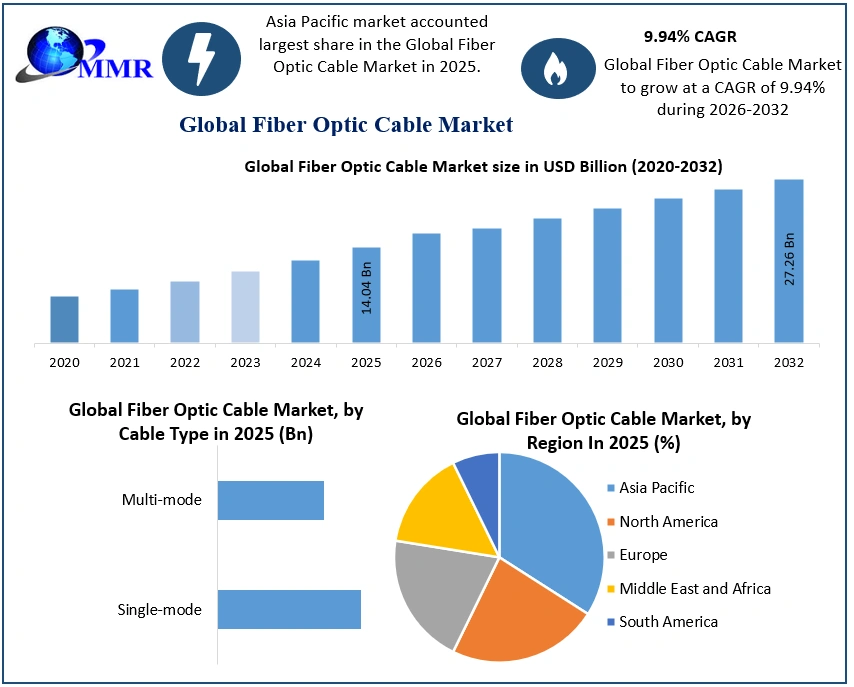
- Market valued at USD 14.04 Billion in 2025, projected to reach USD 27.26 Billion by 2032
- Expected CAGR of 9.94% (2025–2032) driven by global data infrastructure expansion
- Rising demand for high-bandwidth communication networks across telecom and enterprise sectors
- Increasing reliance on fiber backbone networks for digital transformation initiatives
- Expansion of broadband and next-generation connectivity infrastructure
- Growing importance of optical networks in supporting data-heavy applications
Why This Matters Now
The Fiber Optic Cable Market is entering a phase where data infrastructure is becoming a strategic asset rather than a utility upgrade. Network operators, telecom providers, and digital infrastructure investors are under pressure to scale capacity as global data consumption accelerates.
The projected rise from USD 14.04 billion to USD 27.26 billion by 2032 signals sustained capital deployment into high-speed connectivity systems. This shift is reshaping how governments and enterprises approach digital competitiveness, with fiber networks forming the backbone of modern communication ecosystems.
Market Overview
The Fiber Optic Cable Market Size covers optical communication cables used to transmit data through light signals, enabling high-speed and long-distance connectivity across telecom, broadband, enterprise, and infrastructure networks. According to the supplied report, the market is valued at USD 14.04 billion in 2025 and is projected to reach USD 27.26 billion by 2032, expanding at a CAGR of 9.94%
This growth reflects a structural shift toward bandwidth-intensive digital ecosystems. As cloud computing, streaming services, and connected devices expand, fiber networks are becoming essential infrastructure for supporting low-latency and high-capacity communication.
The report does not provide segmentation, regional leadership, or detailed end-user splits, but the growth rate indicates broad-based adoption across telecommunications and digital infrastructure sectors.
Key Trends Driving Growth
The primary driver identified in the report is increasing demand for fiber optic infrastructure. This demand is closely linked to rising global data consumption and the expansion of high-speed communication networks.
Telecom operators are increasingly replacing legacy copper networks with fiber-based systems to meet bandwidth requirements. This transition is accelerating as digital services become more data-intensive.
Another key trend is the expansion of broadband infrastructure in both urban and semi-urban regions. Governments and private operators are investing in network modernization to improve connectivity quality and coverage.
The growth trajectory also reflects increasing reliance on optical networks for enterprise connectivity, where low latency and high reliability are critical for cloud-based operations and distributed digital systems.
For full access to the data, request a sample report now.
Segment Insights
- Dominant Segment: Not specified in the supplied report
- Fastest-Growing Segment: Not specified in the supplied report
The report does not provide segmentation by type, application, or end-user categories. However, overall growth indicates simultaneous expansion across telecom backbone networks, enterprise connectivity, and broadband infrastructure deployments.
The absence of segmentation data highlights a market driven more by infrastructure modernization cycles than by isolated product category growth.
Regional Growth Story
The report does not specify regional revenue distribution or leading geographies. However, the global scale and steady CAGR suggest widespread adoption across developed and emerging economies.
Fiber optic deployment is typically aligned with national broadband expansion programs, telecom modernization initiatives, and digital infrastructure investments. While no regional breakdown is provided, demand is structurally global in nature due to universal data growth trends.Competitive Landscape
The report does not list companies, partnerships, or competitive positioning. However, the market’s nearly 10% CAGR indicates strong competitive pressure among infrastructure providers, telecom suppliers, and network solution companies.
Competitive dynamics are shaped by:
- Capacity expansion in fiber manufacturing
- Cost optimization in large-scale deployment projects
- Technological improvements in optical transmission efficiency
- Integration with 5G and next-generation network architectures
The absence of named participants suggests a fragmented yet scaling ecosystem where infrastructure capability and deployment efficiency define market positioning.
Recent Developments
The report does not provide specific developments, contracts, or technology announcements.
However, the consistent market expansion reflects ongoing global investment in fiber network expansion and broadband modernization programs. Infrastructure scaling continues to align with rising data traffic and digital transformation requirements.
No regulatory, merger, or procurement-specific events are included in the source material.
Strategic Implications
The Fiber Optic Cable Market is becoming a foundational layer of digital infrastructure strategy for governments, telecom operators, and enterprise networks. As data consumption rises, fiber deployment is increasingly linked to national competitiveness in digital services.
For telecom operators, the growth signals continued capital intensity in backbone network expansion. For enterprises, it reinforces the shift toward cloud-first architectures requiring stable high-speed connectivity.
The nearly double-digit CAGR indicates sustained long-term investment cycles rather than short-term infrastructure upgrades. This creates opportunities for suppliers capable of scaling production, improving deployment efficiency, and supporting next-generation network requirements.
The absence of segmentation data suggests that competitive advantage will come from execution scale rather than niche product differentiation.
Future Outlook
The market’s trajectory toward USD 27.26 billion by 2032 reflects sustained expansion of global data infrastructure. As digital ecosystems grow more complex, fiber optic networks will remain the core transmission layer supporting cloud computing, telecom modernization, and enterprise connectivity.
The next phase of competition will be defined by who can build faster, scale efficiently, and sustain the backbone of the global digital economy without capacity constraints.
Analyst Perspective
“The Fiber Optic Cable Market is witnessing steady expansion driven by accelerating demand for high-speed data transmission infrastructure and global digital connectivity requirements.”
— Rucha Deshpande, Analyst
About Maximize Market Research
Maximize Market Research Pvt. Ltd. (MMR) is a global market research and consulting company that provides reliable, data-focused, and practical business insights. The firm serves a wide range of industries, including healthcare, pharmaceuticals, technology, automotive, electronics, chemicals, personal care, and consumer goods. Through market forecasts, competitive analysis, strategic consulting, and industry impact assessments, MMR helps organizations understand changing market conditions, identify growth opportunities, and make informed business decisions for long-term success.
Contact Us :
2nd Floor, Navale IT Park Phase 3
Pune Banglore Highway, Narhe
Pune, Maharashtra 411041, India
+91 9607365656
sales@maximizemarketresearch.com
