Luxury Jewelry Market Gains Momentum as Ethical Sourcing and Premium Self-Purchasing Trends Accelerate Through 2032
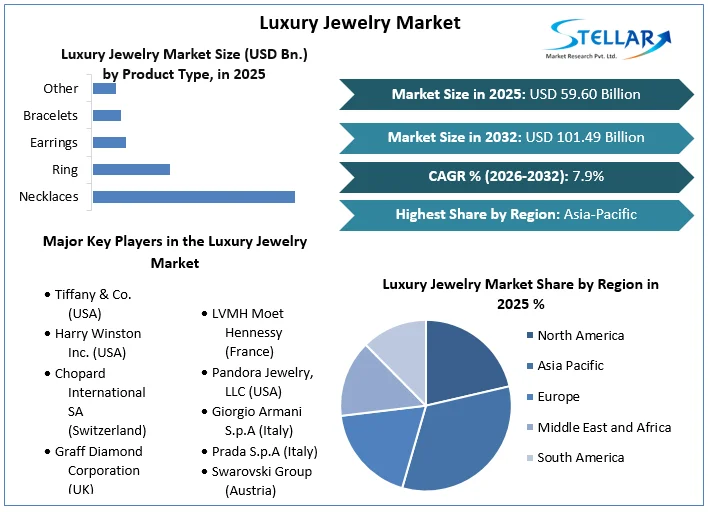
PUNE, India, June 19, 2026 – The Luxury Jewelry Market is undergoing a structural transformation driven by sustainability, digital personalization, and rising self-purchasing behavior among affluent consumers. According to the latest findings from Stellar Market Research, the global market was valued at USD 59.60 billion in 2025 and is projected to reach approximately USD 101.49 billion by 2032, expanding at a CAGR of 7.9% during 2026-2032.
The report highlights how changing consumer preferences, increasing demand for traceable gemstones, and the rapid expansion of premium online retail channels are redefining the competitive dynamics of the industry.
Market Opportunity Overview
Luxury jewelry is evolving beyond traditional gifting and ceremonial purchases. Consumers, particularly women, increasingly view fine jewelry as an expression of identity, investment, and lifestyle. Growing demand for ethically sourced gold, lab-grown diamonds, and personalized collections is encouraging manufacturers and luxury houses to accelerate innovation and strengthen omnichannel capabilities.
Digital engagement, AI-powered recommendations, and sustainability initiatives are creating new revenue opportunities while enhancing customer loyalty. Rising disposable income across emerging economies and growing wealth creation among millennials and Gen Z consumers are expected to support long-term industry expansion.
Download Free PDF Brochure: https: //www.stellarmr.com/report/req_sample/Luxury-Jewelry-Market/1835
Key Findings from the Luxury Jewelry Market Report
The global Luxury Jewelry Market was valued at USD 59.60 billion in 2025 and is forecast to reach USD 101.49 billion by 2032.¹
The market is expected to register a 7.9% CAGR between 2026 and 2032.¹
Key segments include product type, application, distribution channel, and geography.¹
The women’s segment represents the dominant application category, supported by rising self-purchasing trends.¹
Online luxury retail channels are emerging as one of the fastest-growing distribution avenues.
North America remains the leading regional market due to strong luxury spending and brand presence.
Asia-Pacific is emerging as a major growth engine, supported by rising high-net-worth populations and premium consumption patterns.
Market Drivers and Restraints
Key Drivers
Growing Self-Purchasing Culture
Women are increasingly purchasing luxury jewelry for personal use rather than relying solely on gifting occasions, creating sustained demand across premium categories.¹
Expansion of Affluent Consumer Base
Rising disposable income and wealth accumulation in Asia-Pacific and the Middle East are strengthening demand for high-value jewelry collections.
Digital Transformation of Luxury Retail
Luxury brands are investing in omnichannel experiences, virtual consultations, and personalized digital services to improve customer engagement.
Major Restraints
Volatility in Precious Metal Prices
Fluctuations in gold and diamond prices can affect manufacturing costs and pricing strategies.
Counterfeit Products and Supply Chain Challenges
The proliferation of counterfeit goods and concerns regarding gemstone traceability remain major challenges for established brands.
Technology, Regulation, and Sustainability Trends
The industry is witnessing rapid adoption of blockchain-based traceability systems, AI-driven personalization, and digital commerce platforms. ESG considerations are increasingly influencing consumer purchasing decisions, encouraging luxury brands to strengthen responsible sourcing initiatives.
Regulatory scrutiny surrounding gemstone origin, responsible mining, and environmental standards is pushing companies toward greater transparency. Sustainable collections and recycled precious metals are emerging as key differentiators.
Regional Insights
North America Leads Global Revenue
The United States continues to dominate luxury jewelry consumption due to strong purchasing power, established luxury brands, and premium retail infrastructure.
Asia-Pacific Emerges as High-Growth Region
China, India, Japan, and Southeast Asian economies are witnessing increasing demand driven by rising affluence, expanding middle-class populations, and growing acceptance of premium lifestyle products.
Europe Maintains Strong Heritage Position
France, Italy, Switzerland, and the United Kingdom continue to serve as major hubs for luxury jewelry craftsmanship and innovation.
Recent Industry Developments
LVMH (2025): Tiffany & Co. achieved strong performance through flagship expansion and successful high-jewelry collections, supporting continued growth in the luxury jewelry segment.³
Bulgari (2025): The company introduced its Polychroma high jewelry collection, generating record sales for multi-million-dollar pieces.³
Richemont (2025): Jewelry maisons including Cartier and Van Cleef & Arpels delivered double-digit growth, helping offset weakness in the broader luxury sector.⁴
Richemont (2026): Jewelry sales increased by approximately 14%, demonstrating resilience despite slower luxury demand globally.⁵
Rolex and Cartier (2026): Premium pricing adjustments amid rising gold costs highlighted sustained demand among high-net-worth consumers.⁶
Download Free PDF Brochure: https: //www.stellarmr.com/report/req_sample/Luxury-Jewelry-Market/1835
Competitive Landscape
The Luxury Jewelry Market remains highly competitive with leading participants focusing on product innovation, boutique expansion, digital engagement, and sustainability strategies.
Major companies include:
Cartier
Tiffany & Co.
Bulgari
Van Cleef & Arpels
Chopard
Harry Winston
Graff
Piaget
Buccellati
Strategic priorities among industry leaders include flagship store expansion, exclusive collections, premium collaborations, and investments in responsible sourcing initiatives.
Analyst Commentary
“Luxury jewelry is increasingly benefiting from the convergence of sustainability, personalization, and digital commerce. Consumers are demanding transparency and exclusivity simultaneously, creating significant opportunities for brands that can balance heritage craftsmanship with technological innovation,” said a Senior Research Analyst at Stellar Market Research.
Future Outlook
Through 2032, the Luxury Jewelry Market is expected to benefit from increasing premiumization, digital transformation, and expanding affluent populations across emerging economies. Investments in sustainable sourcing, AI-enabled customer experiences, and omnichannel retail ecosystems are likely to redefine competitive positioning.
Companies capable of combining craftsmanship, traceability, and personalization are expected to capture the largest growth opportunities in the coming years.
About Stellar Market Research
Stellar Market Research is a global market research and consulting firm specializing in syndicated and customized studies across multiple industries. The company delivers actionable insights, competitive intelligence, and strategic advisory services that help organizations identify growth opportunities and make informed business decisions. Its comprehensive research methodology combines primary interviews, secondary analysis, and advanced analytical frameworks to provide accurate forecasts and market assessments. Stellar Market Research serves clients worldwide across sectors including healthcare, consumer goods, automotive, chemicals, energy, information technology, and industrial manufacturing, enabling businesses to navigate evolving market landscapes with confidence.
Media Contact
Stellar Market Research
Website: http://stellarmr.com/
Email: sales@stellarmr.com
