Oleic Acid Market Projected to Reach USD 511.39 Million by 2032 as Plant-Based Ingredients Gain Momentum Across Food, Personal Care, and Industrial Applications
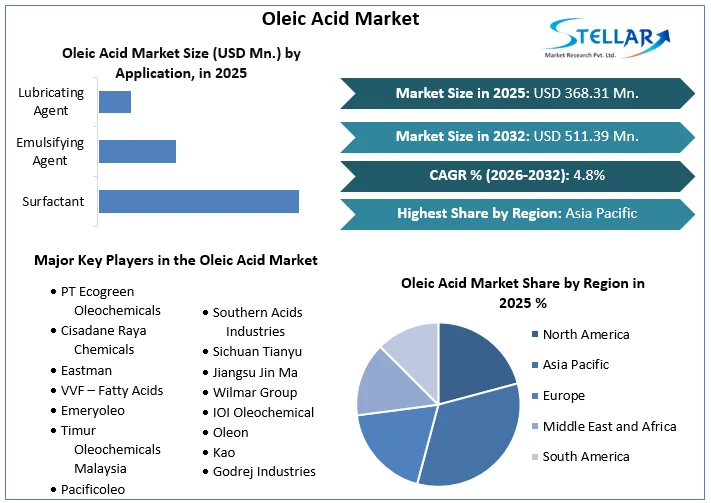
PUNE, India, June 19, 2026 – The Oleic Acid Market is entering a new phase of growth driven by the convergence of clean-label consumer preferences, sustainable sourcing initiatives, and rising industrial demand for bio-based ingredients. According to the latest study by Stellar Market Research, the global oleic acid market was valued at USD 368.31 million in 2025 and is expected to reach USD 511.39 million by 2032, expanding at a CAGR of 4.8% during the forecast period 2026–2032.
Market Opportunity Overview
Oleic acid, a monounsaturated fatty acid derived primarily from vegetable oils, is becoming a strategic raw material across multiple industries. While historically used in soaps, detergents, and lubricants, the market is increasingly benefiting from demand for naturally sourced ingredients in cosmetics, pharmaceuticals, nutraceuticals, and functional foods.
The industry’s transformation is being shaped by manufacturers replacing petroleum-derived chemicals with renewable alternatives. Rising consumer awareness around ingredient transparency and sustainability is encouraging food processors, personal care brands, and industrial formulators to adopt plant-based oleochemicals. This shift is creating new investment opportunities across the value chain, from agricultural feedstocks and refining technologies to specialty chemical manufacturing.
𝐃𝐨𝐰𝐧𝐥𝐨𝐚𝐝 𝐅𝐫𝐞𝐞 𝐏𝐃𝐅 𝐁𝐫𝐨𝐜𝐡𝐮𝐫𝐞: https://www.stellarmr.com/report/req_sample/Oleic-Acid-Market/1454
Key Findings from the Report
The global oleic acid market is forecast to grow from USD 368.31 million in 2025 to USD 511.39 million by 2032 at a CAGR of 4.8%.
Plant-based oleic acid remains the dominant source segment, supported by growing demand for sustainable and vegan-friendly products.
The food-grade segment accounts for the largest share among grades due to widespread usage in food processing and functional ingredients.
Surfactants represent the leading application segment, driven by strong demand from soaps, detergents, and personal care products.
Asia-Pacific holds the largest market share, accounting for more than half of global demand.
China remains the leading producer and consumer, while India is emerging as a high-growth market due to expanding food, pharmaceutical, and cosmetic industries.
Growing investments in bio-based chemicals and sustainable supply chains are enhancing long-term investor attractiveness.
Market Drivers and Restraints
Key Drivers
Growing Demand for Natural and Plant-Based Ingredients
Consumers increasingly prefer naturally derived ingredients in food, skincare, and wellness products. Oleic acid sourced from olive, sunflower, soybean, and palm oils aligns with clean-label and organic product trends.
Expansion of Personal Care and Cosmetics Applications
Oleic acid is widely used as an emollient, moisturizer, and penetration enhancer in skincare formulations. Rising global spending on beauty and personal care products continues to support demand.
Growth of Functional Foods and Nutraceuticals
Health-conscious consumers are increasingly seeking products containing beneficial fats associated with cardiovascular wellness, supporting oleic acid adoption in food and nutraceutical applications.
Key Restraints
Volatility in Vegetable Oil Prices
Fluctuating prices of feedstocks such as palm, soybean, and sunflower oils can impact production costs and profit margins across the value chain.
Regulatory and Sustainability Challenges
Increasing scrutiny regarding palm oil sourcing, land-use practices, and environmental compliance may create operational and supply-chain complexities for manufacturers.
Technology, Regulation, and Sustainability Trends
Advanced oleochemical processing technologies are improving yield efficiency and product purity while reducing environmental impact. Manufacturers are investing in traceability systems, sustainable sourcing certifications, and renewable feedstock optimization to strengthen ESG performance.
Regulatory frameworks supporting renewable chemicals and environmentally responsible manufacturing are encouraging substitution of petroleum-based ingredients with bio-based alternatives. In Europe and North America, tightening sustainability standards and clean-label regulations are influencing procurement decisions across food and personal care sectors.
The market is also witnessing greater integration of circular economy principles, with producers focusing on responsible sourcing, waste reduction, and lower-carbon production models.
Regional Insights
Asia-Pacific: Market Leader
Asia-Pacific is the dominant and fastest-growing region, accounting for more than 50% of global demand. Strong manufacturing capabilities, rising disposable incomes, expanding consumer markets, and growing awareness of health and wellness continue to drive growth. China remains the largest producer and consumer, while India is emerging as a major growth engine.
North America: Innovation and Specialty Applications
North America represents the second-largest regional market, supported by advanced personal care, pharmaceutical, and specialty chemical industries. Demand for sustainable ingredients and premium formulations continues to create opportunities for suppliers.
Europe: Sustainability-Led Growth
European demand is being supported by regulatory emphasis on renewable chemicals, sustainable sourcing, and environmentally responsible manufacturing practices. Germany remains a key market within the region.
Emerging Regions
The Middle East, Africa, and parts of South America are expected to experience accelerated growth due to urbanization, population expansion, and increasing industrialization.
Recent Industry Developments
BASF SE (2025): Expanded sustainable bio-based ingredient initiatives across its personal care portfolio, strengthening renewable raw material adoption in cosmetic formulations.
KLK OLEO (2025): Increased oleochemical production capabilities in Asia to support growing demand from food, personal care, and industrial customers.
IOI Oleochemical (2025): Advanced sustainability certification programs for palm-derived feedstocks, improving traceability and supply-chain transparency.
Emery Oleochemicals (2024): Expanded specialty oleochemical offerings targeting high-performance industrial and personal care applications.
European Union Sustainability Framework (2024–2025): Continued implementation of sustainability and supply-chain due diligence measures, encouraging broader adoption of certified renewable feedstocks across chemical markets.
𝐃𝐨𝐰𝐧𝐥𝐨𝐚𝐝 𝐅𝐫𝐞𝐞 𝐏𝐃𝐅 𝐁𝐫𝐨𝐜𝐡𝐮𝐫𝐞: https://www.stellarmr.com/report/req_sample/Oleic-Acid-Market/1454
Competitive Landscape
The oleic acid market remains moderately consolidated, with competition centered on product quality, sustainability credentials, feedstock sourcing capabilities, and geographic expansion. Major participants include BASF SE, Emery Oleochemicals, KLK OLEO, IOI Oleochemical, AkzoNobel, Vantage Specialty Chemicals, and Shuangma Chemical.
Leading companies are investing in production expansion, strategic partnerships, sustainable sourcing programs, and specialty product development to strengthen market positioning. Vertical integration and feedstock security remain critical competitive advantages.
Analyst Commentary
“The oleic acid industry is moving beyond traditional commodity applications toward higher-value opportunities in personal care, nutraceuticals, and sustainable specialty chemicals. Companies that combine feedstock security, sustainability leadership, and application-focused innovation will be best positioned to capture long-term growth,” said a Senior Research Analyst at Stellar Market Research.
Future Outlook
Through 2032, market expansion will be supported by increasing demand for bio-based chemicals, clean-label ingredients, and sustainable manufacturing practices. Investments in advanced processing technologies, supply-chain transparency, and renewable feedstocks are expected to reshape competitive dynamics.
As governments, consumers, and manufacturers prioritize sustainability and environmental performance, oleic acid is likely to play a growing role as a versatile renewable ingredient across food, personal care, pharmaceutical, and industrial sectors.
About Stellar Market Research
Stellar Market Research is a global market intelligence and business consulting firm delivering actionable insights across industries including chemicals, healthcare, manufacturing, consumer goods, technology, energy, and industrial sectors. The company combines rigorous primary research, advanced analytics, and industry expertise to help organizations identify growth opportunities, assess competitive landscapes, evaluate investment potential, and make data-driven strategic decisions. Through comprehensive market reports, custom research solutions, and consulting services, Stellar Market Research supports businesses, investors, and stakeholders in navigating evolving market dynamics and achieving sustainable growth in competitive global environments.
Media Contact
Stellar Market Research
Website: http://stellarmr.com/
Email: sales@stellarmr.com
