Agricultural Films Market Expected to Reach USD 21.12 Billion by 2032 as Biodegradable Films and Smart Greenhouse Technologies Reshape Agricultural Productivity
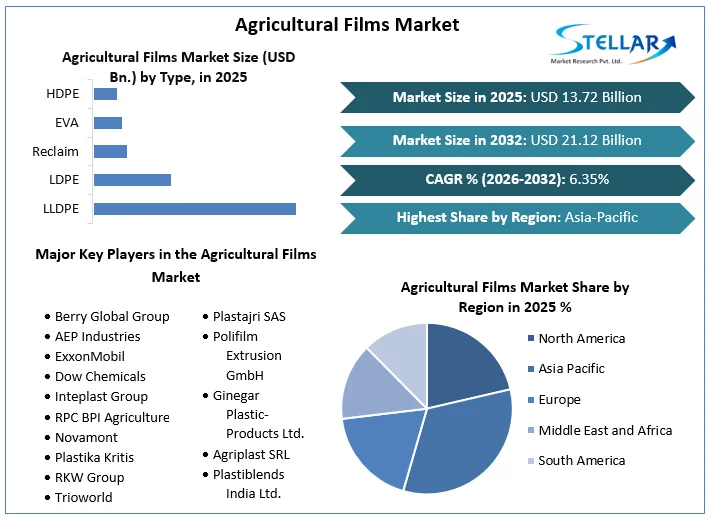
PUNE, India, June 19, 2026 — The Agricultural Films Market, according to the latest study by Stellar Market Research, is entering a new phase of growth driven by sustainability mandates, precision agriculture adoption, and rising demand for protected cultivation. The market was valued at USD 13.72 billion in 2025 and is projected to reach USD 21.12 billion by 2032, expanding at a CAGR of 6.35% during 2026–2032. The report highlights how biodegradable materials, nano-enabled greenhouse films, and increasing investments in climate-resilient agriculture are transforming the competitive landscape across global farming ecosystems.
Agricultural Films Market Opportunity Overview
Agriculture is undergoing a structural transformation as growers face mounting pressure to improve yields while reducing environmental impact. Agricultural films have become a critical component of modern farming systems, supporting moisture conservation, weed control, temperature regulation, and crop protection.
The most significant shift influencing the Agricultural Films Market is the transition from conventional polyethylene-based solutions toward biodegradable and high-performance specialty films. Governments, food producers, and agricultural cooperatives are increasingly prioritizing sustainable inputs that reduce soil contamination and support circular-economy objectives.
Simultaneously, the rapid expansion of greenhouse farming, controlled-environment agriculture, and precision farming technologies is creating new demand for advanced films capable of enhancing light transmission, thermal insulation, and resource efficiency. This convergence of sustainability and productivity is generating attractive opportunities for manufacturers, investors, and agricultural technology providers.
𝐃𝐨𝐰𝐧𝐥𝐨𝐚𝐝 𝐅𝐫𝐞𝐞 𝐏𝐃𝐅 𝐁𝐫𝐨𝐜𝐡𝐮𝐫𝐞: https://www.stellarmr.com/report/req_sample/Agricultural-Films-Market/2217
Key Findings from the Report
Global Agricultural Films Market valued at USD 13.72 billion in 2025.
Market forecast to reach USD 21.12 billion by 2032 at a 6.35% CAGR.
LLDPE (Linear Low-Density Polyethylene) remains the dominant material segment due to flexibility, durability, and cost efficiency.
Mulch Films accounted for the largest application segment, supported by moisture conservation and weed-control benefits.
Asia-Pacific leads the global market, representing the largest concentration of protected cultivation activities.
Europe is emerging as the fastest-growing region due to accelerated adoption of biodegradable agricultural films.
Increasing greenhouse cultivation and precision agriculture investments are creating long-term opportunities for technology-driven film solutions.
Market Drivers and Restraints
Key Drivers
Rising Demand for Food Security
Growing global populations and shrinking arable land are encouraging farmers to adopt productivity-enhancing agricultural technologies, including greenhouse and mulch films.
Expansion of Protected Cultivation
Greenhouse vegetable production continues to increase worldwide, particularly across China, India, Spain, and the Middle East, driving demand for advanced agricultural film products.
Sustainability-Led Innovation
Biodegradable films are gaining traction as regulators and agricultural producers seek alternatives that reduce plastic waste and improve environmental outcomes.
Key Restraints
Volatile Raw Material Prices
Fluctuations in polyethylene and petrochemical feedstock costs continue to affect production economics and pricing strategies.
Higher Costs of Sustainable Alternatives
Although adoption is rising, biodegradable agricultural films remain more expensive than traditional materials, limiting penetration in cost-sensitive markets.
Technology, Regulation, and Sustainability Trends
Technology is emerging as a major differentiator within the Agricultural Films Market. Nano-coated greenhouse films are improving temperature regulation, UV protection, and moisture management while extending product lifespan.
Smart agriculture integration is also advancing. Agricultural films equipped with sensor-compatible technologies enable better monitoring of soil conditions, nutrient levels, and water usage.
From a regulatory perspective, Europe and several Asia-Pacific countries are introducing stricter plastic waste regulations that encourage biodegradable alternatives. These policies are accelerating research into compostable materials and bio-based polymers.
Environmental, Social, and Governance (ESG) priorities are further influencing procurement decisions across agricultural supply chains. As food producers seek lower environmental footprints, demand for recyclable and biodegradable agricultural films is expected to increase significantly throughout the forecast period.
Regional Insights
Asia-Pacific Leads Global Demand
Asia-Pacific remains the dominant region in the Agricultural Films Market. China continues to account for a substantial share of protected cultivation acreage, while India is witnessing increasing adoption of mulch films and greenhouse farming to improve agricultural productivity and water efficiency.
Strong government support for food security, coupled with growing demand for high-value fruits and vegetables, is reinforcing regional growth.
Europe Emerges as Sustainability Hub
Europe is expected to record the fastest growth rate during the forecast period. Countries including Italy, Spain, Germany, and France are increasingly adopting biodegradable agricultural films to comply with sustainability targets and waste-management regulations.
Developing Markets Gain Momentum
South America, the Middle East, and Africa are emerging growth regions as agricultural modernization programs, irrigation investments, and greenhouse infrastructure development gain traction.
Recent Industry Developments
Berry Global (2024): Opened a 12,000-square-foot Circular Innovation and Training Center in Oklahoma, strengthening circular packaging and agricultural plastics innovation capabilities.
Kuraray (2024): Expanded EVAL EVOH production capacity in Singapore, supporting advanced barrier film applications and regional supply chain resilience.
DuPont (2024): Introduced smart agricultural films incorporating nanomaterial technologies for real-time environmental monitoring and crop optimization.
Mitsui Chemicals (2024): Acquired a strategic stake in a nanotechnology startup focused on agricultural film innovation, reinforcing next-generation product development.
BASF (2023–2024): Expanded Ecovio biodegradable polymer capacity across Asia-Pacific to support growing demand for compostable agricultural film applications.
𝐃𝐨𝐰𝐧𝐥𝐨𝐚𝐝 𝐅𝐫𝐞𝐞 𝐏𝐃𝐅 𝐁𝐫𝐨𝐜𝐡𝐮𝐫𝐞: https://www.stellarmr.com/report/req_sample/Agricultural-Films-Market/2217
Competitive Landscape
The Agricultural Films Market remains highly competitive, with companies focusing on sustainability, product differentiation, and geographic expansion.
Key market participants include Berry Global Group, Dow Chemicals, BASF SE, Novamont, RKW Group, Trioworld, Grupo Armando Alvarez, Plastika Kritis, Polifilm Extrusion, Ginegar Plastic Products, SABIC, and ExxonMobil.
Competitive strategies increasingly emphasize biodegradable product portfolios, smart-film technologies, regional manufacturing investments, and strategic partnerships aimed at strengthening market presence and supply-chain capabilities.
Analyst Commentary
“The Agricultural Films Market is evolving from a commodity-driven industry into a technology-enabled sustainability market. Manufacturers that successfully combine biodegradable materials, advanced barrier properties, and precision agriculture compatibility will be best positioned to capture future growth opportunities,” said a Senior Research Analyst at Stellar Market Research.
Future Outlook
Through 2032, market growth will be supported by expanding greenhouse cultivation, rising adoption of biodegradable materials, increasing food security investments, and technological innovation in smart farming.
Investment activity is expected to intensify around bio-based polymers, nanotechnology-enabled films, and circular-economy solutions. Regulatory pressure on agricultural plastic waste will continue to accelerate the shift toward sustainable products, while competition is likely to center on performance, durability, and environmental compliance.
As growers seek higher yields, lower resource consumption, and improved sustainability metrics, agricultural films will remain a critical enabler of modern agricultural productivity.
About Stellar Market Research
Stellar Market Research is a global market research and business consulting firm delivering actionable intelligence across industries including agriculture, chemicals, healthcare, information technology, manufacturing, energy, and consumer goods. The company provides strategic insights through comprehensive market analysis, competitive benchmarking, forecasting models, and customized consulting services. Leveraging rigorous primary and secondary research methodologies, Stellar Market Research helps organizations identify growth opportunities, assess investment potential, manage market risks, and make data-driven business decisions. Its reports are trusted by corporate leaders, investors, policymakers, and industry stakeholders seeking accurate and forward-looking market intelligence in rapidly evolving global markets.
Media Contact
Stellar Market Research
Website: http://stellarmr.com
Email: sales@stellarmr.com
