Baby Food Packaging Market Expected to Reach USD 134.46 Billion by 2032 as Recyclable Materials, Smart Packaging, and Regulatory Compliance Transform Infant Nutrition Supply Chains
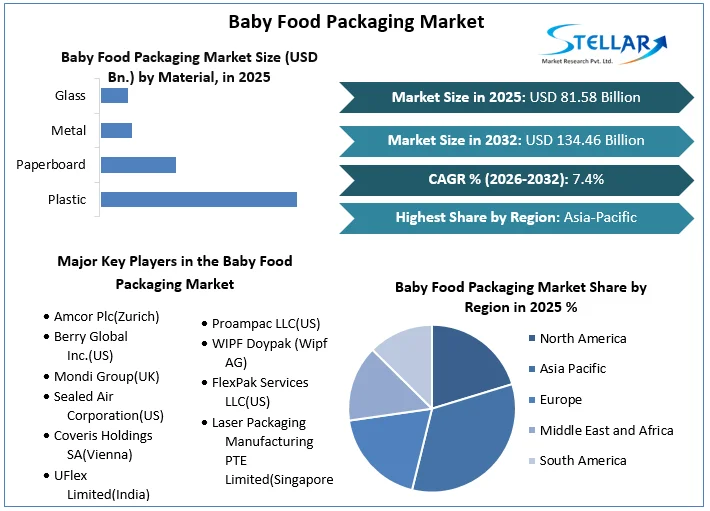
PUNE, India, June 19, 2026 — The Baby Food Packaging Market is entering a new growth phase as sustainability mandates, premium infant nutrition demand, and packaging innovation accelerate investment across global food supply chains. According to the latest Baby Food Packaging Market Report published by Stellar Market Research, the market is projected to grow from USD 81.58 billion in 2025 to USD 134.46 billion by 2032, registering a CAGR of 7.40% during 2026–2032. The report highlights how manufacturers are shifting toward recyclable, lightweight, and high-barrier packaging formats to meet evolving consumer expectations and regulatory requirements.
Market Opportunity Overview
The global baby food industry is undergoing a structural transformation driven by rising demand for convenient, safe, and environmentally responsible packaging. As infant nutrition brands expand premium product portfolios, packaging is increasingly becoming a strategic differentiator rather than a cost center.
Manufacturers are investing in mono-material pouches, recyclable cartons, lightweight plastic alternatives, and smart packaging technologies that improve shelf life while reducing environmental impact. Growing urbanization, increasing numbers of working parents, and expanding e-commerce distribution channels are further elevating the need for durable, portable, and tamper-evident packaging solutions.
The market is also benefiting from stronger food safety regulations and growing awareness among parents regarding product freshness, contamination prevention, and sustainability credentials. These factors are creating significant opportunities for packaging companies capable of delivering compliance-ready and circular-economy-focused solutions.
𝐃𝐨𝐰𝐧𝐥𝐨𝐚𝐝 𝐅𝐫𝐞𝐞 𝐏𝐃𝐅 𝐁𝐫𝐨𝐜𝐡𝐮𝐫𝐞: https://www.stellarmr.com/report/req_sample/Baby-Food-Packaging-Market/293
Key Findings from the Report
The global Baby Food Packaging Market is forecast to grow at a CAGR of 7.40% from 2026 to 2032.
Market value is projected to increase from USD 81.58 billion in 2025 to USD 134.46 billion by 2032.
Plastic-based packaging remains the dominant material segment due to durability, lightweight characteristics, and cost efficiency.
Paperboard and recyclable packaging formats are emerging as the fastest-growing categories due to sustainability initiatives and regulatory pressure.
Pouches and flexible packaging solutions continue gaining adoption because of portability, convenience, and reduced material consumption.
Asia-Pacific is expected to maintain the largest market share through the forecast period, supported by strong demand from China and India.
Rapid investments in sustainable packaging technologies are increasing opportunities for packaging manufacturers, investors, and food brands.
Market Drivers and Restraints
Key Drivers
Growing Demand for Premium Infant Nutrition Products
Rising disposable incomes and increasing awareness regarding infant health are driving demand for premium packaged baby food products that require advanced protective packaging.
Expansion of Sustainable Packaging Solutions
Consumer preference for recyclable, reusable, and lower-carbon packaging materials is accelerating innovation across the value chain.
Growth of E-Commerce and Convenience Packaging
Online retail channels are increasing demand for lightweight, durable, and leak-resistant packaging formats capable of supporting long-distance distribution.
Key Restraints
High Cost of Sustainable Materials
Advanced recyclable and bio-based materials often carry higher production costs than conventional packaging solutions.
Stringent Compliance Requirements
Manufacturers face growing regulatory complexity related to food-contact materials, recyclability standards, and extended producer responsibility obligations.
Technology, Regulation, and Sustainability Trends
The market is witnessing significant technological advancement in high-barrier films, aseptic packaging systems, intelligent labeling, and mono-material flexible packaging. These innovations help preserve nutritional integrity while reducing material consumption.
Regulatory developments are becoming a major market catalyst. The European Union’s Packaging and Packaging Waste Regulation (PPWR), which entered into force in 2025, is accelerating adoption of recyclable and circular packaging systems across global supply chains. The regulation establishes new requirements around recyclability, recycled content, and packaging design, influencing investment decisions throughout the industry.
Sustainability remains central to competitive positioning as manufacturers focus on reducing plastic waste, increasing recycled content, and improving lifecycle performance.
Regional Insights
Asia-Pacific: Market Leader
Asia-Pacific is expected to remain the dominant regional market due to expanding birth populations, increasing urbanization, growing middle-class spending, and rising adoption of packaged infant nutrition products. China and India continue to drive substantial demand growth while attracting investments in manufacturing and packaging infrastructure.
Europe: Emerging Sustainability Hub
Europe is emerging as a major innovation center for sustainable baby food packaging. Regulatory pressure, circular economy initiatives, and strong consumer preference for environmentally responsible products are accelerating adoption of recyclable packaging formats across the region.
Recent Industry Developments
Tetra Pak (2025): Introduced packaging materials containing certified recycled polymers in India, becoming the first food and beverage packaging company in the country to commercialize the solution and align with new recycled-content requirements.
Amcor (2025): Expanded deployment of recycle-ready mono-material pouch technology, supporting industry-wide transition toward circular packaging systems and material reduction strategies.
ProAmpac (2025): Showcased new recyclable flexible and fiber-based packaging solutions designed to enhance sustainability performance for food packaging applications.
European Union (2025): Implemented the Packaging and Packaging Waste Regulation (PPWR), creating a major regulatory framework expected to reshape packaging design, recyclability standards, and material usage across global markets.
Tetra Pak (2026): Reported significant progress in emissions reduction and circular packaging innovation, strengthening industry momentum toward low-carbon packaging systems.
𝐃𝐨𝐰𝐧𝐥𝐨𝐚𝐝 𝐅𝐫𝐞𝐞 𝐏𝐃𝐅 𝐁𝐫𝐨𝐜𝐡𝐮𝐫𝐞: https://www.stellarmr.com/report/req_sample/Baby-Food-Packaging-Market/293
Competitive Landscape
The Baby Food Packaging Market remains highly competitive, with leading companies focusing on product innovation, sustainability investments, strategic partnerships, and geographic expansion.
Major market participants include Amcor Plc, Berry Global Inc., Mondi Group, Sealed Air Corporation, Coveris Holdings, UFlex Limited, Huhtamaki Group, ProAmpac LLC, Sonoco Products Company, Tetra Pak, Cascades Inc., and Hood Packaging Corporation. Companies are increasingly prioritizing recyclable packaging technologies, lightweight material development, and circular economy initiatives to strengthen market positioning.
Analyst Commentary
“The next phase of growth in the Baby Food Packaging Market will be defined by the intersection of sustainability, regulatory compliance, and consumer trust. Companies that successfully combine recyclable materials, food safety performance, and operational efficiency will be best positioned to capture long-term value as the industry transitions toward circular packaging models,” said a Senior Research Analyst at Stellar Market Research.
Future Outlook
Through 2032, the market is expected to experience sustained growth supported by rising infant nutrition consumption, increasing regulatory focus on packaging sustainability, and continued investment in material innovation.
Demand for recyclable flexible packaging, paper-based formats, and smart packaging technologies is expected to accelerate. Meanwhile, regulatory frameworks in Europe, Asia-Pacific, and North America will continue influencing material selection, product design, and investment priorities. Companies capable of balancing performance, compliance, and sustainability objectives are likely to gain competitive advantages in the evolving market landscape.
About Stellar Market Research
Stellar Market Research is a global market research and business consulting firm providing actionable insights across industries including packaging, chemicals, healthcare, technology, manufacturing, consumer goods, and energy. The company delivers comprehensive market intelligence through syndicated research, custom consulting engagements, competitive benchmarking, and strategic advisory services. By combining rigorous primary and secondary research methodologies with advanced analytics, Stellar Market Research helps organizations identify growth opportunities, assess competitive dynamics, evaluate investment potential, and make informed business decisions. Its research supports corporate executives, investors, policymakers, and industry stakeholders seeking reliable data-driven market perspectives across global and regional markets.
Media Contact
Stellar Market Research
Website: http://stellarmr.com
Email: sales@stellarmr.com
