Humanoid Robot Market Set for Rapid Growth as AI, Labor Shortages, and Industrial Automation Reshape Workforce Strategies
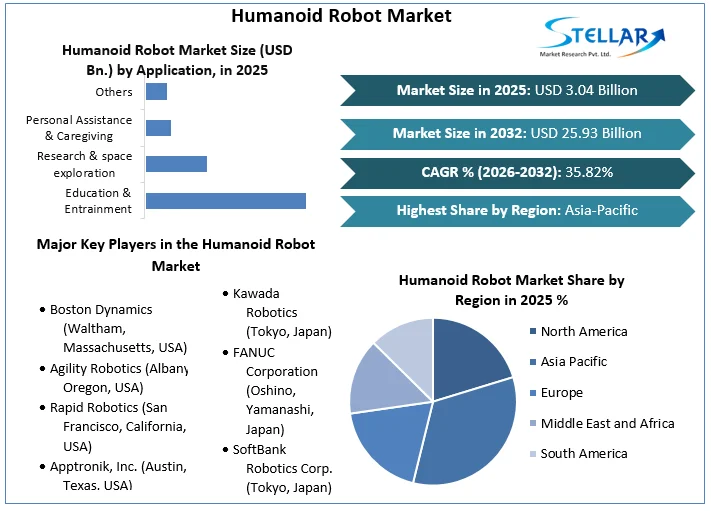
Humanoid Robot Market valued at USD 3.04 billion in 2025 is projected to reach nearly USD 25.93 billion by 2032, expanding at a CAGR of 35.82% during the forecast period. Increasing adoption of AI-enabled robotics across manufacturing, healthcare, logistics, and service industries is driving the next phase of market transformation.
PUNE, India, June 19, 2026 – The Humanoid Robot Market, according to a recent study by Stellar Market Research, is entering a pivotal commercialization phase as advancements in artificial intelligence, machine learning, robotics hardware, and autonomous decision-making accelerate adoption across industrial and service sectors. The report highlights that growing labor shortages, workplace safety concerns, and demand for flexible automation are creating significant opportunities for humanoid robot deployment worldwide.
Market Opportunity Overview
Humanoid robots are evolving from research prototypes into commercially viable workforce augmentation solutions. While traditional industrial robots remain confined to structured environments, humanoid robots are increasingly designed to operate within human-centric workplaces, enabling organizations to automate repetitive, hazardous, and labor-intensive tasks without significant infrastructure changes.
The convergence of generative AI, large language models, computer vision, edge computing, and advanced mobility systems is creating a new generation of intelligent humanoids capable of interacting naturally with people and adapting to dynamic environments. As enterprises face mounting pressure to improve productivity amid labor shortages, humanoid robots are emerging as a strategic investment category across manufacturing, healthcare, logistics, retail, hospitality, and public services.
𝐃𝐨𝐰𝐧𝐥𝐨𝐚𝐝 𝐅𝐫𝐞𝐞 𝐏𝐃𝐅 𝐁𝐫𝐨𝐜𝐡𝐮𝐫𝐞: https://www.stellarmr.com/report/req_sample/Humanoid-Robot-Market/2205
Key Findings from the Report
The global Humanoid Robot Market was valued at USD 3.04 billion in 2025.
The market is forecast to reach approximately USD 25.93 billion by 2032.
The market is expected to grow at a CAGR of 35.82% during 2026–2032.
Hardware components currently account for the largest revenue contribution due to the high value of sensors, actuators, processors, and mobility systems.
AI-powered software platforms are projected to be the fastest-growing segment as autonomous capabilities expand.
Manufacturing remains the dominant application segment owing to increasing factory automation initiatives.
Asia-Pacific is emerging as the fastest-growing regional market, supported by investments from China, Japan, South Korea, and India.
Market Drivers and Restraints
Key Drivers
Growing Labor Shortages Across Industries
Manufacturing, logistics, healthcare, and elderly care sectors continue to experience workforce shortages. Humanoid robots offer organizations a scalable solution to maintain productivity while reducing dependence on manual labor.
Rapid Advancement in Artificial Intelligence
Breakthroughs in machine learning, natural language processing, computer vision, and embodied AI are significantly improving robot autonomy, decision-making, and human interaction capabilities.
Rising Industrial Automation Investments
Organizations pursuing Industry 4.0 strategies increasingly view humanoid robots as flexible automation assets capable of operating in environments designed for humans, reducing capital expenditures associated with facility redesign.
Key Restraints
High Development and Deployment Costs
Advanced sensors, mobility systems, batteries, and AI processors continue to keep acquisition costs high, limiting widespread deployment among small and medium enterprises.
Safety and Regulatory Uncertainty
Governments and industry bodies are still developing frameworks governing AI-powered autonomous robots, creating compliance challenges for large-scale deployment.
Technology, Regulation, and Sustainability Trends
Humanoid robotics is becoming one of the most significant applications of embodied AI. Large language models are enabling robots to interpret complex instructions, learn from experience, and perform multi-step tasks with minimal human supervision.
Regulators across North America, Europe, and Asia are increasingly focusing on AI governance, cybersecurity requirements, workplace safety standards, and ethical AI deployment frameworks. These regulations are expected to improve trust and accelerate commercial adoption.
From a sustainability perspective, humanoid robots are helping organizations optimize resource utilization, reduce workplace accidents, improve operational efficiency, and support aging populations through assistive care applications.
Regional Insights
North America Leads Market Commercialization
North America maintains a leadership position due to strong investments in robotics R&D, advanced manufacturing infrastructure, venture capital funding, and AI innovation ecosystems. The United States remains a major hub for humanoid robot development and pilot deployments.
Asia-Pacific Emerges as the Growth Engine
China, Japan, South Korea, and India are accelerating investments in robotics manufacturing and AI technologies. Government-backed automation initiatives, aging populations, and industrial modernization programs are driving strong regional demand.
China is expected to remain a major production center, while Japan continues to pioneer service robotics and elderly care applications. India is witnessing increasing adoption driven by smart manufacturing and digital transformation initiatives.
Recent Industry Developments
NVIDIA (2025): Expanded Project GR00T, a foundation AI model for humanoid robots, accelerating development of general-purpose robotic intelligence and reducing training complexity for developers.
Figure AI (2025): Strengthened its partnership with OpenAI to integrate advanced language models into humanoid systems, improving reasoning and human-robot interaction capabilities.
Tesla (2025): Continued scaling development of the Optimus humanoid platform, targeting manufacturing and logistics applications while advancing commercial deployment readiness.
UBTECH Robotics (2025): Expanded industrial humanoid robot deployments across manufacturing facilities in Asia, supporting smart factory automation initiatives.
Agility Robotics (2025): Increased commercial deployment of humanoid logistics robots, reinforcing warehouse automation trends and workforce augmentation strategies.
𝐃𝐨𝐰𝐧𝐥𝐨𝐚𝐝 𝐅𝐫𝐞𝐞 𝐏𝐃𝐅 𝐁𝐫𝐨𝐜𝐡𝐮𝐫𝐞: https://www.stellarmr.com/report/req_sample/Humanoid-Robot-Market/2205
Competitive Landscape
The humanoid robot market remains highly innovation-driven, with competition centered on AI capabilities, mobility performance, autonomous decision-making, and industrial scalability.
Major participants include Honda, SoftBank Robotics, Hanson Robotics, Engineered Arts, KAWADA Robotics, Tesla, Figure AI, Agility Robotics, UBTECH Robotics, and NVIDIA-supported ecosystem partners. Companies are pursuing strategic collaborations, AI integration initiatives, manufacturing partnerships, and platform expansion strategies to strengthen competitive positioning.
Analyst Commentary
“Humanoid robots are transitioning from experimental platforms to commercially deployable workforce solutions. The combination of embodied AI, advanced mobility systems, and increasing labor constraints is creating a structural shift in automation strategies. Organizations that invest early in humanoid robotics ecosystems are likely to gain long-term operational and productivity advantages,” said a Senior Research Analyst at Stellar Market Research.
Future Outlook
The Humanoid Robot Market is expected to witness substantial investment through 2032 as enterprises prioritize productivity, resilience, and workforce augmentation. Advancements in generative AI, declining component costs, improved battery technologies, and evolving regulatory frameworks will accelerate commercialization.
As deployment expands beyond manufacturing into healthcare, logistics, hospitality, retail, and personal assistance applications, humanoid robots are expected to become an integral component of the global automation ecosystem. Growing investor interest, increasing venture funding, and rising government support for robotics innovation are expected to further strengthen market momentum.
About Stellar Market Research
Stellar Market Research is a global market research and business consulting firm providing actionable intelligence across technology, healthcare, manufacturing, consumer goods, energy, and industrial sectors. The company delivers comprehensive market assessments, competitive benchmarking, strategic forecasting, and industry trend analysis that help organizations identify growth opportunities and make informed business decisions. Through a combination of primary research, data analytics, and industry expertise, Stellar Market Research supports clients in navigating evolving market dynamics and achieving sustainable competitive advantage. The firm’s research solutions are designed to assist corporations, investors, policymakers, and stakeholders with reliable insights across global and regional markets.
Media Contact
Stellar Market Research
Website: http://stellarmr.com
Email: sales@stellarmr.com
